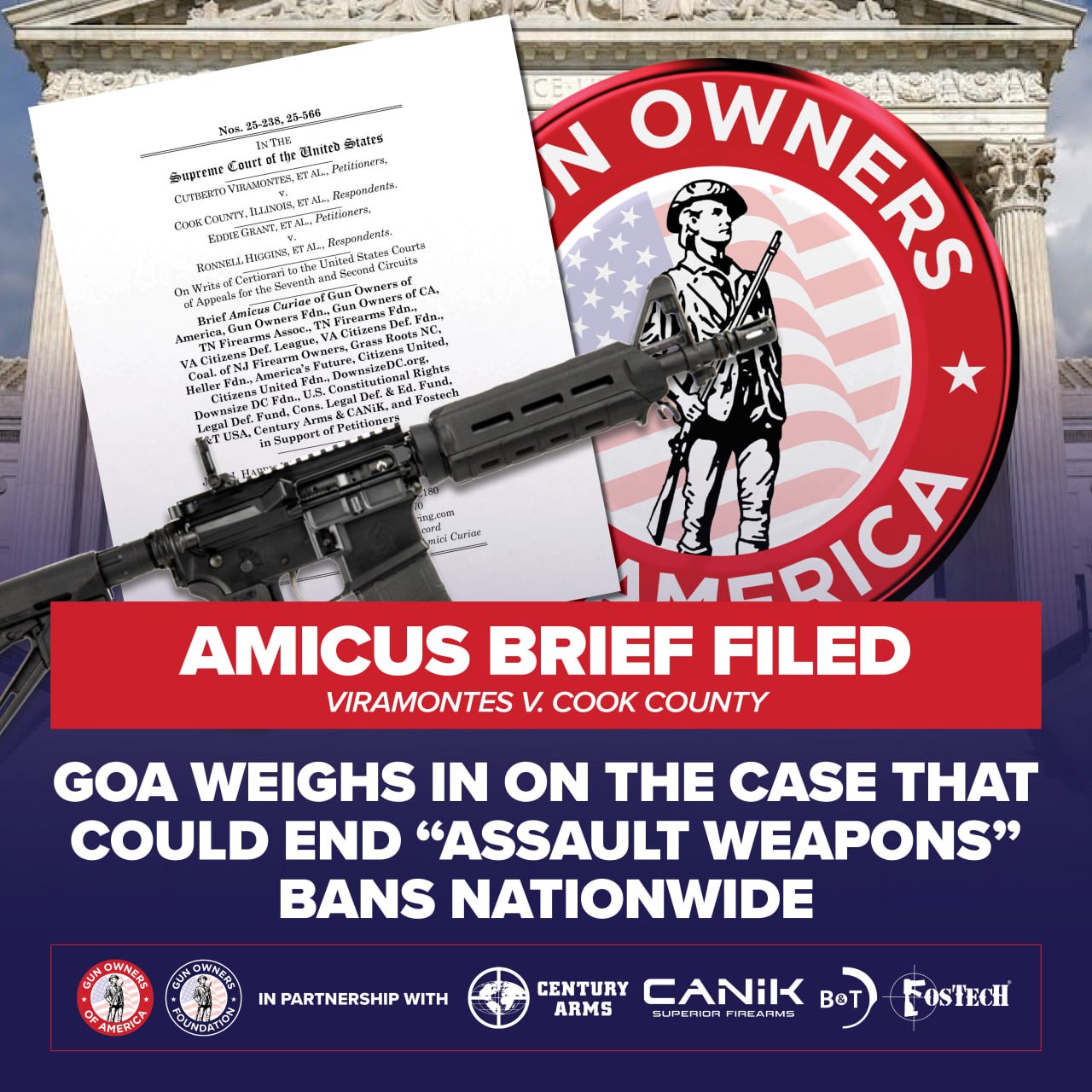
In our amicus brief, which supports the petitioners, we argue that:
First, the AR-15 is in common use. It's known as "America's Rifle." It is undoubtedly one of the most commonly owned rifles across this country today.
Americans have purchased these firearms in the tens of millions, and semi-automatic rifles are both wildly legal, and bought by many ordinary consumers.
By any metric at all, these firearms clearly fit cleanly into the definition of "common use."
That's why it is also clearly and blatantly unconstitutional that anti-gun jurisdictions around the country ban them.
Second, we argue that the logic used by anti-gun Judges across the country do not have any basis in history, as is needed to pass the test laid out in the Supreme Court's Bruen decision.
The Judges who uphold these blanket bans on commonly owned semi-automatic rifles do so by likening these firearms to supposedly unprotected "military" weapons, or by declaring them to be "unusually dangerous," and therefore unprotected.
Decisions like these by anti-gun Judges are thinly veiled "interest balancing." Something that the Supreme Court also put a stop to in the Bruen decision.
In addition, our brief argues that the government cannot ban commonly owned firearms simply because politicians or judges consider them too dangerous or akin to “military-style" weapons.
The Second Amendment does not draw a line between “civilian” and “military” weapons. The Founding Fathers understood that citizens should and would have access to the same kinds of arms used by soldiers.
Ultimately, this case is about who gets to decide what sorts of firearms that the American people may "keep and bear"—the people themselves or the legislatures and unelected judges who serve them.
The answer to this question is clear, and we'll be keeping an eye on this case as oral arguments are set for Dec. 2nd.