
Email
NEWS RELEASE | REMINDER: DNR Celebrates 75 Years Of State Natural Areas
| From | Wisconsin Department of Natural Resources <[email protected]> |
| Subject | NEWS RELEASE | REMINDER: DNR Celebrates 75 Years Of State Natural Areas |
| Date | September 3, 2026 3:03 PM |
Links have been removed from this email. Learn more in the FAQ.
Links have been removed from this email. Learn more in the FAQ.
DNR News Release Header Image [ [link removed] ]
*FOR IMMEDIATE RELEASE: *Sept. 3, 2026
*Contact: *Sarah Herrick, DNR State Natural Areas Program Specialist
[email protected] or 608-712-7305
DNR Celebrates 75 Years Of State Natural Areas
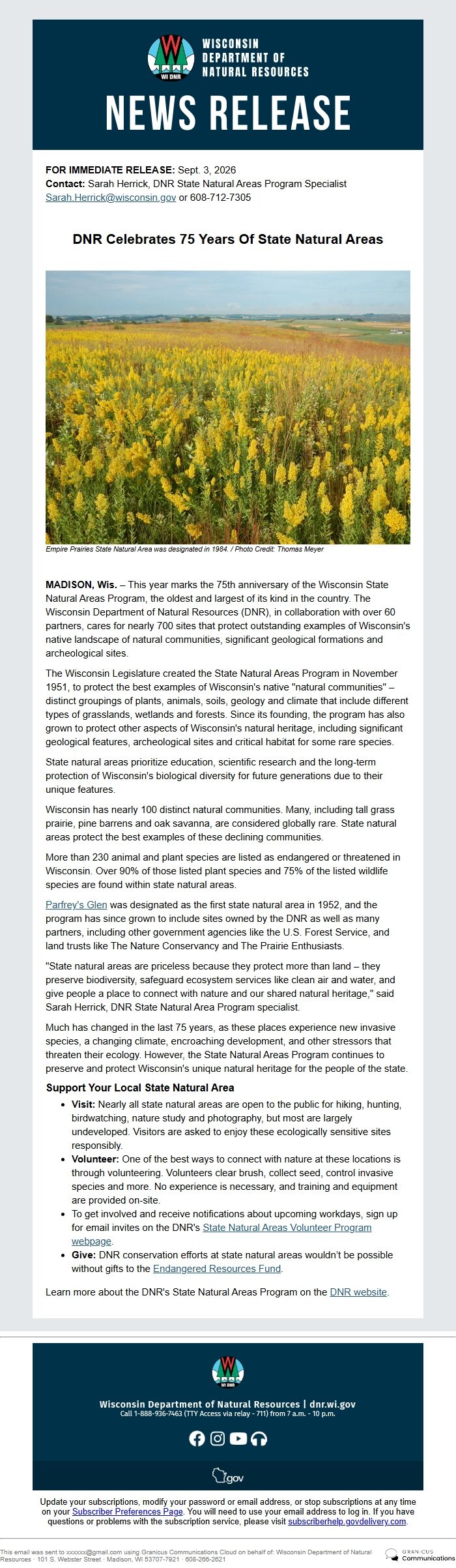
field of yellow plants at Empire Prairie State Natural Area
Empire Prairies State Natural Area was designated in 1984. / Photo Credit: Thomas Meyer
*
MADISON, Wis.* – This year marks the 75th anniversary of the Wisconsin State Natural Areas Program, the oldest and largest of its kind in the country. The Wisconsin Department of Natural Resources (DNR), in collaboration with over 60 partners, cares for nearly 700 sites that protect outstanding examples of Wisconsin's native landscape of natural communities, significant geological formations and archeological sites.
The Wisconsin Legislature created the State Natural Areas Program in November 1951, to protect the best examples of Wisconsin's native "natural communities" – distinct groupings of plants, animals, soils, geology and climate that include different types of grasslands, wetlands and forests. Since its founding, the program has also grown to protect other aspects of Wisconsin's natural heritage, including significant geological features, archeological sites and critical habitat for some rare species.
State natural areas prioritize education, scientific research and the long-term protection of Wisconsin's biological diversity for future generations due to their unique features.
Wisconsin has nearly 100 distinct natural communities. Many, including tall grass prairie, pine barrens and oak savanna, are considered globally rare. State natural areas protect the best examples of these declining communities.
More than 230 animal and plant species are listed as endangered or threatened in Wisconsin. Over 90% of those listed plant species and 75% of the listed wildlife species are found within state natural areas.
Parfrey's Glen [ [link removed] ] was designated as the first state natural area in 1952, and the program has since grown to include sites owned by the DNR as well as many partners, including other government agencies like the U.S. Forest Service, and land trusts like The Nature Conservancy and The Prairie Enthusiasts.
"State natural areas are priceless because they protect more than land – they preserve biodiversity, safeguard ecosystem services like clean air and water, and give people a place to connect with nature and our shared natural heritage," said Sarah Herrick, DNR State Natural Area Program specialist.
Much has changed in the last 75 years, as these places experience new invasive species, a changing climate, encroaching development, and other stressors that threaten their ecology. However, the State Natural Areas Program continues to preserve and protect Wisconsin's unique natural heritage for the people of the state.
Support Your Local State Natural Area
* *Visit: *Nearly all state natural areas are open to the public for hiking, hunting, birdwatching, nature study and photography, but most are largely undeveloped. Visitors are asked to enjoy these ecologically sensitive sites responsibly.
* *Volunteer:* One of the best ways to connect with nature at these locations is through volunteering. Volunteers clear brush, collect seed, control invasive species and more. No experience is necessary, and training and equipment are provided on-site.
* To get involved and receive notifications about upcoming workdays, sign up for email invites on the DNR's State Natural Areas Volunteer Program webpage [ [link removed] ].
* *Give: *DNR conservation efforts at state natural areas wouldn’t be possible without gifts to the Endangered Resources Fund [ [link removed] ].
Learn more about the DNR's State Natural Areas Program on the DNR website [ [link removed] ].
________________________________________________________________________
[ [link removed] ]
[ [link removed] ]
[ [link removed] ] [ [link removed] ] [ [link removed] ] [ [link removed] ]
[ [link removed] ] Update your subscriptions, modify your password or email address, or stop subscriptions at any time on your Subscriber Preferences Page [ [link removed] ]. You will need to use your email address to log in. If you have questions or problems with the subscription service, please visit subscriberhelp.govdelivery.com [ [link removed] ].
________________________________________________________________________
This email was sent to [email protected] using Granicus Communications Cloud on behalf of: Wisconsin Department of Natural Resources · 101 S. Webster Street · Madison, WI 53707-7921 · 608-266-2621 Granicus Communications logo [ [link removed] ]
body .abe-column-block { min-height: 5px; } table.gd_combo_table img {margin-left:10px; margin-right:10px;} table.gd_combo_table div.govd_image_display img, table.gd_combo_table td.gd_combo_image_cell img {margin-left:0px; margin-right:0px;} table.govd_hr {min-width: 100%;} p, li, h1, h2, h3 { overflow-wrap: normal; word-wrap: normal; word-break: keep-all; -moz-hyphens: none; -ms-hyphens: none; -webkit-hyphens: none; hyphens: none; mso-hyphenate: none; }
*FOR IMMEDIATE RELEASE: *Sept. 3, 2026
*Contact: *Sarah Herrick, DNR State Natural Areas Program Specialist
[email protected] or 608-712-7305
DNR Celebrates 75 Years Of State Natural Areas
field of yellow plants at Empire Prairie State Natural Area
Empire Prairies State Natural Area was designated in 1984. / Photo Credit: Thomas Meyer
*
MADISON, Wis.* – This year marks the 75th anniversary of the Wisconsin State Natural Areas Program, the oldest and largest of its kind in the country. The Wisconsin Department of Natural Resources (DNR), in collaboration with over 60 partners, cares for nearly 700 sites that protect outstanding examples of Wisconsin's native landscape of natural communities, significant geological formations and archeological sites.
The Wisconsin Legislature created the State Natural Areas Program in November 1951, to protect the best examples of Wisconsin's native "natural communities" – distinct groupings of plants, animals, soils, geology and climate that include different types of grasslands, wetlands and forests. Since its founding, the program has also grown to protect other aspects of Wisconsin's natural heritage, including significant geological features, archeological sites and critical habitat for some rare species.
State natural areas prioritize education, scientific research and the long-term protection of Wisconsin's biological diversity for future generations due to their unique features.
Wisconsin has nearly 100 distinct natural communities. Many, including tall grass prairie, pine barrens and oak savanna, are considered globally rare. State natural areas protect the best examples of these declining communities.
More than 230 animal and plant species are listed as endangered or threatened in Wisconsin. Over 90% of those listed plant species and 75% of the listed wildlife species are found within state natural areas.
Parfrey's Glen [ [link removed] ] was designated as the first state natural area in 1952, and the program has since grown to include sites owned by the DNR as well as many partners, including other government agencies like the U.S. Forest Service, and land trusts like The Nature Conservancy and The Prairie Enthusiasts.
"State natural areas are priceless because they protect more than land – they preserve biodiversity, safeguard ecosystem services like clean air and water, and give people a place to connect with nature and our shared natural heritage," said Sarah Herrick, DNR State Natural Area Program specialist.
Much has changed in the last 75 years, as these places experience new invasive species, a changing climate, encroaching development, and other stressors that threaten their ecology. However, the State Natural Areas Program continues to preserve and protect Wisconsin's unique natural heritage for the people of the state.
Support Your Local State Natural Area
* *Visit: *Nearly all state natural areas are open to the public for hiking, hunting, birdwatching, nature study and photography, but most are largely undeveloped. Visitors are asked to enjoy these ecologically sensitive sites responsibly.
* *Volunteer:* One of the best ways to connect with nature at these locations is through volunteering. Volunteers clear brush, collect seed, control invasive species and more. No experience is necessary, and training and equipment are provided on-site.
* To get involved and receive notifications about upcoming workdays, sign up for email invites on the DNR's State Natural Areas Volunteer Program webpage [ [link removed] ].
* *Give: *DNR conservation efforts at state natural areas wouldn’t be possible without gifts to the Endangered Resources Fund [ [link removed] ].
Learn more about the DNR's State Natural Areas Program on the DNR website [ [link removed] ].
________________________________________________________________________
[ [link removed] ]
[ [link removed] ]
[ [link removed] ] [ [link removed] ] [ [link removed] ] [ [link removed] ]
[ [link removed] ] Update your subscriptions, modify your password or email address, or stop subscriptions at any time on your Subscriber Preferences Page [ [link removed] ]. You will need to use your email address to log in. If you have questions or problems with the subscription service, please visit subscriberhelp.govdelivery.com [ [link removed] ].
________________________________________________________________________
This email was sent to [email protected] using Granicus Communications Cloud on behalf of: Wisconsin Department of Natural Resources · 101 S. Webster Street · Madison, WI 53707-7921 · 608-266-2621 Granicus Communications logo [ [link removed] ]
body .abe-column-block { min-height: 5px; } table.gd_combo_table img {margin-left:10px; margin-right:10px;} table.gd_combo_table div.govd_image_display img, table.gd_combo_table td.gd_combo_image_cell img {margin-left:0px; margin-right:0px;} table.govd_hr {min-width: 100%;} p, li, h1, h2, h3 { overflow-wrap: normal; word-wrap: normal; word-break: keep-all; -moz-hyphens: none; -ms-hyphens: none; -webkit-hyphens: none; hyphens: none; mso-hyphenate: none; }
Message Analysis
- Sender profile: Wisconsin Department of Natural Resources
- Political Party: n/a
- Country: United States
- State/Locality: Wisconsin
- Office: n/a
-
Email Providers:
- govDelivery