To your income, Tim Plaehn Chief Income Strategist Investors Alley
Information contained in this email and websites maintained by Magnifi Communities LLC (dba Investors Alley) are for educational purposes only and are neither an offer nor a recommendation to buy or sell any security.
Past performance is not necessarily indicative of future results. Trading and investing involve risk, and you may lose your principal investment.
All information contained herein is copyright 2025, Magnifi Communities LLC.
Trump Says 'Let Data Reign.' Warren Says Families Will Pay For It.
Written by Andrew Green
Trump Says 'Let Data Reign.' Warren Says Families Will Pay For It. - Quick Take
The Quick Take
President Trump urged communities to embrace AI data centers, posting that doing so would bring "far lower taxes and jobs all over the place," adding "let Data Reign."
Senator Elizabeth Warren countered that families shouldn't have to "pay higher electricity bills so trillion-dollar tech companies can build their AI empires."
US residential electricity prices rose nearly 5% in 2026, with the steepest increases hitting East Coast regions absorbing the most new data-center load.
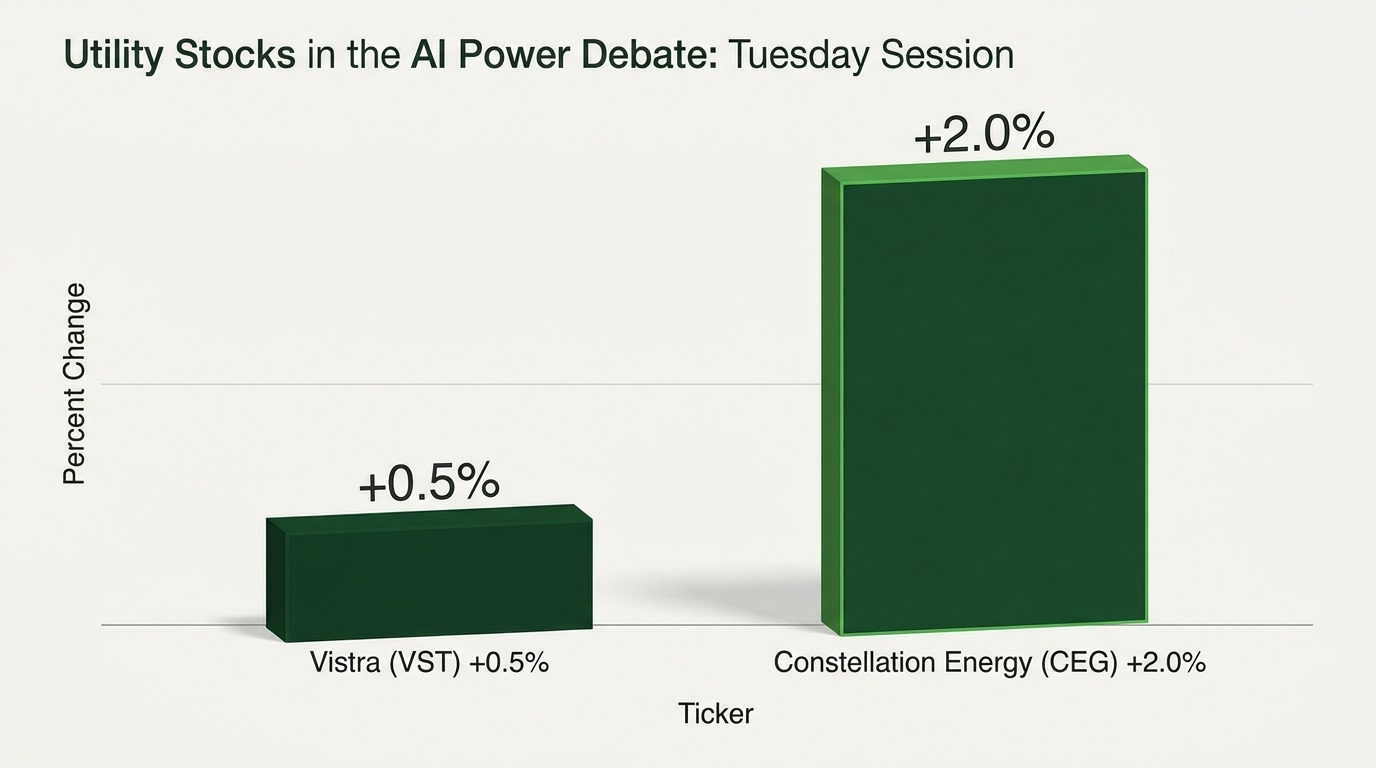
Utility stocks with heavy data-center exposure moved higher Tuesday, with Constellation Energy up about 2.0% and Vistra up about 0.5%.
Small Colorado Company (Backed by Sam Altman) Could Save U.S. Power Grid
A small Colorado company now owns rights to a tech that could save the entire public power grid from collapse. And billionaire Sam Altman is now an investor.
Trump Says 'Let Data Reign.' Warren Says Families Will Pay For It. - Body
What Happened
A Public Fight Over Who Pays for AI's Power Bill
President Trump posted that communities should welcome AI data centers for the jobs and tax revenue they bring, writing that embracing them would mean "far lower taxes and jobs all over the place," and closing with "let Data Reign." Senator Elizabeth Warren responded directly, saying families should not have to "pay higher electricity bills so trillion-dollar tech companies can build their AI empires." Vice President JD Vance, breaking somewhat from the administration's simpler build-it framing, acknowledged that "probably 99% of the backlash to data centers has come in areas where building a data center means higher utility and higher electricity for the people on the ground." The exchange played out largely in public statements and social media posts rather than through any formal policy proposal, which is typical of how this fight has unfolded over the past several months.
The mechanics behind the fight are straightforward. Data centers draw enormous, steady electricity loads, and utilities often need new transmission lines and generation capacity to serve them. Depending on how a state's regulators structure the cost allocation, some or all of that new infrastructure cost gets spread across the broader ratepayer base rather than billed narrowly to the data-center operator. That cost-allocation mechanism, more than any single company's electricity use, is the concrete link behind the "families will pay" argument. Utilities in several states have already asked regulators for permission to build new capacity specifically to serve data-center customers, which is precisely the kind of request that puts cost-allocation questions in front of a commission rather than leaving them as an abstract policy debate.
National data lends some weight to the concern without settling it. US residential electricity prices rose nearly 5% in 2026, with the steepest increases concentrated on the East Coast, where new data-center buildout has been heaviest. That is a national trend, not proof that any single data center caused any single household's bill increase, but the regional overlap between price increases and data-center construction is close enough to explain why the political argument has traction. Utility executives, for their part, have generally argued that new data-center demand helps justify grid investments that benefit all customers over time, a framing regulators in several states are actively weighing against the shorter-term bill impact.
Why It Matters
The Debate Splits Along Where the Data Centers Actually Sit
Both parties broadly want the jobs and tax revenue AI infrastructure investment brings, which is part of why this fight does not split neatly along party lines. The electricity-cost backlash instead concentrates in districts already hosting or slated to host data centers, regardless of which party represents them, which is part of why Vice President Vance's comments departed from the administration's simpler build-it message. The disagreement is less about whether AI data centers should exist and more about who absorbs the grid costs that come with them. That geographic, rather than partisan, pattern is showing up in local elections and utility commission appointments in several states with heavy data-center construction, a dynamic that could matter more to the outcome than any statement from Washington.
Everyone in Washington wants the AI data centers. Fewer people want to explain the electric bill that comes with them.
That distinction matters directly for markets. Utilities like Constellation Energy and Vistra have become AI-adjacent stocks precisely because their power output is the scarce input the data-center boom needs, and both companies' share prices moved higher Tuesday, up roughly 2.0% and 0.5% respectively. Those same stocks are also exposed to the political side of this story, since new state-level cost-allocation rules or a federal framework could reshape how quickly utilities can build new capacity and how much of the cost they can pass through to data-center customers specifically rather than the general ratepayer base.
By The Numbers
Key Fact
What It Means
2026 Residential Electricity Prices
Up nearly 5% nationally, steepest on the East Coast
Constellation Energy (Tuesday)
Closed at $280.25, up about 2.0% on the session
Vistra (Tuesday)
Closed at $138.07, up about 0.5% on the session
Political Positions
Trump: "let Data Reign." Warren: opposes shifting AI power costs onto household bills.
Constellation Energy and Vistra shares on the Tuesday session marking the latest exchange over AI data-center power costs, September 1, 2026.
Reader Question
President Trump frames AI data centers as jobs and tax revenue communities should welcome. Senator Warren frames the same buildout as a bill families shouldn't have to cover. Strip away the politics and the real question is narrower: who should pay for the new power capacity these data centers require? Easier buildout, or protecting household electricity rates?
Hit reply — one line is enough.
What to Watch Next
State Regulators Hold the Real Leverage
The public statements getting headlines this week are not where the actual decisions get made. State public utility commissions set the real cost-allocation rules for new transmission and generation capacity, and several states have already opened or completed formal dockets specifically addressing how data-center electricity demand should be billed. Those proceedings, not a presidential social media post or a senator's floor statement, are likely to determine whether household electricity bills keep climbing alongside data-center construction. Those dockets typically run for months and involve extensive filings from utilities, data-center operators, and consumer advocates, a slower and less visible process than the public statements currently generating headlines.
Watch for any move by Congress or the White House toward a federal framework for data-center electricity costs, which would represent a materially bigger structural shift than the current back-and-forth of public statements. Watch also whether Constellation Energy and Vistra address data-center demand or political and regulatory risk more prominently in their next quarterly guidance, since that would signal how seriously utility management teams are taking the cost-allocation fight.
What to Watch Next
1 · State utility commission dockets
These bodies, not Congress, currently set the rules for how new data-center power demand gets billed to ratepayers.
2 · Federal framework proposals
Any move by the White House or Congress to standardize data-center electricity cost rules would mark a bigger shift than public statements alone.
3 · Utility earnings guidance
Watch whether Constellation Energy and Vistra cite data-center demand or political risk more prominently in upcoming guidance.
The Bottom Line
The public fight over who pays is really a fight over cost-allocation rules that most voters will never read in full, and those rules are being decided state by state in regulatory dockets rather than settled by any single statement out of Washington this week.
A rise in utility share prices does not resolve the underlying question of whether ratepayers or data-center operators bear the new grid costs. That question gets answered in state proceedings over months, not in the headlines generated by a presidential post and a senator's response.
The real decision on who pays for AI's power demand is being made in state utility commission dockets, not in the public statements getting this week's headlines.
One More Question
National electricity prices are up nearly 5% in 2026, and part of that increase traces back to exactly the kind of data-center buildout described in today's story hitting regional grids. A bill increase in that range is easy to miss month to month but adds up over a year. Has your own electricity bill moved enough in 2026 to shape your household budget or your view of utility stocks like the ones here?
TraderInsightMedia.com brought to you by Media One Marketing LLC. This editorial email with educational news was sent to [email protected].
Please add our email address to your contact book (or mark as important) to guarantee that our emails continue to reach your inbox.
Thank you for your comments and inquiries, which are greatly appreciated by Media One Marketing LLC.
Please note that we are unable to provide personalized financial advice. This email does not constitute financial advice, and any investment decisions you make are solely your own responsibility.
Having trouble with the unsubscribe link? Just reply to this email with “Unsubscribe,” and we’ll take care of it. If you have a moment, tell us what you didn’t like — your feedback would be very helpful to our team.