
| From | Hudson in 5 <[email protected]> |
| Subject | Getting Creative About the Munitions Crisis |
| Date | September 2, 2026 11:00 AM |
Links have been removed from this email. Learn more in the FAQ.
Links have been removed from this email. Learn more in the FAQ.
No images? Click here [link removed]
Hudson in 5
Getting Creative About the Munitions Crisis [[link removed]]
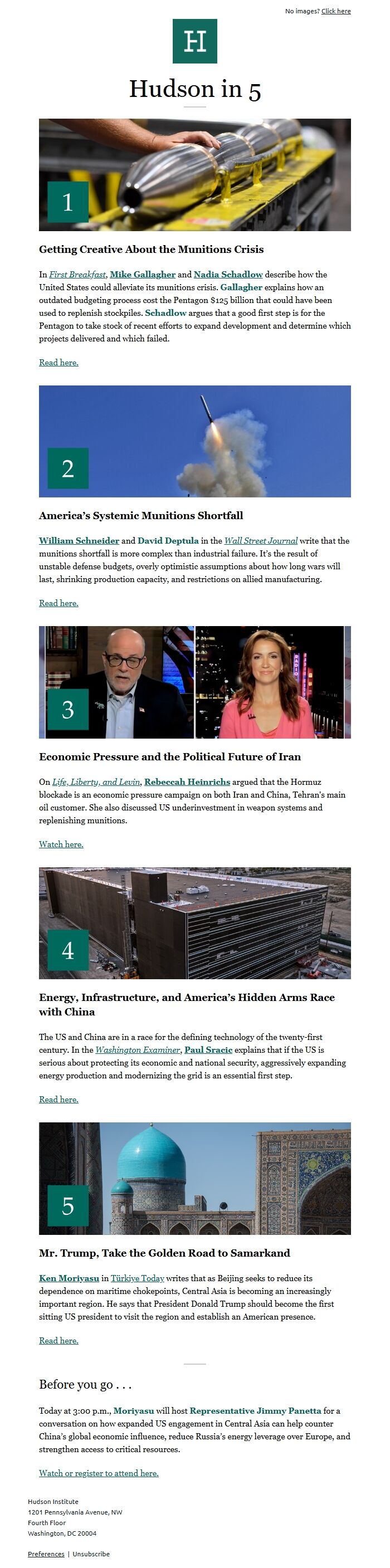
In First Breakfast [[link removed]], Mike Gallagher [[link removed]] and Nadia Schadlow [[link removed]] describe how the United States could alleviate its munitions crisis. Gallagher explains how an outdated budgeting process cost the Pentagon $125 billion that could have been used to replenish stockpiles. Schadlow argues that a good first step is for the Pentagon to take stock of recent efforts to expand development and determine which projects delivered and which failed.
Read here. [[link removed]]
America’s Systemic Munitions Shortfall [[link removed]]
William Schneider [[link removed]] and David Deptula in the Wall Street Journal [[link removed]] write that the munitions shortfall is more complex than industrial failure. It’s the result of unstable defense budgets, overly optimistic assumptions about how long wars will last, shrinking production capacity, and restrictions on allied manufacturing.
Read here. [[link removed]]
Economic Pressure and the Political Future of Iran [[link removed]]
On Life, Liberty, and Levin [[link removed]], Rebeccah Heinrichs [[link removed]] argued that the Hormuz blockade is an economic pressure campaign on both Iran and China, Tehran's main oil customer. She also discussed US underinvestment in weapon systems and replenishing munitions.
Watch here. [[link removed]]
Energy, Infrastructure, and America’s Hidden Arms Race with China [[link removed]]
The US and China are in a race for the defining technology of the twenty-first century. In the Washington Examiner [[link removed]], Paul Sracic [[link removed]] explains that if the US is serious about protecting its economic and national security, aggressively expanding energy production and modernizing the grid is an essential first step.
Read here. [[link removed]]
Mr. Trump, Take the Golden Road to Samarkand [[link removed]]
Ken Moriyasu [[link removed]] in Türkiye Today [[link removed]] writes that as Beijing seeks to reduce its dependence on maritime chokepoints, Central Asia is becoming an increasingly important region. He says that President Donald Trump should become the first sitting US president to visit the region and establish an American presence.
Read here. [[link removed]]
Before you go . . .
Today at 3:00 p.m., Moriyasu will host Representative Jimmy Panetta for a conversation on how expanded US engagement in Central Asia can help counter China’s global economic influence, reduce Russia’s energy leverage over Europe, and strengthen access to critical resources.
Watch or register to attend here. [[link removed]]
Hudson Institute
1201 Pennsylvania Avenue, NW
Fourth Floor
Washington, DC 20004
Preferences [link removed] | Unsubscribe [link removed]
Hudson in 5
Getting Creative About the Munitions Crisis [[link removed]]
In First Breakfast [[link removed]], Mike Gallagher [[link removed]] and Nadia Schadlow [[link removed]] describe how the United States could alleviate its munitions crisis. Gallagher explains how an outdated budgeting process cost the Pentagon $125 billion that could have been used to replenish stockpiles. Schadlow argues that a good first step is for the Pentagon to take stock of recent efforts to expand development and determine which projects delivered and which failed.
Read here. [[link removed]]
America’s Systemic Munitions Shortfall [[link removed]]
William Schneider [[link removed]] and David Deptula in the Wall Street Journal [[link removed]] write that the munitions shortfall is more complex than industrial failure. It’s the result of unstable defense budgets, overly optimistic assumptions about how long wars will last, shrinking production capacity, and restrictions on allied manufacturing.
Read here. [[link removed]]
Economic Pressure and the Political Future of Iran [[link removed]]
On Life, Liberty, and Levin [[link removed]], Rebeccah Heinrichs [[link removed]] argued that the Hormuz blockade is an economic pressure campaign on both Iran and China, Tehran's main oil customer. She also discussed US underinvestment in weapon systems and replenishing munitions.
Watch here. [[link removed]]
Energy, Infrastructure, and America’s Hidden Arms Race with China [[link removed]]
The US and China are in a race for the defining technology of the twenty-first century. In the Washington Examiner [[link removed]], Paul Sracic [[link removed]] explains that if the US is serious about protecting its economic and national security, aggressively expanding energy production and modernizing the grid is an essential first step.
Read here. [[link removed]]
Mr. Trump, Take the Golden Road to Samarkand [[link removed]]
Ken Moriyasu [[link removed]] in Türkiye Today [[link removed]] writes that as Beijing seeks to reduce its dependence on maritime chokepoints, Central Asia is becoming an increasingly important region. He says that President Donald Trump should become the first sitting US president to visit the region and establish an American presence.
Read here. [[link removed]]
Before you go . . .
Today at 3:00 p.m., Moriyasu will host Representative Jimmy Panetta for a conversation on how expanded US engagement in Central Asia can help counter China’s global economic influence, reduce Russia’s energy leverage over Europe, and strengthen access to critical resources.
Watch or register to attend here. [[link removed]]
Hudson Institute
1201 Pennsylvania Avenue, NW
Fourth Floor
Washington, DC 20004
Preferences [link removed] | Unsubscribe [link removed]
Message Analysis
- Sender: Hudson Institute
- Political Party: n/a
- Country: United States
- State/Locality: n/a
- Office: n/a
-
Email Providers:
- Campaign Monitor