Did China just fire shots at America?
Last week, in Tiananmen Square, China put on a chilling display of military power.
Fighter jets, tanks, AI-guided drones — all paraded under the red flag, in front of Vladimir Putin, Kim Jong Un, and more than two dozen world leaders. | 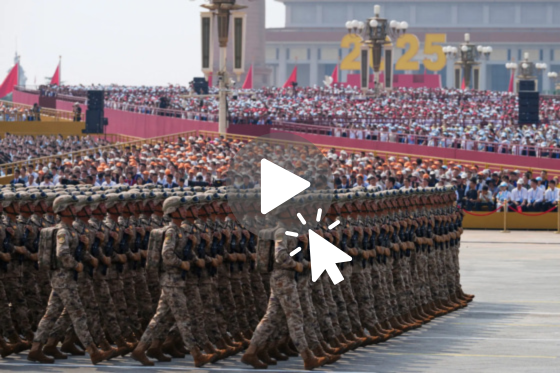 | Meanwhile, in Washington, President Trump watched.
“They were hoping I was watching,” he said. “And I was watching.”
But what he didn’t say matters more. Because while the media calls it a “celebration,” those of us paying attention know what it really was:
A warning shot at America. A not-so-subtle message to the United States — and to every American who still believes we call the shots.
The world is realigning. China. Russia. India. They’re drawing closer. And Trump’s high-risk trade policies are pushing them into each other’s arms.
The U.S. is becoming isolated and distrusted under our glorious leader.
And we’re drowning in debt – $21 billion a day added and growing.
And this Chinese parade – as symbolic as it was strategic – signals that the world may be entering a post-American financial era.
One where the dollar no longer dominates… and U.S. influence is no longer guaranteed.
The White House won’t admit it, but the signs are everywhere.
Foreign alliances are being formed without us… economic blocks are shifting against us… our tariffs are backfiring and capital is fleeing the country… debt is exploding past $37 trillion with no plans to stop it.
For those looking to protect themselves as this global power shift takes place… I highly suggest you watch this critical broadcast from Porter Stansberry.
In it, he details exactly how this new global power structure could impact your finances… and what he believes every American must do to protect their money before September 30, when America’s 2026 budget exposes just how bad things have become.
Click here to watch it now. | | | |
Brent Settled Near $95 — the Highest Since Late July — After WTI Jumped 5.2%, Its Biggest Single-Day Gain in Five Weeks, in a Third Straight Session of Gains. The US Strikes Around Hormuz After the Tanker Attacks Drove a Decisive Return of the War Premium Toward the July Peak. |
The escalation drove oil sharply higher for a third straight session: Brent crude settled near $95 a barrel on Tuesday, the highest since late July, after West Texas Intermediate jumped 5.2% — its biggest single-day gain in five weeks — and advanced toward $91. The surge came after the US military launched new strikes against Iranian targets around the Strait of Hormuz following the attacks on two oil tankers, and it marks a decisive return of the war premium, carrying Brent well above the $90 defensive trigger and back toward the levels last seen at the July peak. |
The magnitude of the move — a 5.2% single-session jump, the largest in five weeks — signals a fundamental repricing of the conflict risk. Where last week the market had discounted the war premium on the de-escalation narrative, driving Brent below $89, the escalation has now driven a sharp reversal that erases that decline and pushes prices to a five-week high near $95. The third consecutive session of gains confirms this is not a one-day spike but a sustained repricing, as the market digests the reciprocal strikes, the supertanker mine incident, and the threats of further escalation, concluding that the conflict has re-entered a dangerous phase that threatens the energy flows through Hormuz. The return to $95 is analytically significant because it approaches the July peak that had defined the height of the crisis, signaling that the market now views the current escalation as comparably serious. At these levels, the energy contribution to inflation intensifies sharply, the pressure on the Fed mounts, and the stagflationary risk that has defined the conflict’s economic impact returns in full force, just as the pivotal September data approaches. The premium has not merely reasserted but surged toward crisis levels. |
For the investor, the surge to $95 is a decisive repricing that re-engages the full elevated-oil scenario and its stagflationary implications, strongly reinforcing the defensive positioning. The move well above the $90 trigger toward the July peak signals that the energy-inflation pressure is intensifying sharply, which reinforces the higher-for-longer rate environment and the case for defensive, inflation-aware positioning heading into the September data. The practical read is that the surge validates and strengthens the energy hedges, argues for the defensive tilt toward value and quality over rate-sensitive growth, and re-engages the stagflationary concerns just as the jobs report and September 11 CPI approach with oil near $95. The disciplined approach is to treat the surge to $95 as a decisive reassertion of the elevated-oil scenario, to hold and value the energy hedges that are now protecting the portfolio as oil approaches its July peak, and to maintain the defensive tilt that the intensifying stagflationary pressure warrants. The premium has surged toward crisis levels; position firmly for the elevated-oil, higher-for-longer environment it re-engages. |
Sources — Bloomberg, September 2, 2026 · Trading Economics, September 1, 2026 · OilPrice, September 1, 2026 |
|
|
EPISODE 415
America's Bitcoin Strategy and
Trump's First 100 Days
|
| |
|
[email protected] is on ObliqueFront.com list because you opted in before the crowd caught on.
If we go quiet — look in promotions, updates, or wherever your inbox files things it hasn't figured out yet.
Unsubscribe. We'll part ways cleanly.
If something's off, you can reach us here
© 2026 Alpha One Marketers LLC. All rights reserved.
254 Chapman Rd Ste 208 Newark, Delaware 19702. |
|
|
© 2026 Alpha One Marketers LLC. All rights reserved. |
|
|
|