
Email
CORRECTION: $2.4 million in grants available for invasive species projects in Michigan
| From | Michigan DNR <[email protected]> |
| Subject | CORRECTION: $2.4 million in grants available for invasive species projects in Michigan |
| Date | September 1, 2026 1:31 PM |
Links have been removed from this email. Learn more in the FAQ.
Links have been removed from this email. Learn more in the FAQ.
Proposals accepted through Nov. 1
Share or view as webpage [ [link removed] ] | Update preferences [ [link removed] ]
Michigan Invasive Species Program banner [ [link removed] ]
"News Release"
The earlier version of this release included an incorrect link to the 2026 MISGP handbook. The link has been corrected in the body of the story below. We apologize for any inconvenience.
Contact: Kelsey Dietz <[email protected]>, 517-388-8473 or Joanne Foreman <[email protected]>, 517-284-5814
$2.4 million in grants available for invasive species projects in Michigan
"Proposals accepted through Nov. 1"
Michigan’s Invasive Species Grant Program is now accepting proposals for the 2026 funding cycle, with an anticipated $2.4 million available to applicants.
The program – a joint effort of the Michigan departments of Natural Resources; Environment, Great Lakes, and Energy; and Agriculture and Rural Development – is a statewide initiative to help prevent, detect and control invasive species in Michigan.
Invasive species [ [link removed] ] are those that are not native and whose introduction causes or is likely to cause harm to Michigan’s economy, environment or human health.
Program handbook, webinar
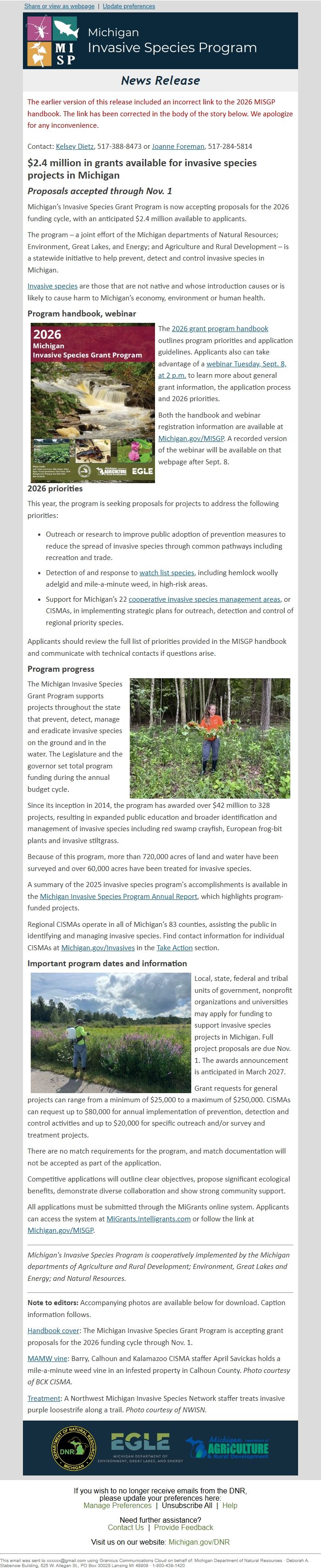
The MISGP 2026 handbook cover featuring a waterfall photo and insets of water-primrose, red swamp crayfish and purple jewelweed.
The 2026 grant program handbook [ [link removed] ] outlines program priorities and application guidelines. Applicants also can take advantage of a webinar Tuesday, Sept. 8, at 2 p.m. [ [link removed] ] to learn more about general grant information, the application process and 2026 priorities.
Both the handbook and webinar registration information are available at Michigan.gov/MISGP [ [link removed] ]. A recorded version of the webinar will be available on that webpage after Sept. 8.
2026 priorities
This year, the program is seeking proposals for projects to address the following priorities:
* Outreach or research to improve public adoption of prevention measures to reduce the spread of invasive species through common pathways including recreation and trade.
* Detection of and response to watch list species [ [link removed] ], including hemlock woolly adelgid and mile-a-minute weed, in high-risk areas.
* Support for Michigan’s 22 cooperative invasive species management areas [ [link removed] ], or CISMAs, in implementing strategic plans for outreach, detection and control of regional priority species.
Applicants should review the full list of priorities provided in the MISGP handbook and communicate with technical contacts if questions arise.
Program progress
A woman standing in a forest opening holding a long mile-a-minute weed vine.
The Michigan Invasive Species Grant Program supports projects throughout the state that prevent, detect, manage and eradicate invasive species on the ground and in the water. The Legislature and the governor set total program funding during the annual budget cycle.
Since its inception in 2014, the program has awarded over $42 million to 328 projects, resulting in expanded public education and broader identification and management of invasive species including red swamp crayfish, European frog-bit plants and invasive stiltgrass.
Because of this program, more than 720,000 acres of land and water have been surveyed and over 60,000 acres have been treated for invasive species.
A summary of the 2025 invasive species program's accomplishments is available in the Michigan Invasive Species Program Annual Report [ [link removed] ], which highlights program-funded projects.
Regional CISMAs operate in all of Michigan’s 83 counties, assisting the public in identifying and managing invasive species. Find contact information for individual CISMAs at Michigan.gov/Invasives [ [link removed] ] in the Take Action [ [link removed] ] section.
Important program dates and information
A man with a backpack sprayer treats invasive purple loosestrife along the edge of a paved trail.
Local, state, federal and tribal units of government, nonprofit organizations and universities may apply for funding to support invasive species projects in Michigan. Full project proposals are due Nov. 1. The awards announcement is anticipated in March 2027.
Grant requests for general projects can range from a minimum of $25,000 to a maximum of $250,000. CISMAs can request up to $80,000 for annual implementation of prevention, detection and control activities and up to $20,000 for specific outreach and/or survey and treatment projects.
There are no match requirements for the program, and match documentation will not be accepted as part of the application.
Competitive applications will outline clear objectives, propose significant ecological benefits, demonstrate diverse collaboration and show strong community support.
All applications must be submitted through the MiGrants online system. Applicants can access the system at MiGrants.Intelligrants.com [ [link removed] ] or follow the link at Michigan.gov/MISGP [ [link removed] ].
________________________________________________________________________
"Michigan's Invasive Species Program is cooperatively implemented by the Michigan departments of Agriculture and Rural Development; Environment, Great Lakes and Energy; and Natural Resources."
________________________________________________________________________
*Note to editors:* Accompanying photos are available below for download. Caption information follows.
Handbook cover [ [link removed] ]: The Michigan Invasive Species Grant Program is accepting grant proposals for the 2026 funding cycle through Nov. 1.
MAMW vine [ [link removed] ]: Barry, Calhoun and Kalamazoo CISMA staffer April Savickas holds a mile-a-minute weed vine in an infested property in Calhoun County. "Photo courtesy of BCK CISMA."
Treatment [ [link removed] ]: A Northwest Michigan Invasive Species Network staffer treats invasive purple loosestrife along a trail. "Photo courtesy of NWISN."
DNR Logo 24 bit PNGDept of Environment, Great Lakes and Energy logoMDARD Logo
If you wish to no longer receive emails from the DNR,
please update your preferences here:
Manage Preferences [ [link removed]? ] | Unsubscribe All [ [link removed] ] | Help [ [link removed] ]
Need further assistance?
Contact Us [ [link removed] ] | Provide Feedback <[email protected]>
Visit us on our website: Michigan.gov/DNR [ [link removed] ]
________________________________________________________________________
This email was sent to [email protected] using Granicus Communications Cloud on behalf of: Michigan Department of Natural Resources · Deborah A. Stabenow Building, 525 W. Allegan St., PO Box 30028 Lansing MI 48909 · 1-800-439-1420
Share or view as webpage [ [link removed] ] | Update preferences [ [link removed] ]
Michigan Invasive Species Program banner [ [link removed] ]
"News Release"
The earlier version of this release included an incorrect link to the 2026 MISGP handbook. The link has been corrected in the body of the story below. We apologize for any inconvenience.
Contact: Kelsey Dietz <[email protected]>, 517-388-8473 or Joanne Foreman <[email protected]>, 517-284-5814
$2.4 million in grants available for invasive species projects in Michigan
"Proposals accepted through Nov. 1"
Michigan’s Invasive Species Grant Program is now accepting proposals for the 2026 funding cycle, with an anticipated $2.4 million available to applicants.
The program – a joint effort of the Michigan departments of Natural Resources; Environment, Great Lakes, and Energy; and Agriculture and Rural Development – is a statewide initiative to help prevent, detect and control invasive species in Michigan.
Invasive species [ [link removed] ] are those that are not native and whose introduction causes or is likely to cause harm to Michigan’s economy, environment or human health.
Program handbook, webinar
The MISGP 2026 handbook cover featuring a waterfall photo and insets of water-primrose, red swamp crayfish and purple jewelweed.
The 2026 grant program handbook [ [link removed] ] outlines program priorities and application guidelines. Applicants also can take advantage of a webinar Tuesday, Sept. 8, at 2 p.m. [ [link removed] ] to learn more about general grant information, the application process and 2026 priorities.
Both the handbook and webinar registration information are available at Michigan.gov/MISGP [ [link removed] ]. A recorded version of the webinar will be available on that webpage after Sept. 8.
2026 priorities
This year, the program is seeking proposals for projects to address the following priorities:
* Outreach or research to improve public adoption of prevention measures to reduce the spread of invasive species through common pathways including recreation and trade.
* Detection of and response to watch list species [ [link removed] ], including hemlock woolly adelgid and mile-a-minute weed, in high-risk areas.
* Support for Michigan’s 22 cooperative invasive species management areas [ [link removed] ], or CISMAs, in implementing strategic plans for outreach, detection and control of regional priority species.
Applicants should review the full list of priorities provided in the MISGP handbook and communicate with technical contacts if questions arise.
Program progress
A woman standing in a forest opening holding a long mile-a-minute weed vine.
The Michigan Invasive Species Grant Program supports projects throughout the state that prevent, detect, manage and eradicate invasive species on the ground and in the water. The Legislature and the governor set total program funding during the annual budget cycle.
Since its inception in 2014, the program has awarded over $42 million to 328 projects, resulting in expanded public education and broader identification and management of invasive species including red swamp crayfish, European frog-bit plants and invasive stiltgrass.
Because of this program, more than 720,000 acres of land and water have been surveyed and over 60,000 acres have been treated for invasive species.
A summary of the 2025 invasive species program's accomplishments is available in the Michigan Invasive Species Program Annual Report [ [link removed] ], which highlights program-funded projects.
Regional CISMAs operate in all of Michigan’s 83 counties, assisting the public in identifying and managing invasive species. Find contact information for individual CISMAs at Michigan.gov/Invasives [ [link removed] ] in the Take Action [ [link removed] ] section.
Important program dates and information
A man with a backpack sprayer treats invasive purple loosestrife along the edge of a paved trail.
Local, state, federal and tribal units of government, nonprofit organizations and universities may apply for funding to support invasive species projects in Michigan. Full project proposals are due Nov. 1. The awards announcement is anticipated in March 2027.
Grant requests for general projects can range from a minimum of $25,000 to a maximum of $250,000. CISMAs can request up to $80,000 for annual implementation of prevention, detection and control activities and up to $20,000 for specific outreach and/or survey and treatment projects.
There are no match requirements for the program, and match documentation will not be accepted as part of the application.
Competitive applications will outline clear objectives, propose significant ecological benefits, demonstrate diverse collaboration and show strong community support.
All applications must be submitted through the MiGrants online system. Applicants can access the system at MiGrants.Intelligrants.com [ [link removed] ] or follow the link at Michigan.gov/MISGP [ [link removed] ].
________________________________________________________________________
"Michigan's Invasive Species Program is cooperatively implemented by the Michigan departments of Agriculture and Rural Development; Environment, Great Lakes and Energy; and Natural Resources."
________________________________________________________________________
*Note to editors:* Accompanying photos are available below for download. Caption information follows.
Handbook cover [ [link removed] ]: The Michigan Invasive Species Grant Program is accepting grant proposals for the 2026 funding cycle through Nov. 1.
MAMW vine [ [link removed] ]: Barry, Calhoun and Kalamazoo CISMA staffer April Savickas holds a mile-a-minute weed vine in an infested property in Calhoun County. "Photo courtesy of BCK CISMA."
Treatment [ [link removed] ]: A Northwest Michigan Invasive Species Network staffer treats invasive purple loosestrife along a trail. "Photo courtesy of NWISN."
DNR Logo 24 bit PNGDept of Environment, Great Lakes and Energy logoMDARD Logo
If you wish to no longer receive emails from the DNR,
please update your preferences here:
Manage Preferences [ [link removed]? ] | Unsubscribe All [ [link removed] ] | Help [ [link removed] ]
Need further assistance?
Contact Us [ [link removed] ] | Provide Feedback <[email protected]>
Visit us on our website: Michigan.gov/DNR [ [link removed] ]
________________________________________________________________________
This email was sent to [email protected] using Granicus Communications Cloud on behalf of: Michigan Department of Natural Resources · Deborah A. Stabenow Building, 525 W. Allegan St., PO Box 30028 Lansing MI 48909 · 1-800-439-1420
Message Analysis
- Sender profile: State of Michigan
- Political Party: n/a
- Country: United States
- State/Locality: MIchigan
- Office: n/a
-
Email Providers:
- govDelivery