| Unsubscribe |
On January 1, 2027, the rules for critical minerals used in U.S. defense systems change.
New Pentagon rules are tightening restrictions on materials tied to foreign adversaries. Defense supply chains now have just months to secure new sources for materials long dominated by China.
China controls more than 90% of global rare earth processing capacity.
Titanium poses an even greater challenge. America imports 100% of its titanium sponge.
That's putting a spotlight on North American projects that could help fill the coming supply gap.
And one little-known critical minerals company is approaching what could be its most value-defining milestone yet.
At the company's flagship Radar project, more than 23,000 meters have been drilled, with all 92 drill holes intersecting mineralization.
Now comes the milestone that could give investors their first real measure of the discovery: A maiden mineral resource estimate expected in Q4 2026.
Meanwhile, drilling is underway at SAGA's Wolverine heavy rare earth project.
With the DFARS deadline approaching and multiple catalysts ahead, the next few months could be pivotal.
See what's next for SAGA Metals.
Tomorrow Investor
Advance Auto Parts Plunged, But Its Turnaround Is Still Working
Written by Thomas Hughes. Posted: 8/21/2026.

Key Points
- Advanced Auto Parts shares fell after weaker-than-expected DIY sales in Q2, but margin expansion and improving cash flow suggest the drop is a buying opportunity.
- High short interest of nearly 20% ahead of earnings amplified the decline, and improving fundamentals could eventually trigger a short-covering rally.
- Analysts rate the stock a Hold with upside potential, institutions own about 88% of shares and have been accumulating, and the dividend yields more than 2.4%.
- Special Report: SpaceX is offering you shares. Don't take them.
Advance Auto Parts (NYSE: AAP)'s August price plunge looks like an opportunity to buy because the causes of the decline are largely outside the company’s control, while the factors within its control continue to improve.
The catalyst for the plunge was weaker-than-expected DIY sales, which were expected to decline as cash-strapped consumers pulled back on projects.
A letter from Shannon Stansberry (Ad)
Porter Stansberry nearly canceled the entire project. When he first saw the claimed returns - only one down year in nearly two decades and total gains of almost 2,000% - his immediate reaction was disbelief.
It took a trusted friend's personal vouching for Emmet Savage and a face-to-face trip to Ireland to change his mind. The full documentary, Investigating Project Prophet, is now live.
Watch the full story and see the verified track record for yourselfHowever concerning the news may be, the likely scenario is that AAP’s tepid Q2 results were a one-off. The weakness may have been echoed in reports from other major retailers, but results from Target (NYSE: TGT), Walmart (NYSE: WMT), and The TJX Companies (NYSE: TJX) all showed strength.
The takeaway from their reports is that consumers are spending across a broad range of categories. For AAP, weakness was concentrated in the final week of the quarter, as end-of-summer budgets came under pressure.
Advance Auto Parts: A Short Squeeze in the Making?
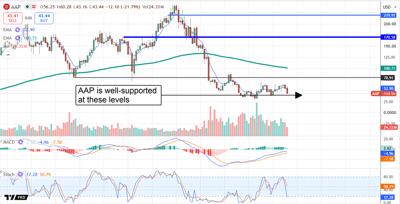
A primary cause of the plunge’s steepness is short interest. Nearly 20% of the market was short going into the earnings release, with short interest trending near long-term highs on expectations of weakness. However, consumer weakness can last only so long, and the company is demonstrating a strong recovery strategy.
Advance Auto Parts shifted gears years ago to improve operational quality and cash flow, achieving its goal in Q2. The company returned to positive year-to-date free cash flow in Q2 and expects to continue building on that improvement.
This positions the company to sustain balance sheet improvements, strengthen its dividend outlook and potentially resume share buybacks. Altogether, these improvements pave the way for accelerated earnings growth in upcoming quarters and years. They also create a catalyst for short covering, which could be only a matter of time.
Q2 Weakness Overshadows Advance Auto Parts’ Margin Improvement
Advance Auto Parts had a tough quarter, with the DIY segment contracting more than expected. The weakness offset strength in the Pro segment, which advanced by a low-single-digit percentage, leaving revenue down slightly year over year (YOY) at $2 billion. The top line also underperformed consensus, setting the stage for short sellers to lean into their trade and drive shares lower. Internally, comparable-store sales were down about 0.5%, offset by store-count growth.
The silver lining was margin improvement. While IEEPA tariff refunds contributed, they did not account for all of the strength. Gross, adjusted gross, operating and adjusted operating margins all expanded, enabling bottom-line growth despite the weak top line. Excluding the tariff refund, earnings per share of 72 cents came in below expectations but increased more than 4% YOY, providing additional evidence that the company’s strategy is working.
Further evidence of the strategy’s success can be seen on the balance sheet. Cash flow improvements enabled quarterly debt reduction while the company sustained cash levels and built inventory. The net result was an incremental increase in equity and improved shareholder leverage. Assuming the company can sustain this improvement, it will likely continue reducing debt and strengthening its balance sheet and profitability in future quarters.
Advance Auto Parts: Limited Downside With Robust Long-Term Potential
Analyst ratings and institutional trends suggest AAP may have reached its bottom, with limited downside in 2026. MarketBeat tracks 20 analysts with current ratings. Collectively, they rate the stock a Hold, with an 85% Hold bias, while still forecasting considerable upside.
The earnings-induced price decline put the stock below the low end of analysts’ target range and deep into the range where institutions have been buying. Institutional data reflects a solid, accumulating support base: institutions own about 88% of the shares, have been net buyers each quarter this year and accelerated their activity in early Q3. The Q2 results are unlikely to trigger buying, but the 20% stock price discount could.
The risk for investors is that the consumer rebound may take a long time to materialize. In this scenario, AAP shares could remain range-bound near current levels indefinitely. The offset is the dividend and the company’s improving capacity for capital returns. The dividend yields more than 2.4% with the stock in the low-$40 range—roughly double the S&P 500 average—and its safety is improving. The hope is that AAP can resume annual distribution increases and share buybacks, either of which could catalyze further price action.
The most visible near-term catalyst is margin improvement. While the market focused on near-term noise, it overlooked the company’s guidance, which was reaffirmed at the top end and improved at the bottom. Despite the hurdles and weaknesses, Advance Auto Parts is well on its way with its turnaround strategy and poised to build value for shareholders.
3 Dividend Stocks Raising Their Payouts as Investors Search for Growth and Income
Written by Chris Markoch. Posted: 8/24/2026.

Key Points
- Omega Healthcare Investors, Clorox and Ashland offer investors different combinations of dividend income and potential share-price growth.
- Each company has recently increased its payout despite operating in very different industries and market environments.
- Yield, dividend-growth history and company-specific catalysts can help investors distinguish among these three income opportunities.
- Special Report: SpaceX is offering you shares. Don't take them.
It's hard to be an investor in 2026 without a sound strategy. For growth investors, artificial intelligence (AI) stocks remain a good option. However, many of these names carry more volatility than risk-averse investors are willing to take on.
Income-oriented investors often turn to fixed-income investments. But while these investments provide stability, they come at the expense of growth.
Sell these "safe" blue chips immediately (Ad)
Marc Chaikin, founder of Chaikin Analytics, says two forces - AI disruption and fracturing global trade - are triggering a historic wealth transfer already underway in 2026. Household names like Intuit (-57%), Boston Scientific (-49%), and Tractor Supply (-40%) are cratering, while lesser-known companies like Sandisk (+573%) and Rackspace (+444%) surge.
Chaikin has identified specific stocks he believes investors should sell before they fall further - and the names may surprise you. He's also pinpointing a company tapped as Nvidia's self-driving partner and a potential AI megadeal that could split into three high-growth stocks.
Stream his free presentation to get every buy and sell recommendation with no membership or credit card required.
Watch Marc Chaikin's free presentation and get his full buy-and-sell list todayThat's why many investors are turning to quality dividend stocks. These investments can provide a solid mix of growth and income, increasing an investor's total return. When companies increase their dividends, it creates a compounding effect that, over time, can lead to gains that exceed those of many growth stocks.
Many companies use earnings season as an opportunity to announce dividend increases. But before looking at each stock, it's important to explain why all dividend stocks aren't alike.
Dividend Growth Matters More Than a High Yield
In many cases, dividend analysis starts with a stock's dividend yield. Conventional wisdom holds that the higher the yield, the better the dividend. That's not a bad premise, but it's not the whole story. In fact, in some cases, a high yield can mask a company's underlying problems.
A better indicator of dividend quality is whether a company increases its payout. Dividends are frequently paid out of earnings. So when a company increases its dividend payout, it's making a statement about the stability and likely growth of future earnings.
That can create a virtuous cycle in which earnings growth fuels dividend growth, which fuels stock price growth. That combination of growth and income builds on itself year after year.
One way to identify dividend raisers likely to increase their payouts is to look for stocks with current or future catalysts. Here are three stocks that have increased their dividends, along with the catalysts likely to drive further dividend growth.
Omega Healthcare Stock Offers High Yield and Dividend Growth
Omega Healthcare (NYSE: OHI) is an example of a dividend stock that offers both a high yield and an opportunity for solid future growth. The real estate investment trust (REIT) is the largest pure-play skilled-nursing landlord in the country. That positioning plays well as the aging-of-America narrative, pitched 20 years ago, is now becoming a reality.
Over the last 20 years, OHI has delivered a total return of over 1,200%. That's due in no small part to the company's dividend. REITs have tax advantages that require them to pay out a high percentage of their earnings as dividends.
That doesn't necessarily mean the company will increase its dividend. However, Omega recently did just that as tenant coverage rates recover. At 68 cents per share and with a dividend yield of 5.79%, OHI is worth a look, particularly for investors who believe the payout will continue to increase.
Clorox Stock Shows the Power of Dividend Aristocrat Status
When it comes to slow-and-steady compounding, The Clorox Company (NYSE: CLX) shows why it can be a core holding in a dividend portfolio. Consumer staples stocks have been brutal for growth investors as inflation and higher interest rates drive shifts toward private-label brands.
Clorox has not been immune. The company was a superstar during the pandemic, but has faced tougher times since then. Still, CLX has delivered a total return of over 220% over the last 20 years, and its dividend is a key reason.
Despite the ups and downs, Clorox has continued to increase its dividend. In fact, the company is part of an exclusive group of stocks known as Dividend Aristocrats, which have increased their payouts for at least 25 consecutive years. Investors also get a yield of 4.62%, which is well above the sector average.
Ashland Stock Combines Dividend Growth With Upside Potential
Ashland Inc. (NYSE: ASH) is a materials company that focuses on specialty chemicals. ASH is up over 34% in the last 12 months, with most of that gain coming in 2026. That growth comes despite significant internal manufacturing disruptions at the company's Hopewell facility and the Calvert City outage.
However, analysts have been raising their price targets above the current consensus price of $73.90.
The nature of the company's business is cyclical. That hasn't kept the company from increasing its dividend for 16 consecutive years. That growth has come at an annual rate of 8.3% over the last five years.
That dividend currently yields 2.32%, but the stock has had a total return similar to Clorox over the last 20 years. That's a dynamic that investors can get behind.
This message is a paid sponsorship for The Tomorrow Investor, a third-party advertiser of The Early Bird and MarketBeat.
This message is a paid advertisement for Saga Metals (OTCQB: SAGMF, TSX-V: SAGA) from The Tomorrow Investor and Think Ink Marketing. MarketBeat Media, LLC receives a fixed fee for each subscriber that clicks on a link in this email, totaling up to $4,500. Other than the compensation received for this advertisement sent to subscribers, MarketBeat and its principals are not affiliated with either The Tomorrow Investor or Think Ink Marketing. MarketBeat and its principals do not own any of the stocks mentioned in this email or in the article that this email links to. Neither MarketBeat nor its principals are FINRA-registered broker-dealers or investment advisers. The content of this email should not be taken as advice, an endorsement, or a recommendation from MarketBeat to buy or sell any security. MarketBeat has not evaluated the accuracy of any claims made in this advertisement. MarketBeat recommends that investors do their own independent research and consult with a qualified investment professional before buying or selling any security. Investing is inherently risky. Past-performance is not indicative of future results. Please see the disclaimer regarding Saga Metals (OTCQB: SAGMF, TSX-V: SAGA) on Think Ink Marketing' website for additional information about the relationship between Think Ink Marketing and Saga Metals (OTCQB: SAGMF, TSX-V: SAGA) .
If you need help with your account, please don't hesitate to email MarketBeat's South Dakota based support team at [email protected].
If you no longer wish to receive email from The Early Bird, you can unsubscribe.
© 2006-2026 MarketBeat Media, LLC. All rights protected.
345 North Reid Place, Sixth Floor, Sioux Falls, South Dakota 57103-7078. United States of America..