| THE HILL REPORT The Box Is Anonymous by Design Connor Hill · InsightfulWord · September 1, 2026 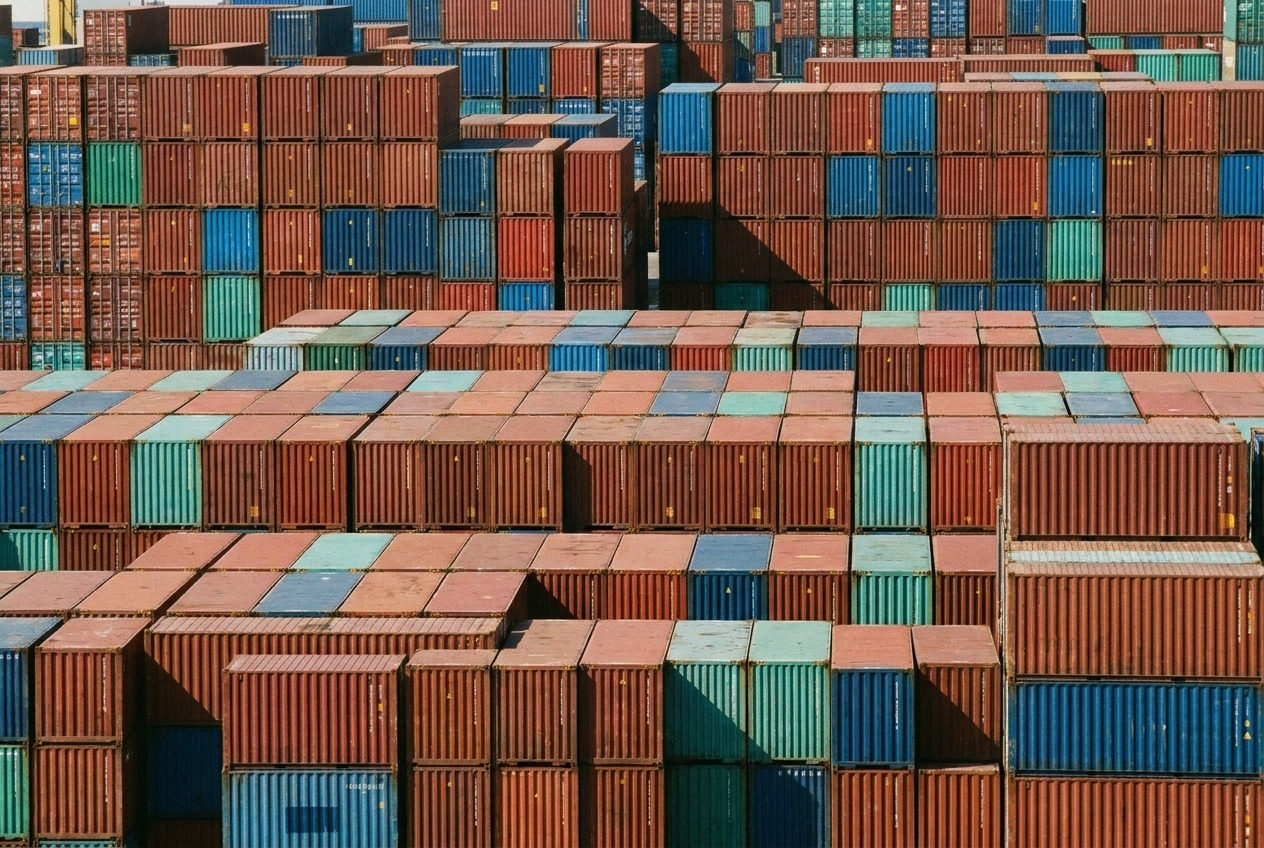 The most consequential object in modern trade is a steel rectangle that tells an observer nothing. That is not a defect. It is the entire point, and it was achieved deliberately over about twenty years of standards work. Before the standard, cargo was handled piece by piece. A ship arriving in port was unloaded by gangs of longshoremen moving individual crates, sacks and barrels, and a vessel could spend as long in port as it spent at sea. Handling cost, on some routes, exceeded the cost of the voyage. The solution was not a better crane. It was an agreement that every box would be the same box: identical corner fittings in identical positions, identical maximum weights, identical lifting and securing geometry, so that any crane, any chassis, any railcar and any ship could take any container without knowing or caring what was inside. That indifference to contents is the source of the efficiency. A terminal that had to know what was in a box in order to handle it would be a slower terminal. The system works precisely because the outside of the box carries no information about the inside. The scale that resulted is difficult to hold in mind. Ports worldwide handled roughly 920 million twenty-foot equivalent units in 2024, growth of about seven percent on the year before. Each of those movements is a featureless box passing through a system that has no interest in its contents. Which is why the presence of unmarked rectangular units in a yard, on a chassis, beside a substation or in a field is not, by itself, information about anything. It is the ordinary appearance of the ordinary way things are moved and increasingly the ordinary way equipment is packaged. The standardization eventually escaped shipping. Once a globally interchangeable enclosure existed with known dimensions, known structural ratings and known handling equipment everywhere, it became the default housing for anything that needed to be moved and then operated: generators, data halls, water treatment, pumping plant, electrical equipment. What follows is the standard that made the box interchangeable, why the corner fitting rather than the box is the real invention, what a sealed container is legally required to declare, why counting from the outside has always failed, and where the record that actually says what is inside is kept. The Standard That Made the Box Interchangeable The governing document is a short one, and its brevity is the achievement. The international standard for series one freight containers specifies external dimensions, ratings and classification. The base unit is nominally twenty feet long, eight feet wide and eight feet six inches high, which in the metric values that actually govern is 6.058 meters by 2.438 meters by 2.591 meters. The tolerances are tight because the whole system depends on interchangeability. A container that is a few centimeters out cannot be stacked, locked or carried by equipment built for the standard, and is therefore worthless regardless of how sound it is. Length is the dimension that varies. Forty-foot units are the workhorse of the trade; forty-five-foot units exist; and high-cube variants add roughly a foot of interior height while keeping the footprint identical. Width has stayed constant, because it is what allows two rows to sit within a road lane and a rail loading gauge. The counting unit follows from the geometry. A twenty-foot equivalent unit is the standard measure of throughput, and a forty-foot container counts as two. This is why throughput figures are quoted in equivalent units rather than boxes: the boxes are not the same size, but they are exact multiples. Maximum gross weight is specified as well, and it is the constraint that most often binds in practice. Dense cargo fills the weight limit long before it fills the volume, which is why heavy goods travel in twenty-foot units and light goods in forty-foot ones. Why the Corner Fitting Is the Real Invention Strip the standard down to the one element that made everything else possible, and it is not the box. It is eight steel castings at the corners. Each corner fitting is a hollow steel block with oval apertures on three faces, positioned to a tolerance measured in millimeters. Every lifting and securing device in the global system engages those apertures and nothing else. | 📈 Number of the Day 920 million Twenty-foot equivalent units of containers handled in ports worldwide during 2024, growth of 6.9 percent on the previous year. The unit exists because containers come in multiples of a standard footprint fixed by international standard, which specifies a base unit of 6.058 by 2.438 by 2.591 meters and the corner fittings that make any box interchangeable with any other. Source: UNCTAD, maritime transport data. | | Support or oppose: should container contents be publicly disclosed at the shipment level? Supporters argue that customs authorities already hold the data, that public visibility would expose sanctions evasion, counterfeit flows and mislabeled hazardous cargo, and that opacity in a system this large is a standing invitation to abuse it. Opponents answer that shipment-level data reveals commercial relationships, order sizes and sourcing that competitors would immediately exploit, that disclosure regimes push trade toward jurisdictions without them, and that enforcement is better served by targeted access than by open publication. Which is better? Hit reply — one line is enough. | A crane's spreader drops onto the box, its four twistlocks enter the top fittings, rotate ninety degrees and lock. The same geometry at the bottom engages the chassis, the railcar well and the deck fittings of a ship. One motion, no adjustment, no knowledge of contents. The consequence for handling time is the whole economic story. A movement that took a gang of workers an appreciable part of an hour became a crane cycle measured in a couple of minutes, performed by one operator. Port time for a vessel collapsed from weeks to under a day on many services. It also transformed what a port is. Terminals became sorting yards for identical objects rather than warehouses for varied ones, which is why a modern container terminal looks like a stacking problem rather than a storage problem, and why it can be automated at all. The same fittings are why containers became a general-purpose enclosure. Anything built inside a container inherits a worldwide fleet of equipment that can lift, carry, stack and secure it without modification. What a Sealed Box Legally Has to Declare The outside of the container is not entirely blank, but what it carries is identity, not contents. Every container has a unique alphanumeric identification: a three-letter owner code, a category identifier, a six-digit serial number and a check digit. That code appears on the sides, ends and roof, and it is the key that links the physical box to every document about it. Alongside it sits a plate certifying that the container has been approved for transport under the international convention for safe containers, together with weight ratings and inspection dates. What is not on the outside is contents, ownership of cargo, origin, destination or value. Those exist in documents, not paint. The exception is dangerous goods, which require prescribed placards showing hazard class and identification number, because emergency responders must know from a distance. The seal is a separate matter and a legally significant one. A high-security mechanical seal with a unique number is applied at stuffing, and its number is recorded on the transport documents. The seal does not prevent entry; it makes undetected entry impossible to conceal, which is a different and more useful property. The general principle is that the physical box is an identity token. Everything else about it lives in a record, and the record is the only place it lives. Counting From the Outside Has Always Failed Attempting to infer activity by counting visible units is an old method with a consistently poor record, and the reasons are structural rather than incidental. | Context — what an infrastructure count implies about any particular company An observed build-out, even one accurately counted, is not evidence about the economics of the firm doing it. Deployment can be funded by customers, by subsidy, by a partner, or by capital raised against future rather than current returns. Equipment visible in a yard may be installed, uninstalled, in storage, or awaiting return. And in a competitive market the firm doing the building is frequently not the firm capturing the margin. Nothing here is a comment on any specific company, sector or security, and none of it is a recommendation. | The first problem is the denominator. A count of what an observer happened to see says nothing without knowing what fraction of the total was observable, and that fraction is almost never estimable from the observations themselves. The second is that identical enclosures are used for unrelated purposes. A row of white rectangular units beside a substation could be batteries, switchgear, capacitor banks, a temporary generator, a contractor's site accommodation, or equipment awaiting return to a leasing company. The third is double counting. Units move. The same equipment observed at a manufacturing site, at a distribution yard and at a project location is one unit and three observations, and reconciling them requires the identification numbers rather than photographs. The fourth is timing. Presence establishes that something is there, not that it is connected, commissioned, energized or operating. In electrical infrastructure specifically, the interval between physical delivery and commercial operation routinely runs to many months. The historical record on this method is unkind. Counting rigs, ships, trucks, cranes and lit windows have all been proposed as ways to read an industry from the outside, and each has produced confident conclusions that the eventual filings contradicted. Where the Paper Trail Actually Lives The information the box withholds exists in a documented chain, and most of the chain is more accessible than people assume. The bill of lading is the foundational document. It names shipper and consignee, describes the goods, states the container and seal numbers, and functions as a document of title. The customs entry declares the goods to the importing authority under a tariff classification with a defined code, states the declared value, the origin and the duty owed. The classification codes are public and detailed enough to distinguish product categories precisely. Aggregated trade statistics are compiled from those entries and published by national statistical agencies at the level of commodity code and trading partner. This is how a genuine change in flows of a specific category of goods becomes visible, and it becomes visible with a lag of weeks to a couple of months rather than in real time. For equipment installed rather than merely shipped, a second and usually better trail exists on the receiving end: permits, inspections, interconnection filings and, for anything grid-connected, a regulatory record with dates. The composite point is that a claim about how much of something has been deployed is checkable, and the way to check it is never the photographs. It is the filings, and their absence where they would be required is itself the most informative observation available. | The bill, not the debate The container was standardized so that any box could be handled by any equipment without anyone knowing the contents, and roughly 920 million equivalent units moved through the world's ports in a single year on that basis. An anonymous steel rectangle is the normal condition of freight, not an anomaly. When a count of visible units is offered to you as evidence, is any filing cited alongside it? Connor Hill reads every reply. | | Connor Hill · InsightfulWord | |