
Email
Caught On Camera: The man who smiled at the gas pump 📸
| From | Security cameras caught - Oblique Front <[email protected]> |
| Subject | Caught On Camera: The man who smiled at the gas pump 📸 |
| Date | August 31, 2026 10:43 AM |
Links have been removed from this email. Learn more in the FAQ.
Links have been removed from this email. Learn more in the FAQ.
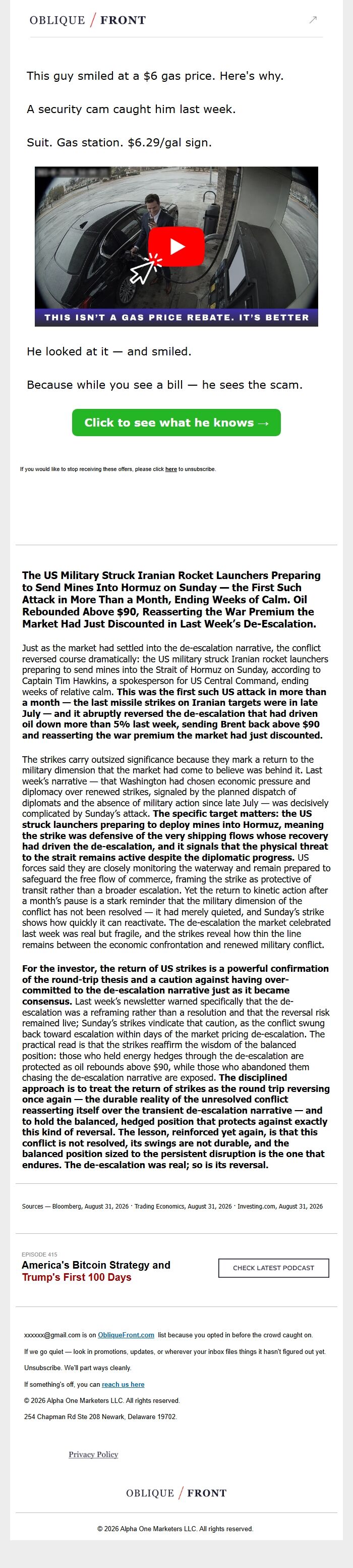
This guy smiled at a $6 gas price. Here's why. A security cam caught him last
week. Suit. Gas station. $6.29/gal sign.
<[link removed]>
Сⅼіϲkhеrе and I'll reveal the shocking details. <[link removed]>
This guy smiled at a $6 gas price. Here's why.
A security cam caught him last week.
Suit. Gas station. $6.29/gal sign.
<[link removed]>
He looked at it — and smiled.
Because while you see a bill — he sees the scam.
Click to see what he knows →
<[link removed]>
If you would like to stop receiving these offers, please click here
<[link removed]>
to unsubscribe.
The US Military Struck Iranian Rocket Launchers Preparing to Send Mines Into
Hormuz on Sunday — the First Such Attack in More Than a Month, Ending Weeks of
Calm. Oil Rebounded Above $90, Reasserting the War Premium the Market Had Just
Discounted in Last Week’s De-Escalation.
Just as the market had settled into the de-escalation narrative, the conflict
reversed course dramatically: the US military struck Iranian rocket launchers
preparing to send mines into the Strait of Hormuz on Sunday, according to
Captain Tim Hawkins, a spokesperson for US Central Command, ending weeks of
relative calm.This was the first such US attack in more than a month — the last
missile strikes on Iranian targets were in late July — and it abruptly reversed
the de-escalation that had driven oil down more than 5% last week, sending
Brent back above $90 and reasserting the war premium the market had just
discounted.
The strikes carry outsized significance because they mark a return to the
military dimension that the market had come to believe was behind it. Last
week’s narrative — that Washington had chosen economic pressure and diplomacy
over renewed strikes, signaled by the planned dispatch of diplomats and the
absence of military action since late July — was decisively complicated by
Sunday’s attack.The specific target matters: the US struck launchers preparing
to deploy mines into Hormuz, meaning the strike was defensive of the very
shipping flows whose recovery had driven the de-escalation, and it signals that
the physical threat to the strait remains active despite the diplomatic
progress. US forces said they are closely monitoring the waterway and remain
prepared to safeguard the free flow of commerce, framing the strike as
protective of transit rather than a broader escalation. Yet the return to
kinetic action after a month’s pause is a stark reminder that the military
dimension of the conflict has not been resolved — it had merely quieted, and
Sunday’s strike shows how quickly it can reactivate. The de-escalation the
market celebrated last week was real but fragile, and the strikes reveal how
thin the line remains between the economic confrontation and renewed military
conflict.
For the investor, the return of US strikes is a powerful confirmation of the
round-trip thesis and a caution against having over-committed to the
de-escalation narrative just as it became consensus. Last week’s newsletter
warned specifically that the de-escalation was a reframing rather than a
resolution and that the reversal risk remained live; Sunday’s strikes vindicate
that caution, as the conflict swung back toward escalation within days of the
market pricing de-escalation. The practical read is that the strikes reaffirm
the wisdom of the balanced position: those who held energy hedges through the
de-escalation are protected as oil rebounds above $90, while those who
abandoned them chasing the de-escalation narrative are exposed.The disciplined
approach is to treat the return of strikes as the round trip reversing once
again — the durable reality of the unresolved conflict reasserting itself over
the transient de-escalation narrative — and to hold the balanced, hedged
position that protects against exactly this kind of reversal. The lesson,
reinforced yet again, is that this conflict is not resolved, its swings are not
durable, and the balanced position sized to the persistent disruption is the
one that endures. The de-escalation was real; so is its reversal.
Sources — Bloomberg, August 31, 2026 · Trading Economics, August 31, 2026 ·
Investing.com, August 31, 2026
EPISODE 415
America's Bitcoin Strategy and
Trump's First 100 Days
<[link removed]>
[email protected] is on ObliqueFront.com <[link removed]>
list because you opted in before the crowd caught on.
If we go quiet — look in promotions, updates, or wherever your inbox files
things it hasn't figured out yet.
Unsubscribe
<[link removed]>
. We'll part ways cleanly.
If something's off, you can reach us here <mailto:[email protected]>
© 2026 Alpha One Marketers LLC. All rights reserved.
254 Chapman Rd Ste 208 Newark, Delaware 19702.
<[link removed]>
<[link removed]>
<[link removed]>
© 2026 Alpha One Marketers LLC. All rights reserved.
week. Suit. Gas station. $6.29/gal sign.
<[link removed]>
Сⅼіϲkhеrе and I'll reveal the shocking details. <[link removed]>
This guy smiled at a $6 gas price. Here's why.
A security cam caught him last week.
Suit. Gas station. $6.29/gal sign.
<[link removed]>
He looked at it — and smiled.
Because while you see a bill — he sees the scam.
Click to see what he knows →
<[link removed]>
If you would like to stop receiving these offers, please click here
<[link removed]>
to unsubscribe.
The US Military Struck Iranian Rocket Launchers Preparing to Send Mines Into
Hormuz on Sunday — the First Such Attack in More Than a Month, Ending Weeks of
Calm. Oil Rebounded Above $90, Reasserting the War Premium the Market Had Just
Discounted in Last Week’s De-Escalation.
Just as the market had settled into the de-escalation narrative, the conflict
reversed course dramatically: the US military struck Iranian rocket launchers
preparing to send mines into the Strait of Hormuz on Sunday, according to
Captain Tim Hawkins, a spokesperson for US Central Command, ending weeks of
relative calm.This was the first such US attack in more than a month — the last
missile strikes on Iranian targets were in late July — and it abruptly reversed
the de-escalation that had driven oil down more than 5% last week, sending
Brent back above $90 and reasserting the war premium the market had just
discounted.
The strikes carry outsized significance because they mark a return to the
military dimension that the market had come to believe was behind it. Last
week’s narrative — that Washington had chosen economic pressure and diplomacy
over renewed strikes, signaled by the planned dispatch of diplomats and the
absence of military action since late July — was decisively complicated by
Sunday’s attack.The specific target matters: the US struck launchers preparing
to deploy mines into Hormuz, meaning the strike was defensive of the very
shipping flows whose recovery had driven the de-escalation, and it signals that
the physical threat to the strait remains active despite the diplomatic
progress. US forces said they are closely monitoring the waterway and remain
prepared to safeguard the free flow of commerce, framing the strike as
protective of transit rather than a broader escalation. Yet the return to
kinetic action after a month’s pause is a stark reminder that the military
dimension of the conflict has not been resolved — it had merely quieted, and
Sunday’s strike shows how quickly it can reactivate. The de-escalation the
market celebrated last week was real but fragile, and the strikes reveal how
thin the line remains between the economic confrontation and renewed military
conflict.
For the investor, the return of US strikes is a powerful confirmation of the
round-trip thesis and a caution against having over-committed to the
de-escalation narrative just as it became consensus. Last week’s newsletter
warned specifically that the de-escalation was a reframing rather than a
resolution and that the reversal risk remained live; Sunday’s strikes vindicate
that caution, as the conflict swung back toward escalation within days of the
market pricing de-escalation. The practical read is that the strikes reaffirm
the wisdom of the balanced position: those who held energy hedges through the
de-escalation are protected as oil rebounds above $90, while those who
abandoned them chasing the de-escalation narrative are exposed.The disciplined
approach is to treat the return of strikes as the round trip reversing once
again — the durable reality of the unresolved conflict reasserting itself over
the transient de-escalation narrative — and to hold the balanced, hedged
position that protects against exactly this kind of reversal. The lesson,
reinforced yet again, is that this conflict is not resolved, its swings are not
durable, and the balanced position sized to the persistent disruption is the
one that endures. The de-escalation was real; so is its reversal.
Sources — Bloomberg, August 31, 2026 · Trading Economics, August 31, 2026 ·
Investing.com, August 31, 2026
EPISODE 415
America's Bitcoin Strategy and
Trump's First 100 Days
<[link removed]>
[email protected] is on ObliqueFront.com <[link removed]>
list because you opted in before the crowd caught on.
If we go quiet — look in promotions, updates, or wherever your inbox files
things it hasn't figured out yet.
Unsubscribe
<[link removed]>
. We'll part ways cleanly.
If something's off, you can reach us here <mailto:[email protected]>
© 2026 Alpha One Marketers LLC. All rights reserved.
254 Chapman Rd Ste 208 Newark, Delaware 19702.
<[link removed]>
<[link removed]>
<[link removed]>
© 2026 Alpha One Marketers LLC. All rights reserved.
Message Analysis
- Sender: n/a
- Political Party: n/a
- Country: n/a
- State/Locality: n/a
- Office: n/a
-
Email Providers:
- Iterable