| Unsubscribe |
China just declared war on America.
Not with troops, ships or a cyber attack but with something far more underhanded: a new monetary system designed to create an exodus from America’s broken dollar.
As currency analyst Stern Drew reports: “For the first time ever, the People’s Bank of China has made expanding the yuan’s global reach a central priority.”
They’re planning physical gold vaults in Hong Kong, a central gold-clearing system, yuan-denominated contracts with physical delivery, and cross-border payment networks that allow nations to settle trade without the dollar.
China already controls more than 90% of the world’s refined rare earths – the critical materials essential to new technology like data servers, drones and EVs.
Put it together with their new currency system and the strategy becomes clear:
Control the resources the world needs, build a payment system outside the dollar, then give foreign nations a hard-asset reason to use the yuan instead.
This is how you stage a reserve currency coup… but today I can show you that Beijing’s assault on our money is not a “first strike”, but a counter-attack.
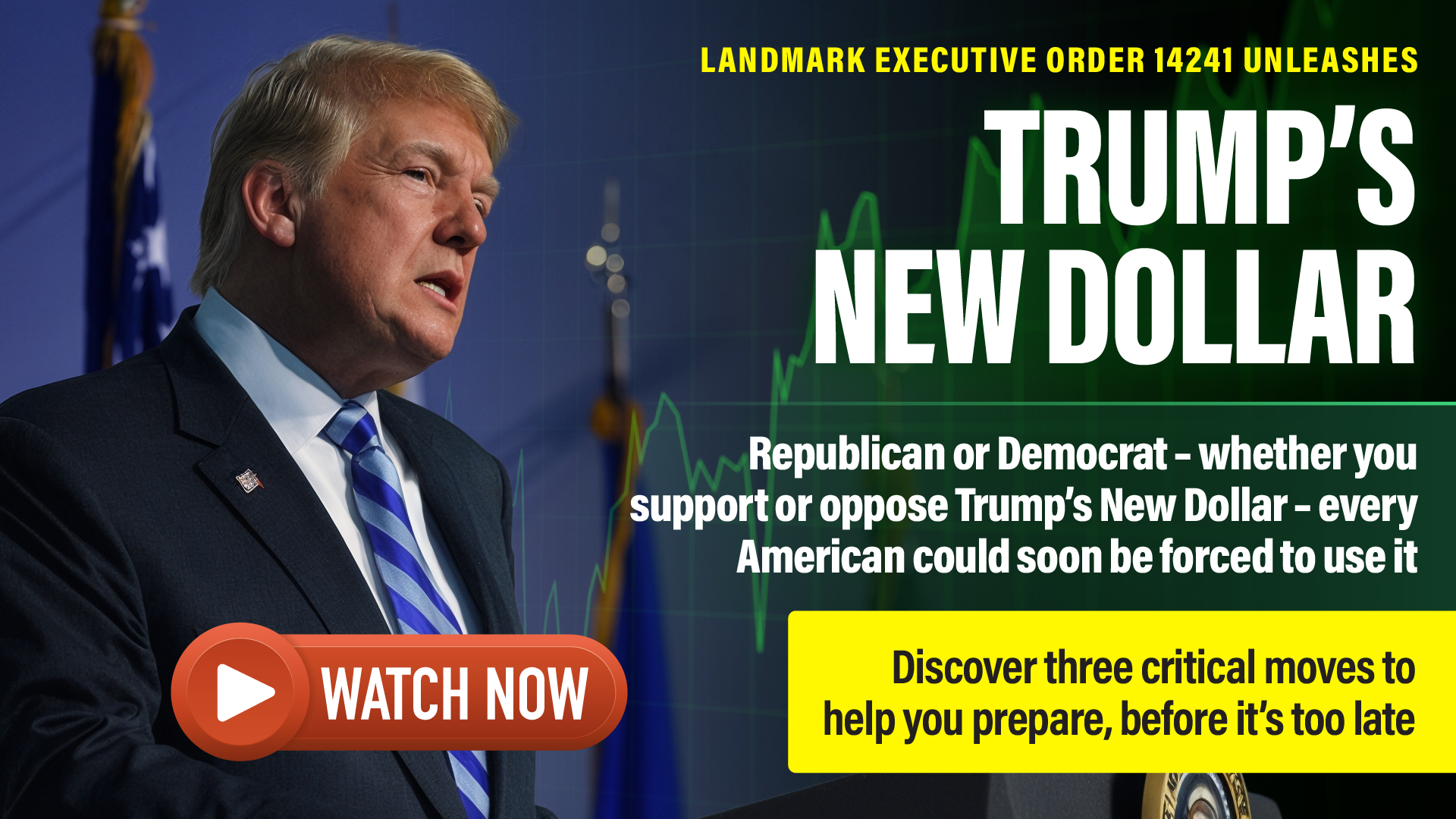
Because I believe President Trump has already set America’s own monetary coup in motion.
It wasn’t debated in Congress and it wasn’t voted on in the Senate…
Trump’s controversial plan has been assembled through a flurry of executive orders, bilateral deals, government stakes in strategic companies – and a landmark pact signed by 13 nations behind closed doors inside the State Department.
And I believe it represents the first complete reset of the U.S. dollar in more than half a century.
Trump isn’t merely defending the old dollar.
Not with Bitcoin, or a CBDC – or a gold-linked currency like China’s…
My research suggests Trump intends to revive the fading dollar with a new kind of money anchored to the most important physical resources of the 21st century:
With the minerals, energy, metals and colossal infrastructure without which artificial intelligence cannot exist.
If Trump succeeds, this emerging new monetary architecture could secure America’s reserve-currency dominance for decades to come. Even longer.
If he fails, China will be waiting with its gold, its payment system, and its stranglehold over the world’s critical resources.
When the world’s two greatest powers fight for control of money, everything could be radically repriced:
Stocks, commodities, savings, retirement accounts – practically every asset you own.
The last time America reset the dollar, it minted an average of more than a thousand new millionaires every day while quietly destroying the purchasing power of families who never understood what was happening.
And I believe it is unfolding again.
That’s why I’ve produced a critical new documentary exposing Trump’s secret dollar reset, the five companies sitting at its most valuable chokepoints, and the name and ticker of my No. 1 move to make today.
Most Americans have no idea this war has even started – and that means they are totally unprepared for what could happen next.
Good investing,
Porter Stansberry
Gold and Bitcoin Are Rebounding—2 ETFs Give Investors a Different Kind of Exposure
Written by Jessica Mitacek. First Published: 8/26/2026.

Key Points
- Gold and Bitcoin prices are rebounding from bear markets, offering ETF investors a way to diversify beyond major stock indices.
- The VanEck Gold Miners ETF (GDX) has surged around 40% in the past month, outpacing gold's roughly 16% gain, while paying a modest dividend.
- The iShares Bitcoin Trust ETF (IBIT) has attracted $4.32 billion in inflows over the past year as Bitcoin rallied more than 23% from its yearly low.
- Special Report: Forget SpaceX. Buy the company Musk can't replace.
With market concentration remaining near all-time highs, achieving true portfolio diversification means today’s investors need to look beyond the major indices. That entails funds that provide exposure to international value stocks, small caps, and emerging markets.
For investors seeking broader diversification, a small allocation to alternative assets (alts) can be an option, whether in private equity, private credit, or digital and physical commodities. But markets for the latter—specifically, Bitcoin (BTC) and gold—can require an esoteric level of understanding that is often off-putting to retail investors who rely on equity markets.
Get in before the Senate returns (Ad)
When the Senate comes back in September, one of the biggest crypto bills in years gets a real shot at a floor vote… and the money that's been sitting on the sidelines for years won't wait around to see how it plays out.
The question is: which coin is best set up to catch the move? We believe we've found the answer.
A network built from the ground up for regulated finance: tokenized securities, stablecoin settlement, institutional payments, collateral movement, privacy, and the compliance and auditability trails institutions actually require... and it's already in the room with names like Goldman Sachs, J.P. Morgan, Bank of America, and Citadel.
Reveal the #1 Coin Before the Clarity Act vote in September.Fortunately, the proliferation of exchange-traded funds (ETFs) in recent years has lowered the barrier to accessing alts. Right now, those two assets may warrant attention as gold and BTC prices are well on their way to recovering from bear markets.
Gold’s Rebound Suggests the Worst of the Sell-Off May Be Over
Following its well-publicized run-up to an all-time high (ATH) price in January, gold has been in retreat ever since. From January 2024 to the precious metal’s ATH earlier this year, the price of gold increased by more than 156%. But from its January high to its year-to-date (YTD) low in mid-July, gold lost more than 25%.
Some of the decline was caused by profit-taking, but other factors also came into play. President Donald Trump’s appointment of new Federal Reserve Chair Kevin Warsh, who is seen as a monetary policy hawk, spooked the market as inflation remained above the central bank’s target. More recently, surging bond yields have incentivized income-focused investors to rotate out of safe havens like gold. In Q2, gold had its worst quarterly performance since 2013.
However, gold’s structural tailwinds remained in place despite the multimonth sell-off. The ongoing war between the United States and Iran has led to increased equity volatility and energy market uncertainty.
Consumer prices—and, subsequently, consumer confidence—are hurting major retailers like Walmart (NASDAQ: WMT) and Home Depot (NYSE: HD). Meanwhile, the U.S. dollar remains near its lowest levels since the world emerged from the COVID-19 pandemic and is down 13% from its five-year high.
As a result, gold prices have risen more than 17% from their YTD low in mid-July and are now around 13% lower than their ATH. For investors looking to add the precious metal to their portfolios, there is no shortage of ETFs tracking gold’s spot price. But one fund provides more nuanced exposure alongside an income component.
GDX Offers Gold-Miner Exposure Plus a Modest Yield
With more than $32 billion in assets under management (AUM), the VanEck Gold Miners ETF (NYSEARCA: GDX) is the third-largest gold ETF on the market today.
As its name implies, it doesn’t track gold prices. Rather, it follows the MarketVector Global Gold Miners Index.
In doing so, the fund can benefit from jumps in gold prices, which can support miners’ revenue and margins. However, production levels, operating costs, hedging, and company execution also affect results.
That has already shown up in the ETF’s recent performance. Over the past month, while gold prices have gained more than 16%, GDX has gained around 40%.
Shareholders have been able to capture the gold market’s upside without having to pick and choose among senior gold miners. The fund’s portfolio includes prominent positions in Newmont (NYSE: NEM), the world’s largest gold producer, as well as AngloGold Ashanti (NYSE: AU), Wheaton Precious Metals (NYSE: WPM), and Kinross Gold (NYSE: KGC).
Physical gold doesn’t generate income. But the GDX pays a dividend that yields a modest 0.6%, or 63 cents per share annually at current prices. That means investors are rewarded for holding shares while gold continues its rally.
Bitcoin’s Rally Could Mark the End of the Fourth Crypto Winter
Since hitting its ATH of $126,198.07 on Oct. 6, 2025, Bitcoin’s market cap has shrunk to around $1.59 trillion. BTC prices plummeted from that record high to their lowest levels since 2024. The market entered its fourth crypto winter, and by July 1, Bitcoin was trading at a YTD low of around $59,000.
But as with gold, many of the tailwinds that drove BTC to its ATH persisted, including weakness in fiat currencies, elevated inflation, and geopolitical unrest. Over the past month, Bitcoin has rallied more than 23%, reaching its highest prices since mid-May. It remains down around 36% from its record high, which means investors seeking exposure through the equities market can take advantage of spot Bitcoin ETFs that track its price movement.
The iShares Bitcoin Trust ETF (NASDAQ: IBIT) is one such fund. With a net expense ratio of 0.25%, the ETF has more than $59 billion in AUM and has been popular among institutional investors.
Over the past 12 months, IBIT has seen inflows of $4.32 billion, more than double its outflows of $1.9 billion. Current short interest remains low at just 2.88% of the float, suggesting that bearish positioning in IBIT remains relatively limited.
Palantir's Kool-Aid Moment: The Math Behind Karp's Forecast
Written by Chris Markoch. First Published: 8/26/2026.

Key Points
- CEO Alex Karp's forecast of $15 billion to $18 billion in free cash flow within two years is driving Palantir's valuation debate more than recent earnings.
- Discounted cash flow models show Palantir's fair value ranging from about $74 to $627 per share depending on assumed annual growth rates.
- Karp's front-loaded two-year growth forecast would lower the required growth rate for years three through ten to a more plausible 28% to 31% annually.
- Special Report: Forget SpaceX. Buy the company Musk can't replace.
Palantir Technologies (NASDAQ: PLTR) has become a stock behavioral psychologists would love to study. That’s because every data point splits investors into the same two camps. The bulls believe Palantir is a rare, one-of-one stock with much more runway than the current price suggests. The bears see PLTR as an overvalued example of why this time is not different.
About three weeks removed from the company’s Aug. 3 earnings report, PLTR is up about 40% in August alone. Yet the blowout earnings report hasn’t been the only headline news.
Get in before the Senate returns (Ad)
When the Senate comes back in September, one of the biggest crypto bills in years gets a real shot at a floor vote… and the money that's been sitting on the sidelines for years won't wait around to see how it plays out.
The question is: which coin is best set up to catch the move? We believe we've found the answer.
A network built from the ground up for regulated finance: tokenized securities, stablecoin settlement, institutional payments, collateral movement, privacy, and the compliance and auditability trails institutions actually require... and it's already in the room with names like Goldman Sachs, J.P. Morgan, Bank of America, and Citadel.
Reveal the #1 Coin Before the Clarity Act vote in September.On Aug. 20, CEO Alex Karp filed to sell more than 402,000 shares worth about $70.3 million. That same week, ARK Invest’s Cathie Wood trimmed her Palantir position to fund a new SpaceX purchase. Normally, that combination of insider selling and a marquee investor’s trim would rattle a stock in the middle of a rally. This time, it barely registered.
Despite the company’s genuinely strong fundamentals, PLTR’s price action may be driven by a forecast Karp made in a July interview. Understanding that forecast—and what it means for the Palantir math—is the difference between viewing Palantir’s valuation as speculative fantasy and viewing it as a coherent, if aggressive, bet on the company’s next decade.
The Forecast That’s Doing the Heavy Lifting
In a July 1 CNBC interview, Karp said Palantir has “more business than we can supply,” adding: “If you just look at our financials, you can see, two years out, $15... $18 billion of free cash flow.”
For perspective, Palantir’s full-year 2025 adjusted free cash flow came in at around $2.27 billion. Karp’s target implies an increase of roughly 560% to 690% over two years. That’s a forecast that reframes the entire valuation debate around the stock.
Skeptics, led by investor Michael Burry, have argued that Karp is talking up his book amid a rough 2026 for the stock, which was down roughly 25% for the year before its recent surge. But Karp has a track record that shouldn’t be dismissed too quickly.
In 2022, he told investors that Palantir would reach $4.5 billion in revenue in 2025. Actual 2025 revenue came in at $4.475 billion. That was essentially a bull’s-eye on a target that looked implausible at the time.
What the Math Actually Says
Here’s where the numbers get interesting. A discounted cash flow (DCF) model run on Palantir using a conservative 20% annual growth rate over 10 years—well below the company’s current pace—produces a fair value of around $74 per share, compared with recent prices of around $173. That reading paints Palantir as badly overvalued, and it’s the version that bears tend to cite.
Run the same model at 50% annual growth for 10 years, still a steep discount to Palantir’s trailing performance over the last two years, and fair value jumps to roughly $627 per share. The gap between those two outputs—roughly $74 versus $627 from the same model—is the entire Palantir debate in miniature: The stock’s valuation lives or dies on how long investors believe hypergrowth can persist.
Karp’s two-year target adds a layer that most coverage misses. Going from $2.27 billion to $15 billion to $18 billion in free cash flow over two years isn’t a 50% annual pace. It’s an annualized rate of roughly 157% to 182% for those two years alone, more than three times the “bull case” growth rate used in the DCF model above.
That sounds as if it makes the bullish scenario even more extreme. In fact, it does the opposite because a front-loaded, two-year sprint at that pace dramatically lowers the bar for the remaining eight years.
Back out what’s needed after year two to still land on the same 10-year outcome implied by the flat 50% model, and the required growth rate for years three through eight falls to roughly 28% to 31% annually. That’s an aggressive but genuinely plausible pace for a maturing enterprise software company, not a fantasy number.
Why This Matters More Than the Headline Multiple
Most valuation debates around Palantir get flattened into a single question: Is the stock too expensive? That framing misses what’s actually happening.
The real disagreement is about the shape of Palantir’s growth curve, not just its magnitude. A flat 50% annual growth assumption for a decade is difficult to defend for any company at any stage. A two-year burst followed by a normalization to the high-20s or low-30s is a fundamentally different—and more familiar—growth story, one that mirrors how other hypergrowth software companies have historically matured.
Taken literally, Karp’s claim doesn’t ask investors to believe Palantir will sustain breakneck growth indefinitely. It asks them to believe that the next 24 months will be extraordinary and that, afterward, Palantir will behave like a very good, not miraculous, software company. That’s a materially different bet from the one either bulls or bears typically frame.
None of this settles the valuation question. This simplified DCF model uses a single, flat growth rate and can’t natively capture a two-stage curve like the one Karp is describing. So any version of “Karp’s math checks out” requires investors to build that two-stage model themselves rather than rely on off-the-shelf calculators.
But the insider selling that spooked no one this week and the DCF model that separates a $74 stock from a $627 one point to the same underlying tension: Palantir’s price isn’t really being set by its last quarter. It’s being set by whether investors believe in one specific, extraordinary forecast.
This message is a paid advertisement provided by Porter & Company, a third-party advertiser of Earnings360 and MarketBeat.
If you have questions about your newsletter, please don't hesitate to email MarketBeat's South Dakota based support team at [email protected].
If you no longer wish to receive email from Earnings360, you can unsubscribe.
© 2006-2026 MarketBeat Media, LLC.
345 N Reid Pl. #620, Sioux Falls, SD 57103-7078. United States of America..