 Dear Friend, A drilling crew near the Grand Canyon just confirmed what the International Energy Agency calls one of the largest energy resources ever measured. Enough to meet global electricity demand 140 times over. Not 140 percent. One hundred and forty times. Everyone knew the energy was there. Reaching it was the problem - miles of solid rock. That changed last year. A crew drilled nearly three miles down in 16 days. The Department of Energy said it would take 64. They weren't after oil. They were after the heat. Google already signed a 15-year deal. Bill Gates wrote a $100 million check. And on August 18th, Washington hands this resource an edge no other energy source has. One company sits at the center. See the company behind the Grand Canyon discovery >> “The Buck Stops Here,”
Kelly Maguire
Behind the Markets
Just For You Commodities Are Booming, But These 3 ETFs Tell Different StoriesAuthor: Nathan Reiff. Article Published: 8/17/2026. 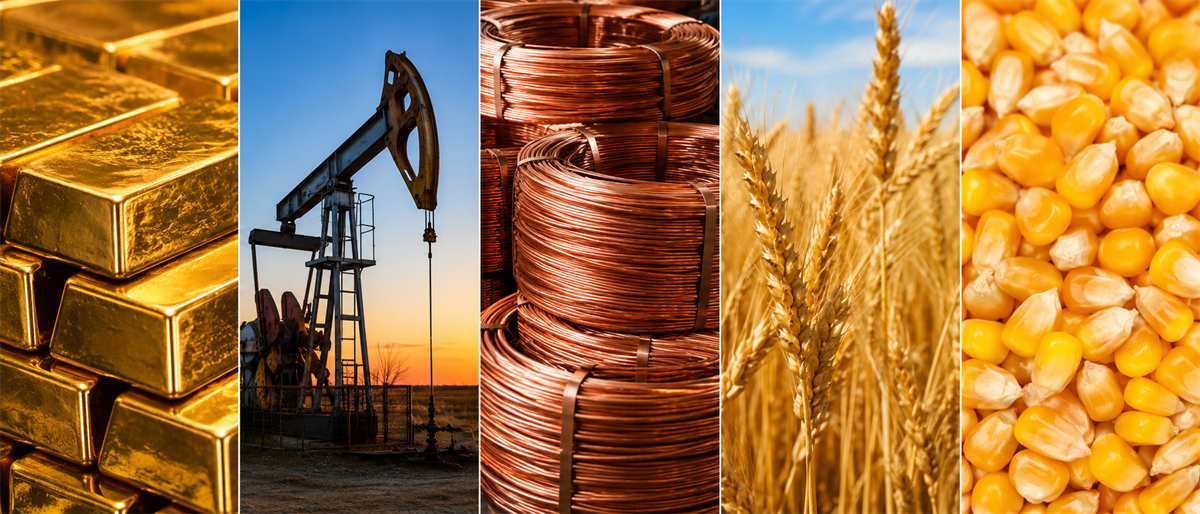
Key Points- The abrdn Bloomberg All Commodity Strategy K-1 Free ETF offers low-cost exposure across major commodity groups, allowing investors to participate without having to choose a single winning commodity
- The Invesco Optimum Yield Diversified Commodity Strategy No K-1 ETF combines active futures management with broad exposure and has delivered some of the strongest performance among the three funds
- The Direxion Auspice Broad Commodity Strategy ETF takes a more defensive long-or-flat approach, but its higher fee and much smaller asset base make it a more specialized option
- Special Report: 3 AI stocks to buy before August 2026
Inflation remains stubbornly persistent, which has helped commodities maintain their staying power. Add in their hedging properties, constrained supply in many key areas, massive geopolitical upheaval, and soaring demand for essential metals used in AI infrastructure and electrification, and you have a recipe for success in the commodities space. Of course, commodities are far from interchangeable, and timing can be critical in cyclical markets, even during periods of sustained demand. As a result, commodities have been highly segmented this year, allowing some commodity-focused exchange-traded funds (ETFs) to thrive while others have faltered or stalled despite fairly strong inflows across the space. Investors must take the time to differentiate among commodity ETFs—not only because so many are now available, but also because they could perform very differently as the war involving Iran and other important factors continue to shape the market. BCI Balances Breadth With a History of Strong PerformanceSeveral commodity ETFs take a broad approach in an effort to capture the entirety—or nearly all—of the space. The abrdn Bloomberg All Commodity Strategy K-1 Free ETF (NYSEARCA: BCI) tracks an index of commodity futures across the spectrum, including gold and crude oil, natural gas, corn, livestock, and more. This breadth may appeal to investors because the index—and, in turn, the fund—can pivot with each rebalance to emphasize the areas of the commodities space that are thriving. For instance, as gold prices have trended upward again in recent weeks, BCI has been positioned with gold futures as its leading holding. Investors may expect BCI to trade some of its risk profile for return potential because of its breadth, but the fund still managed to beat the market by a solid margin in 2026. BCI has returned 26% year to date (YTD), a strong showing, especially considering its annual fee of 0.26%. This expense ratio is quite low compared with those of some funds dedicated to single commodities within BCI's portfolio. Funds focused on oil and gas, for instance, often carry much higher costs. Futures contracts may deter some investors seeking physical holdings, but the breadth of BCI's basket also allows it to pay a notable dividend, with a current yield of 2.63%. PDBC's Hassle-Free Approach to Active Management Provides Winning Returns and YieldAnother fund taking a broad approach to commodities is the Invesco Optimum Yield Diversified Commodity Strategy No K-1 ETF (NASDAQ: PDBC). While BCI tracks a diversified commodity futures index, PDBC is actively managed and narrows its focus somewhat to commodities linked to energy, precious and industrial metals, and agriculture. Two distinct benefits help set PDBC apart. First, the fund's active management can protect against negative roll yield, a contango-linked phenomenon that can erode the returns of passive commodity ETFs. Second, as its name suggests, PDBC provides exposure to these futures without requiring a Schedule K-1, the tax form associated with some ETFs that some investors find cumbersome—all for an expense ratio of 0.59%. PDBC thus aims to provide a low-maintenance way to access commodities, and the fund's nearly $6.8 billion in assets under management suggests it has found success in that regard. It also helps that the ETF has returned about 35% YTD alongside a dividend yield of 3.17%. A Unique Long/Flat Approach Has Yet to Gain TractionAdopting a long/flat approach, the Direxion Auspice Broad Commodity Strategy ETF (NYSEARCA: COM) focuses on a group of a dozen individual commodities, including copper, soybeans, wheat, gasoline, and crude oil. Although it doesn't take the same active-management approach as PDBC, it aims to be more responsive than some other commodity funds. The fund conducts month-end reviews to modify position sizes or move investments in any of those commodities from a long position to a "flat" position—meaning cash—if a short signal is triggered. COM has outperformed the broader market this year, returning about 15% YTD. However, the fund's unique strategy may be too convoluted for some investors. This ETF has substantially lower trading volume and fewer assets than the other funds on this list, and it also carries a higher annual fee of 0.72%. When it comes to broad commodity funds, COM has performed well relative to the S&P 500, but investors may find cheaper, better-performing alternatives. . | 


