
|
 |


 |
Regular readers know that I have written quite a bit about AI and the breathtaking speed at which it has grown. Dario Amodei, the CEO of Anthropic, described the trajectory as heading toward “a country of geniuses in a datacenter.” It sure feels like the future will be filled with machines that can already outthink most humans in most domains. But it’s not just intellectually where the machines are surpassing us. It’s physically too.
Being outperformed by a machine is nothing new. After all, cars and tractors and factories full of equipment have been doing so for centuries. But the development of humanoid robots, machines built to resemble humans that walk on two legs with two moving arms, has been advancing at accelerating rate. Further, the humanoids are increasingly becoming autonomous.
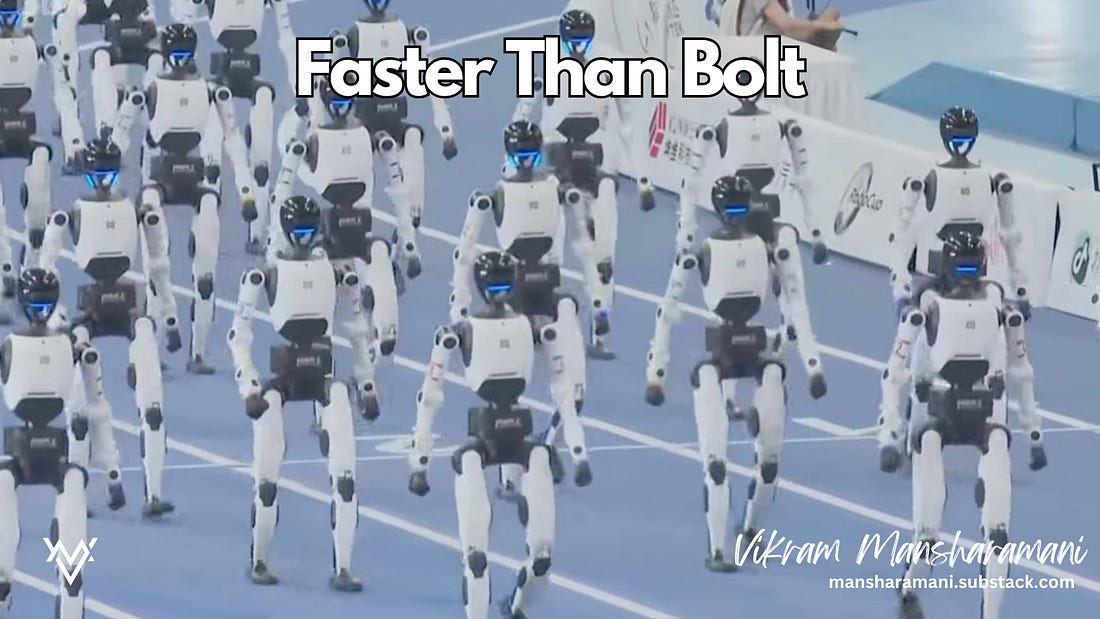
All of this was on full display during the recent World Humanoid Robot Games in Beijing. Held at the National Speed Skating Oval, the very venue the PRC built for the 2022 Winter Olympics, the competition brought together over 2,000 humanoid robots from 666 teams across 16 countries. The robots competed in 51 events, from sprinting to soccer and table tennis to kickboxing. More than 40% of the events required fully autonomous operation. And by fully autonomous, I mean that there were no human operators with joysticks, remote controls, or intervention of any kind. These robots operated on their own.

Some of the achievements were staggering. China’s Tiangong Ultra clocked 9.39 seconds in the 100-meter dash; faster than Usain Bolt’s human world record of 9.58. Another robot ran 400 meters in 39.7 seconds. The pace of improvement is stunning. The fastest 100-meter time at last year’s inaugural Games was 21.5 seconds. In a mere twelve months, the robots shaved more than 12 seconds off the sprint, a 56% improvement. Human improvement in the 100-meter event has been measured in hundredths of a second per decade. Robots improved by twelve seconds in a year.
Even as robot improvements are accelerating, there are clearly still some challenges to replacing humans. They’re not perfect (yet). Just for fun, you might enjoy watching this video with some of the biggest “fails” from the Beijing event:

Of course, there’s a geopolitical angle to the humanoids as well. This event was designed to showcase China’s ambitions and capabilities, and the message was sent very loudly for the world to hear. Although teams from the United States, Germany, Japan, and Brazil participated, the overwhelming majority of competitors were Chinese.
The PRC has designated humanoid robotics as a national strategic priority, which means they have been pouring state resources into research, development, and commercialization in much the same way it did with solar panels, electric vehicles, and 5G. Beijing isn’t hosting a robot Olympics for entertainment or for social media likes. It was making a statement: Even if the United States is temporarily ahead in AI software (i.e. the brains), China holds the lead in the bodies those brains will inhabit.
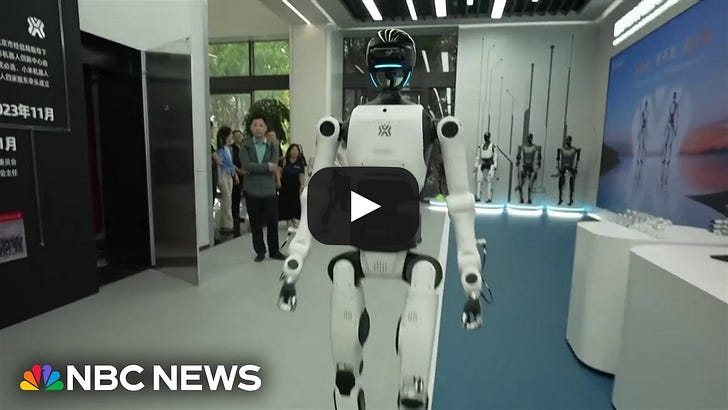
And what happens when these physical machines are married to AI? You end up with a Nobel Prize-winning mathematician who is faster than Usain Bolt and stronger than Arnold Schwarzenegger. A machine that can outthink you, outrun you, and outlift you, and never needs to sleep, eat, take a vacation, or call in sick. The implications for the global economy, for labor markets, for military applications, and for daily life are staggering. The hundreds of billions that five American tech companies are spending on AI infrastructure this year isn’t just building chatbots. It’s building the brains that will eventually power the bodies that just outran the fastest human who ever lived.
So what? Why does this matter? Well, since time immemorial, there has been one truism about human societies, expressed by Auguste Comte as: “Demography is destiny.” The fates of hunter-gatherer societies and great empires alike have been determined in large part by the number of young people they have to work, fight, and reproduce. Even today, many people have suggested the future of the 21st century is being written by the baby bust in the developed world and the ramifications of the one-child policy in China.

But what if the fates of nations were untethered from how many babies were being born? Armies of robot workers and soldiers would make demographics largely irrelevant, and destinies would instead be written by whose humanoids were smartest, fastest, and strongest. And the corollary, of course, is perhaps countries with high fertility rates and young populations (i.e. those with perfect demographic pyramids!) may no longer be those with bright futures. Could it be that large populations of young workers are a liability for a country in today’s world? After all, young ambitious individuals expect jobs and not having enough jobs risks social and political unrest. And does that mean small population but wealthy countries can compete as global economic, military, or technological superpowers?
All of this is what makes the World Humanoid Robot Games more than just a curiosity. Labor is now increasingly interchangeable with technology. And if technology is increasingly accessible to anyone with capital, does this mean the age old battle between capital and labor is over? Has capital won? And if so, what are the implications for the future of wages, wealth distribution over time, and the risk of revolution?
The World Humanoid Robot Games took place in China. But unlike the saying about Las Vegas, what happens in Beijing is unlikely to stay in Beijing.
 |
VIKRAM MANSHARAMANI is an entrepreneur, consultant, scholar, neighbor, husband, father, volunteer, and professional generalist who thinks in multiple-dimensions and looks beyond the short-term. Self-taught to think around corners and connect original dots, he spends his time speaking with global leaders in business, government, academia, and journalism. He’s currently the Chairman and CEO of Goodwell Foods, a manufacturer of private label frozen pizza. LinkedIn has twice listed him as its #1 Top Voice in Money & Finance, and Worthprofiled him as one of the 100 Most Powerful People in Global Finance. Vikram earned a PhD From MIT, has taught at Yale and Harvard, and is the author of three books, The Making of a Generalist: An Independent Thinker Finds Unconventional Success in an Uncertain World, Think for Yourself: Restoring Common Sense in an Age of Experts and Artificial Intelligence and Boombustology: Spotting Financial Bubbles Before They Burst. Vikram lives in Lincoln, New Hampshire with his wife and two children, where they can usually be found hiking or skiing.
You're currently a free subscriber to Navigating Uncertainty. For the full experience, upgrade your subscription.
| ||||||||||


