 In 2022, I made a call that made people question my judgment. I told my readers to buy Rolls-Royce. The stock was trading under $2. Most people heard "Rolls-Royce" and pictured luxury cars for billionaires. A relic. A name from another era. But that's not what I saw. I saw a world-class aerospace company — one that builds the engines powering half the world's wide-body aircraft — hidden beneath a name the market had stopped taking seriously. There was a massive disconnect between price and reality. And disconnects like that don't last forever. The stock eventually climbed more than 1,100% over a 3–4-year period. Over that time, some subscribers reported making $141,000. Others reported $272,000. One told us he'd made more than $1 million. I believe the same kind of setup is unfolding right now — in a completely different sector. See what I'm looking at today. I'm not bringing up Rolls-Royce to relive an old winner. I'm bringing it up because the pattern I'm seeing today feels eerily familiar. A misunderstood technology. A market that's barely paying attention. And a catalyst that could force investors to take a second look. The technology is what I call the Energy Cube. Here's what most people don't realize: there's a next-generation compact nuclear energy system — roughly the size of a shipping container — capable of powering up to 1,000 homes. No combustion. No emissions. It runs 24 hours a day regardless of whether the sun is shining or the wind is blowing. And it may be the single most viable answer to the biggest bottleneck in the AI buildout: the explosive demand for always-on, clean power that the current grid simply cannot meet. Bill Gates has backed companies tied to it. Jeff Bezos has backed companies tied to it. Google and Microsoft are making billion-dollar commitments in the same direction. Yet most investors still have no idea this technology — or the company behind it — even exists. Get the full story behind the Energy Cube. That may change very soon. The Nuclear Regulatory Commission is expected to issue a key approval decision as early as August — the first of its kind for this class of technology in over a decade. If that approval comes through, it would clear the single biggest regulatory hurdle standing between this company and full-scale commercial deployment. And it could force institutional capital off the sidelines overnight. The market eventually figured out Rolls-Royce. By the time it did, the biggest gains were already behind the people who waited. I believe the same window may be opening right now. See Why I'm Making This Call Now Yours in smart speculation, Karim Rahemtulla
Co-Founder, Monument Traders Alliance P.S. The NRC decision I'm watching is expected in August. If it plays out the way I anticipate, this stock may not stay under the radar much longer. I'd encourage you to watch my full presentation before then — while the opportunity is still ahead of the news cycle.
Bonus Content from MarketBeat.com IREN’s AI Pivot Looks Real, But the Market Wanted a Faster Payoff After EarningsAuthored by Chris Markoch. Date Posted: 8/28/2026. 
Key Points- IREN's fiscal fourth-quarter revenue fell year-over-year but beat consensus estimates as AI cloud revenue surged while Bitcoin mining revenue wound down.
- The company's contracted annualized recurring revenue is on track to exceed $4 billion by year-end, backed by validation from Microsoft and NVIDIA.
- Despite bullish analyst ratings and reduced dilution risk from prepayments and financing, management does not expect sustained profitability until 2029 or 2030.
- Special Report: Sell these "safe" blue chips immediately
IREN Limited (NASDAQ: IREN) reported fiscal fourth-quarter results Aug. 27, and the headline numbers looked rough at first glance. Revenue of $137.2 million was down from $187 million a year ago, while the company's net loss widened. But investors chasing the headline are missing the story. This was a transition quarter by design. The company's Bitcoin mining revenue continues to wind down as AI cloud revenue ramps—and the results actually beat consensus estimates of $132.29 million. The number that matters is contracted annualized recurring revenue, which IREN says is on track to exceed $4 billion by year-end, with $1 billion already operating. AI cloud revenue more than doubled sequentially to $70.5 million and grew roughly eightfold year-over-year to $128.8 million for the full year. IREN stock's roughly 8% decline after the report appears to be a short-term reaction to perception. However, the underlying business shifted meaningfully toward the story IREN has been selling for two years. Business Is Real, But the Timeline Is a Risk.IREN's report wasn't short on validation. Microsoft (NASDAQ: MSFT) physically inspected the first building IREN built for it under its five-year, $9.7 billion contract. NVIDIA (NASDAQ: NVDA) awarded that same site "Exemplar Cloud" status after testing its GB300 equipment on-site. Pricing on new contracts has risen from roughly $20 million per megawatt to around $25 million, with management pointing to a payback period of approximately two years for new capacity. That's the bull case: a hyperscaler validating the build, a chipmaker validating the performance, and pricing power moving in IREN's favor. The financing picture also looks less dilutive than bears assumed. Customer prepayments now cover 45% to 55% of GPU capital expenditures, and a new $2.8 billion facility covers roughly 90% of associated GPU spending. Combined, those two sources reduce the need for IREN to fund its buildout by issuing new shares. That was a key concern for the nearly 29% of the float currently sold short. Here's the catch, and it's a real one: management's own commentary points to 2029 or 2030 as a realistic window for sustained profitability. That's not a red flag. Data center buildouts at this scale take years to depreciate and monetize. But it does mean investors expecting a near-term inflection are working from the wrong timeline. This is a story that requires more patience than most retail investors have—and that mismatch, rather than the business itself, is probably what drives IREN's volatility around every earnings report. The Harder Question for Bulls: What's the Actual Payoff?Execution risk is a visible risk. The less discussed risk is scale. IREN's current footprint spans a handful of sites—Childress and Sweetwater in Texas, Prince George and Canal Flats in Canada, and a scattering of smaller locations. On the one hand, that's a real, differentiated position in grid-connected land and power. However, it's also a small number of projects in a market where every hyperscaler, sovereign wealth fund, and government AI initiative is racing to secure the same inputs: power, land, and GPUs. A rough back-of-the-envelope estimate of the payoff: if IREN reaches its $4 billion contracted annual recurring revenue (ARR) target and achieves a two-year payback on new capacity at roughly $25 million per megawatt, that implies a business capable of generating meaningful free cash flow once the buildout phase ends. That could plausibly happen in the same 2029–2030 window management has identified for profitability. The math works if contracts convert to revenue on schedule and pricing holds. But both are assumptions, not certainties. Technical Setup: Bearish Chart, Bullish AnalystsHere's where perception and fundamentals split most clearly. IREN shares closed regular trading Aug. 27 at $40.53, up 2.4% before the report. But shares slid to around $37.58 in after-hours trading. That reversal suggests the market—or at least the algorithms—wanted more than a "realistic" quarter. The daily chart shows why sentiment was fragile heading into the report. The price sits below both its 50-day moving average ($42.07) and its 200-day moving average ($46.06)—a classic bearish setup, technically speaking, even before the earnings reaction. Shares are also down roughly 47% from their 52-week high near $77, set in May, following a round trip that took the stock from January's lows through a summer rally and back down again. That's a story of a stock that's been de-rated for months, not one reacting to a single report. 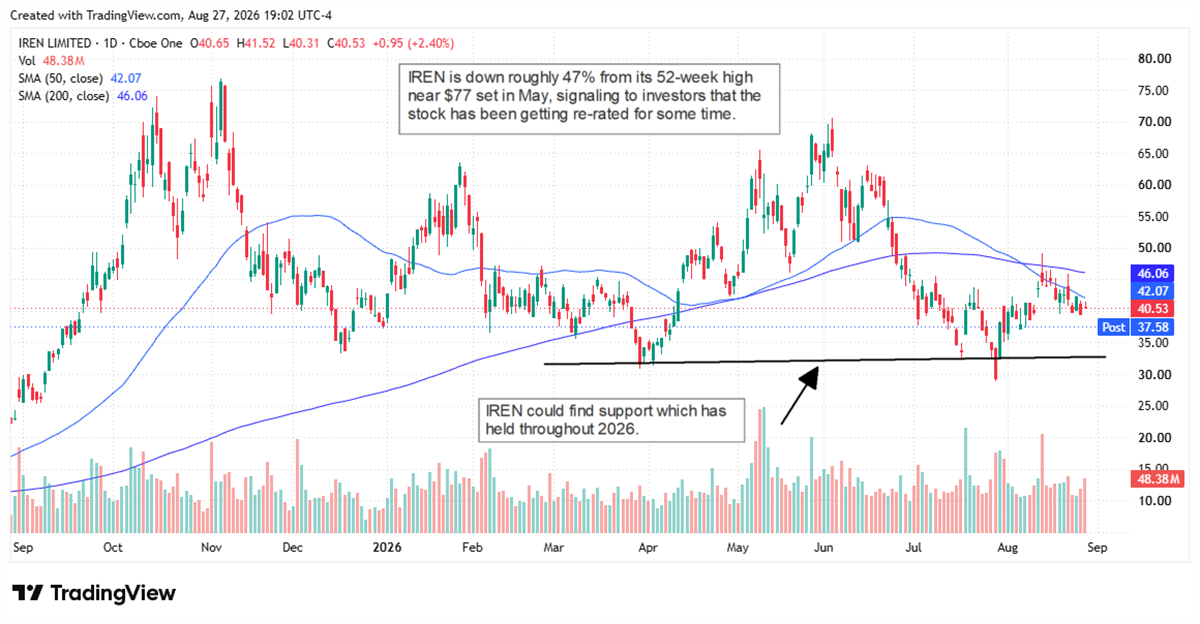
Short interest adds fuel. Nearly 29% of IREN's float was sold short heading into the report. That's a level that typically means any sign of good news can force rapid covering, but it also means bears have real conviction that the story doesn't work at current prices. The analyst picture leans bullish. Consensus sits at Moderate Buy, with the average price target implying substantial upside from current levels. But JPMorgan analyst Richard Choe reiterated a Sell rating heading into earnings, citing uncontracted GPU capacity and elevated debt as key risks. That said, his own $46 price target implies some upside. For a stock this split between bulls and bears—both on the charts and among analysts—price action around this report is likely to remain choppy regardless of which side is "right." That's the honest takeaway from this report. It wasn't a bad quarter. It was a realistic one, and realistic isn't what a stock that has sharply risen over the past year wants to hear. Optimists who expected an earlier profitability timeline now have to wait longer. Pessimists betting on a funding crisis now have less to point to. Both sides received a report that complicates their thesis rather than confirming it, which, for a company still writing its own story, might be the most useful outcome of all.
This ad is sent on behalf of The Oxford Club. 105 W Monument St, Baltimore, Maryland 21201. If you would like to optout from receiving offers from The Oxford Club please click here | 
