Hello,
Welcome to our flagship newsletter, MarketBeat Daily Ratings.
We'll deliver the latest "Buy" and "Sell" ratings from Wall Street's top-rated analysts directly to your inbox each morning.
But first, we need you to do two quick things:
1. Hit reply, and send a simple "Yes." Just one word. This tells Google (and other emails providers) that you actually want to get our newsletter.
2. After that, this link to confirm your subscription. That will tell us that you received our welcome email and that we should start sending your daily report.
Confirm your subscription here.
After you have completed these two steps, we would like to gift you a free copy of one of our most popular investing reports: 7 Stocks to Buy and Hold Forever. You can download the report with this link.
Thank you again for subscribing. We look forward to being an important part of your investing journey

Matthew Paulson
Founder and CEO, MarketBeat.
P.S. If you didn’t intend to subscribe, no problem—you can unsubscribe with this link.
(ARReply-161)
This Week's Featured Article Tesla's Cybercab Launch Could Reshape Margins for Uber and LyftBy Jeffrey Neal Johnson. Publication Date: 8/19/2026. 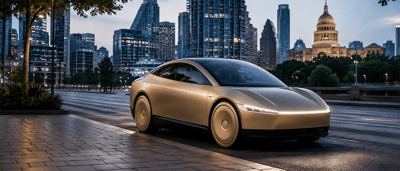
Key Points- Tesla is preparing for an August commercial rollout of its steering-wheel-free Cybercab in Austin, Texas, accelerating the autonomous mobility timeline.
- Vertically integrated driverless fleets could push ride costs toward sub-$1 per mile, threatening the take-rate economics that ride-hailing platforms rely on.
- Uber's diversified, multi-modal business appears better insulated from autonomous pricing pressure than Lyft, while Tesla's high valuation leaves little room for execution risks.
- Special Report: The company SpaceX cannot operate without
The narrative around driverless cars has existed in the realm of speculative research for years, but that timeline has now accelerated. Internal directives preparing for an August commercial rollout of a purpose-built vehicle without a steering wheel in Austin signal that autonomous mobility is finally reaching public roads.
When autonomous vehicles transition from closed-course testing to revenue generation, the baseline cost of a physical ride begins to change. The shift from human-driven variable costs to capital-intensive autonomous fleets could rewrite the fundamental economics of the broader mobility sector. Understanding the mechanics of this disruption could help investors evaluate legacy platforms and adjust their portfolio exposure accordingly.
Green Light: Cybercab Enters the Commercial ArenaMarc Chaikin, founder of Chaikin Analytics, says two forces - AI disruption and fracturing global trade - are triggering a historic wealth transfer already underway in 2026. Household names like Intuit (-57%), Boston Scientific (-49%), and Tractor Supply (-40%) are cratering, while lesser-known companies like Sandisk (+573%) and Rackspace (+444%) surge.
Chaikin has identified specific stocks he believes investors should sell before they fall further - and the names may surprise you. He's also pinpointing a company tapped as Nvidia's self-driving partner and a potential AI megadeal that could split into three high-growth stocks.
Stream his free presentation to get every buy and sell recommendation with no membership or credit card required. Watch Marc Chaikin's free presentation and get his full buy-and-sell list today The conversation around driverless networks has recently shifted from conceptual timelines to live municipal deployments. Tesla, Inc. (NASDAQ: TSLA) is actively preparing its operational staff for the commercial launch of its Cybercab platform in Austin, Texas. Coupled with expanding regulatory approvals in Nevada and federal safety data reflecting zero at-fault collisions during recent monitoring periods, the path to mass commercialization appears to be clearing rapidly.
This development represents a direct structural challenge to the legacy take-rate economics that current ride-hailing networks rely on to generate free cash flow. A successful municipal launch would demonstrate that vertically integrated hardware and software can operate safely in complex urban environments without human operators. When a manufacturer can deploy vehicles directly to consumers, the traditional aggregator model faces a potentially sudden and severe pricing headwind.
Margin Mileage: Driver Take-Rates vs. AV FleetsTo understand the severity of this shift, investors can examine the mobility sector's underlying margin mechanics. Incumbent ride-hailing networks operate with an asset-light, variable-cost structure. Under this model, roughly 50% to 70% of gross booking revenue flows directly out of the ecosystem to compensate human drivers. This structural ceiling limits platform gross-margin expansion and keeps the average consumer cost per mile in the $2 to $3 range.
A vertically integrated, driverless mobility platform eliminates that revenue-sharing bottleneck. By owning the manufacturing layer, in-house computer-vision systems and charging infrastructure, an autonomous fleet operator shifts the business from a variable-labor model to a fixed-capital model. Once the upfront manufacturing and software-development costs are absorbed, the marginal cost of operating a robotaxi could drop sharply.
Over time, this dynamic could push total operating costs per mile below $1. Legacy apps typically retain a take rate of around 25% to 30% of the total fare. If a vertically integrated original equipment manufacturer can profitably offer rides at a fraction of the current market rate, legacy aggregators could face severe, permanent margin compression as they try to maintain consumer volume. Capturing 25% of a much smaller fare would drastically reduce the top-line revenue available to cover corporate overhead.
2 Lanes: Diversified Networks and Pure-Play RisksNot all legacy platforms are equally exposed to this pricing pressure. Uber Technologies, Inc. (NYSE: UBER) has spent the last few years building a robust, multimodal aggregation network.
With segments spanning mobility, food delivery and freight logistics, Uber generates more than $55 billion in trailing-12-month revenue, alongside healthy net margins approaching 17%. Recent quarters highlight strong operational efficiency, with Uber Technologies reporting earnings per share of approximately 81 cents and beating consensus estimates.
Uber's management is actively positioning the platform as a third-party aggregation partner. The company brings a highly engaged global demand engine to the table, offering immediate consumer liquidity to third-party autonomous fleet operators that want to deploy vehicles without building an expensive user base from scratch. This hybrid approach could help insulate Uber Technologies' balance sheet from the direct impact of autonomous pricing wars.
Conversely, Lyft, Inc. (NASDAQ: LYFT) faces a much steeper climb. As a domestic, pure-play passenger network without Uber Technologies' delivery diversification or international scale, Lyft's core cash flow is highly exposed to North American ride pricing.
Lyft operates with razor-thin profitability, and its trailing-12-month pretax margin remains slightly below breakeven. With a forward price-to-earnings ratio of around 24x, Lyft has fewer levers to pull if autonomous fleets trigger a localized price war in key metropolitan markets.
To defend shareholder value against these looming headwinds, Lyft's board recently authorized a $1 billion share repurchase plan. While buybacks can support Lyft's balance sheet and offset equity dilution, they are a financial-engineering tool rather than an operational pivot. A buyback does not resolve the structural vulnerability of operating an asset-light passenger network against asset-heavy autonomous disruptors.
Speed Bumps: Separating the Trend From the TickerRecognizing the long-term economic potential of robotaxis is entirely different from assuming that the leading hardware manufacturer is currently trading at an attractive valuation.
The market has heavily front-run the success of autonomous scaling. Tesla trades at a forward price-to-earnings multiple approaching 386x and a price-to-sales ratio near 13x, while carrying a compressed automotive net margin of roughly 3.6%. Tesla also recently missed Q2 earnings estimates, reporting a 33-cent-per-share loss against consensus expectations of a 50-cent-per-share profit.
That elevated valuation leaves very little room for the gritty operational realities of physical fleet management. Scaling a commercial robotaxi network involves more than perfecting self-driving software. Tesla will need to manage localized regulatory bottlenecks, navigate edge-case municipal interventions, and absorb significant fleet depreciation and maintenance costs.
The physical world is messy: vehicles must be cleaned, tires replaced and localized charging hubs built. The transition to autonomous mobility is a secular tailwind, but investors may want to separate the technology's viability from execution risks that may not yet be priced into what is essentially an automotive manufacturing stock.
Mapping the Route: Hedging the Driverless TransitionThe commercialization of autonomous fleets will reshape transportation economics over the coming years, rewarding business models that can adapt to a capital-intensive environment while placing significant pressure on pure-play human-driver networks. The upcoming rollout in Texas will serve as a critical real-world testing ground for utilization rates, consumer adoption and cost efficiency.
Investors monitoring the mobility sector may want to evaluate their exposure to asset-light passenger aggregators versus diversified transportation networks. They should also watch state-level permitting expansions and strategic partnership announcements between autonomous vehicle manufacturers and global demand platforms. These alliances may ultimately determine which enterprises control margins in a driverless economy, providing a clearer roadmap for identifying long-term value. |