
| From | Muhammad Syed <[email protected]> |
| Subject | 25 Years After 9/11, We’re Still Afraid to Name the Problem |
| Date | August 28, 2026 6:03 AM |
Links have been removed from this email. Learn more in the FAQ.
Links have been removed from this email. Learn more in the FAQ.
Canada struggles to name religious violence while Britain prosecutes religious mockery
No images? Click here [link removed]
Welcome back!
In Canada, the CBC circulated a memo ahead of the September 11 anniversary instructing staff not to call the attacks "terrorist attacks". In Britain, the Crown Prosecution Service secured a criminal conviction against a retired policeman for resharing a crude meme about Islam.
Unbelief Brief
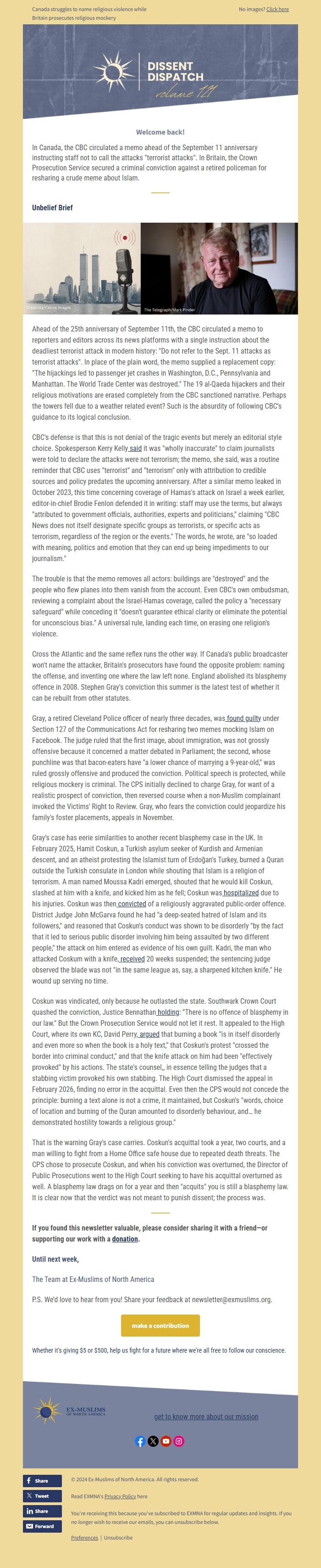
Ahead of the 25th anniversary of September 11th, the CBC circulated a memo to reporters and editors across its news platforms with a single instruction about the deadliest terrorist attack in modern history: "Do not refer to the Sept. 11 attacks as terrorist attacks". In place of the plain word, the memo supplied a replacement copy: "The hijackings led to passenger jet crashes in Washington, D.C., Pennsylvania and Manhattan. The World Trade Center was destroyed." The 19 al-Qaeda hijackers and their religious motivations are erased completely from the CBC sanctioned narrative. Perhaps the towers fell due to a weather related event? Such is the absurdity of following CBC’s guidance to its logical conclusion.
CBC's defense is that this is not denial of the tragic events but merely an editorial style choice. Spokesperson Kerry Kelly said [[link removed]] it was "wholly inaccurate" to claim journalists were told to declare the attacks were not terrorism; the memo, she said, was a routine reminder that CBC uses "terrorist" and "terrorism" only with attribution to credible sources and policy predates the upcoming anniversary. After a similar memo leaked in October 2023, this time concerning coverage of Hamas's attack on Israel a week earlier, editor-in-chief Brodie Fenlon defended it in writing: staff may use the terms, but always "attributed to government officials, authorities, experts and politicians," claiming "CBC News does not itself designate specific groups as terrorists, or specific acts as terrorism, regardless of the region or the events." The words, he wrote, are "so loaded with meaning, politics and emotion that they can end up being impediments to our journalism."
The trouble is that the memo removes all actors: buildings are "destroyed" and the people who flew planes into them vanish from the account. Even CBC's own ombudsman, reviewing a complaint about the Israel-Hamas coverage, called the policy a "necessary safeguard" while conceding it "doesn't guarantee ethical clarity or eliminate the potential for unconscious bias." A universal rule, landing each time, on erasing one religion's violence.
Cross the Atlantic and the same reflex runs the other way. If Canada's public broadcaster won't name the attacker, Britain's prosecutors have found the opposite problem: naming the offense, and inventing one where the law left none. England abolished its blasphemy offence in 2008. Stephen Gray's conviction this summer is the latest test of whether it can be rebuilt from other statutes.
Gray, a retired Cleveland Police officer of nearly three decades, was found guilty [[link removed]] under Section 127 of the Communications Act for resharing two memes mocking Islam on Facebook. The judge ruled that the first image, about immigration, was not grossly offensive because it concerned a matter debated in Parliament; the second, whose punchline was that bacon-eaters have "a lower chance of marrying a 9-year-old," was ruled grossly offensive and produced the conviction. Political speech is protected, while religious mockery is criminal. The CPS initially declined to charge Gray, for want of a realistic prospect of conviction, then reversed course when a non-Muslim complainant invoked the Victims' Right to Review. Gray, who fears the conviction could jeopardize his family's foster placements, appeals in November.
Gray’s case has eerie similarities to another recent blasphemy case in the UK. In February 2025, Hamit Coskun, a Turkish asylum seeker of Kurdish and Armenian descent, and an atheist protesting the Islamist turn of Erdoğan's Turkey, burned a Quran outside the Turkish consulate in London while shouting that Islam is a religion of terrorism. A man named Moussa Kadri emerged, shouted that he would kill Coskun, slashed at him with a knife, and kicked him as he fell; Coskun was hospitalized [[link removed]] due to his injuries. Coskun was then convicted [[link removed]] of a religiously aggravated public-order offence. District Judge John McGarva found he had "a deep-seated hatred of Islam and its followers," and reasoned that Coskun's conduct was shown to be disorderly "by the fact that it led to serious public disorder involving him being assaulted by two different people," the attack on him entered as evidence of his own guilt. Kadri, the man who attacked Coskum with a knife, received [[link removed]] 20 weeks suspended; the sentencing judge observed the blade was not "in the same league as, say, a sharpened kitchen knife." He wound up serving no time.
Coskun was vindicated, only because he outlasted the state. Southwark Crown Court quashed the conviction, Justice Bennathan holding [[link removed]]: "There is no offence of blasphemy in our law." But the Crown Prosecution Service would not let it rest. It appealed to the High Court, where its own KC, David Perry, argued [[link removed]] that burning a book "is in itself disorderly and even more so when the book is a holy text," that Coskun's protest "crossed the border into criminal conduct," and that the knife attack on him had been "effectively provoked" by his actions. The state's counsel,, in essence telling the judges that a stabbing victim provoked his own stabbing. The High Court dismissed the appeal in February 2026, finding no error in the acquittal. Even then the CPS would not concede the principle: burning a text alone is not a crime, it maintained, but Coskun's "words, choice of location and burning of the Quran amounted to disorderly behaviour, and… he demonstrated hostility towards a religious group."
That is the warning Gray's case carries. Coskun's acquittal took a year, two courts, and a man willing to fight from a Home Office safe house due to repeated death threats. The CPS chose to prosecute Coskun, and when his conviction was overturned, the Director of Public Prosecutions went to the High Court seeking to have his acquittal overturned as well. A blasphemy law drags on for a year and then "acquits" you is still a blasphemy law. It is clear now that the verdict was not meant to punish dissent; the process was.
If you found this newsletter valuable, please consider sharing it with a friend—or supporting our work with a donation [[link removed]].
Until next week,
The Team at Ex-Muslims of North America
P.S. We’d love to hear from you! Share your feedback at [email protected].
make a contribution [[link removed]]
Whether it’s giving $5 or $500, help us fight for a future where we're all free to follow our conscience.
get to know more about our mission [[link removed]]
[[link removed]] Share [link removed] Tweet [link removed] Share [[link removed]] Forward [link removed]
© 2024 Ex-Muslims of North America. All rights reserved.
Read EXMNA's Privacy Policy [[link removed]] here
You're receiving this because you've subscribed to EXMNA for regular updates and insights. If you no longer wish to receive our emails, you can unsubscribe below.
Preferences [link removed] | Unsubscribe [link removed]
No images? Click here [link removed]
Welcome back!
In Canada, the CBC circulated a memo ahead of the September 11 anniversary instructing staff not to call the attacks "terrorist attacks". In Britain, the Crown Prosecution Service secured a criminal conviction against a retired policeman for resharing a crude meme about Islam.
Unbelief Brief
Ahead of the 25th anniversary of September 11th, the CBC circulated a memo to reporters and editors across its news platforms with a single instruction about the deadliest terrorist attack in modern history: "Do not refer to the Sept. 11 attacks as terrorist attacks". In place of the plain word, the memo supplied a replacement copy: "The hijackings led to passenger jet crashes in Washington, D.C., Pennsylvania and Manhattan. The World Trade Center was destroyed." The 19 al-Qaeda hijackers and their religious motivations are erased completely from the CBC sanctioned narrative. Perhaps the towers fell due to a weather related event? Such is the absurdity of following CBC’s guidance to its logical conclusion.
CBC's defense is that this is not denial of the tragic events but merely an editorial style choice. Spokesperson Kerry Kelly said [[link removed]] it was "wholly inaccurate" to claim journalists were told to declare the attacks were not terrorism; the memo, she said, was a routine reminder that CBC uses "terrorist" and "terrorism" only with attribution to credible sources and policy predates the upcoming anniversary. After a similar memo leaked in October 2023, this time concerning coverage of Hamas's attack on Israel a week earlier, editor-in-chief Brodie Fenlon defended it in writing: staff may use the terms, but always "attributed to government officials, authorities, experts and politicians," claiming "CBC News does not itself designate specific groups as terrorists, or specific acts as terrorism, regardless of the region or the events." The words, he wrote, are "so loaded with meaning, politics and emotion that they can end up being impediments to our journalism."
The trouble is that the memo removes all actors: buildings are "destroyed" and the people who flew planes into them vanish from the account. Even CBC's own ombudsman, reviewing a complaint about the Israel-Hamas coverage, called the policy a "necessary safeguard" while conceding it "doesn't guarantee ethical clarity or eliminate the potential for unconscious bias." A universal rule, landing each time, on erasing one religion's violence.
Cross the Atlantic and the same reflex runs the other way. If Canada's public broadcaster won't name the attacker, Britain's prosecutors have found the opposite problem: naming the offense, and inventing one where the law left none. England abolished its blasphemy offence in 2008. Stephen Gray's conviction this summer is the latest test of whether it can be rebuilt from other statutes.
Gray, a retired Cleveland Police officer of nearly three decades, was found guilty [[link removed]] under Section 127 of the Communications Act for resharing two memes mocking Islam on Facebook. The judge ruled that the first image, about immigration, was not grossly offensive because it concerned a matter debated in Parliament; the second, whose punchline was that bacon-eaters have "a lower chance of marrying a 9-year-old," was ruled grossly offensive and produced the conviction. Political speech is protected, while religious mockery is criminal. The CPS initially declined to charge Gray, for want of a realistic prospect of conviction, then reversed course when a non-Muslim complainant invoked the Victims' Right to Review. Gray, who fears the conviction could jeopardize his family's foster placements, appeals in November.
Gray’s case has eerie similarities to another recent blasphemy case in the UK. In February 2025, Hamit Coskun, a Turkish asylum seeker of Kurdish and Armenian descent, and an atheist protesting the Islamist turn of Erdoğan's Turkey, burned a Quran outside the Turkish consulate in London while shouting that Islam is a religion of terrorism. A man named Moussa Kadri emerged, shouted that he would kill Coskun, slashed at him with a knife, and kicked him as he fell; Coskun was hospitalized [[link removed]] due to his injuries. Coskun was then convicted [[link removed]] of a religiously aggravated public-order offence. District Judge John McGarva found he had "a deep-seated hatred of Islam and its followers," and reasoned that Coskun's conduct was shown to be disorderly "by the fact that it led to serious public disorder involving him being assaulted by two different people," the attack on him entered as evidence of his own guilt. Kadri, the man who attacked Coskum with a knife, received [[link removed]] 20 weeks suspended; the sentencing judge observed the blade was not "in the same league as, say, a sharpened kitchen knife." He wound up serving no time.
Coskun was vindicated, only because he outlasted the state. Southwark Crown Court quashed the conviction, Justice Bennathan holding [[link removed]]: "There is no offence of blasphemy in our law." But the Crown Prosecution Service would not let it rest. It appealed to the High Court, where its own KC, David Perry, argued [[link removed]] that burning a book "is in itself disorderly and even more so when the book is a holy text," that Coskun's protest "crossed the border into criminal conduct," and that the knife attack on him had been "effectively provoked" by his actions. The state's counsel,, in essence telling the judges that a stabbing victim provoked his own stabbing. The High Court dismissed the appeal in February 2026, finding no error in the acquittal. Even then the CPS would not concede the principle: burning a text alone is not a crime, it maintained, but Coskun's "words, choice of location and burning of the Quran amounted to disorderly behaviour, and… he demonstrated hostility towards a religious group."
That is the warning Gray's case carries. Coskun's acquittal took a year, two courts, and a man willing to fight from a Home Office safe house due to repeated death threats. The CPS chose to prosecute Coskun, and when his conviction was overturned, the Director of Public Prosecutions went to the High Court seeking to have his acquittal overturned as well. A blasphemy law drags on for a year and then "acquits" you is still a blasphemy law. It is clear now that the verdict was not meant to punish dissent; the process was.
If you found this newsletter valuable, please consider sharing it with a friend—or supporting our work with a donation [[link removed]].
Until next week,
The Team at Ex-Muslims of North America
P.S. We’d love to hear from you! Share your feedback at [email protected].
make a contribution [[link removed]]
Whether it’s giving $5 or $500, help us fight for a future where we're all free to follow our conscience.
get to know more about our mission [[link removed]]
[[link removed]] Share [link removed] Tweet [link removed] Share [[link removed]] Forward [link removed]
© 2024 Ex-Muslims of North America. All rights reserved.
Read EXMNA's Privacy Policy [[link removed]] here
You're receiving this because you've subscribed to EXMNA for regular updates and insights. If you no longer wish to receive our emails, you can unsubscribe below.
Preferences [link removed] | Unsubscribe [link removed]
Message Analysis
- Sender: Ex-Muslims of North America
- Political Party: n/a
- Country: United States
- State/Locality: n/a
- Office: n/a
-
Email Providers:
- Campaign Monitor