
| From | AEI DataPoints <[email protected]> |
| Subject | The Collapse of Confidence in College |
| Date | August 27, 2026 9:37 AM |
Links have been removed from this email. Learn more in the FAQ.
Links have been removed from this email. Learn more in the FAQ.
Also: The “China Shock” Myth and Falling Birth Rates
AEIDataPoints-Banner ([link removed] )
Expert analysis made easy. Breaking down the news with data, charts, and maps.
Edited by Hannah Bowen and Lexi Baker
Happy Thursday! In today’s newsletter, we examine the collapse of confidence in higher education, the “China shock” myth, and plummeting global birth rates.
Don’t forget—subscribe ([link removed] ) and send DataPoints to a friend!
For inquiries, please email [email protected] (mailto:[email protected]) .
1. Americans Have Lost Faith in College ([link removed] )
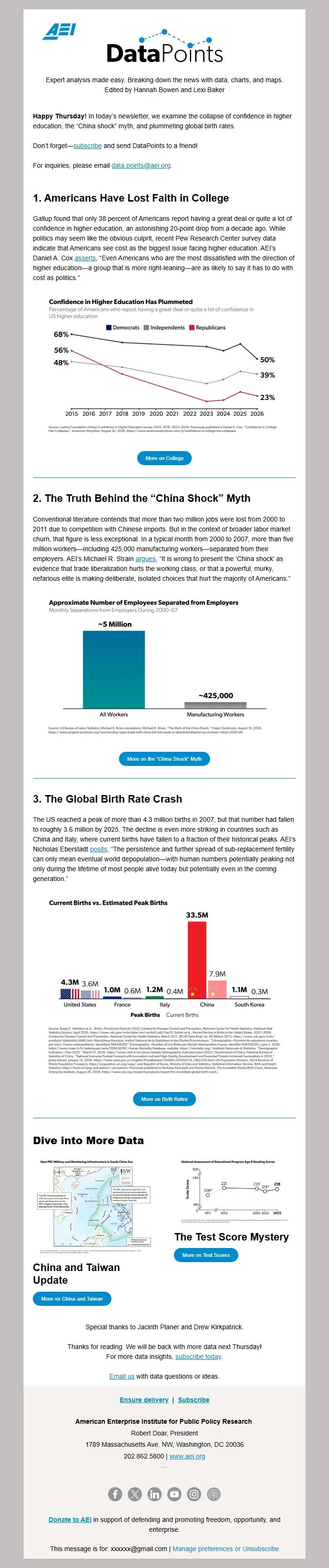
Gallup found that only 38 percent of Americans report having a great deal or quite a lot of confidence in higher education, an astonishing 20-point drop from a decade ago. While politics may seem like the obvious culprit, recent Pew Research Center survey data indicate that Americans see cost as the biggest issue facing higher education. AEI’s Daniel A. Cox asserts ([link removed] ) , “Even Americans who are the most dissatisfied with the direction of higher education—a group that is more right-leaning—are as likely to say it has to do with cost as politics.”
08.27_Cox ([link removed] )
More on College
([link removed] )
2. The Truth Behind the “China Shock” Myth ([link removed] )
Conventional literature contends that more than two million jobs were lost from 2000 to 2011 due to competition with Chinese imports. But in the context of broader labor market churn, that figure is less exceptional. In a typical month from 2000 to 2007, more than five million workers—including 425,000 manufacturing workers—separated from their employers. AEI’s Michael R. Strain argues ([link removed] ) , “It is wrong to present the ‘China shock’ as evidence that trade liberalization hurts the working class, or that a powerful, murky, nefarious elite is making deliberate, isolated choices that hurt the majority of Americans.”
08.27_Strain-1 ([link removed] )
More on the “China Shock” Myth
([link removed] )
3. The Global Birth Rate Crash ([link removed] )
The US reached a peak of more than 4.3 million births in 2007, but that number had fallen to roughly 3.6 million by 2025. The decline is even more striking in countries such as China and Italy, where current births have fallen to a fraction of their historical peaks. AEI’s Nicholas Eberstadt posits ([link removed] ) , “The persistence and further spread of sub-replacement fertility can only mean eventual world depopulation—with human numbers potentially peaking not only during the lifetime of most people alive today but potentially even in the coming generation.”
08.27_Eberstadt ([link removed] )
More on Birth Rates
([link removed] )
Dive into More Data
08.27_CDOT ([link removed] )
China and Taiwan Update ([link removed] )
More on China and Taiwan
([link removed] )
08.27_Malkus ([link removed] )
The Test Score Mystery ([link removed] )
More on Test Scores
([link removed] )
Special thanks to Jacinth Planer and Drew Kirkpatrick.
Thanks for reading. We will be back with more data next Thursday!
For more data insights, subscribe today ([link removed] ) .
Email us (mailto:[email protected]) with data questions or ideas.
Ensure delivery ([link removed] ) | Subscribe ([link removed] )
American Enterprise Institute for Public Policy Research
Robert Doar, President
1789 Massachusetts Ave. NW, Washington, DC 20036
202.862.5800 | www.aei.org ([link removed] )
Unsubscribe from the link below. ([link removed] )
Facebook ([link removed] )
X ([link removed] )
LinkedIn ([link removed] )
YouTube ([link removed] )
Instagram ([link removed] )
Podcast Logo New_Gray ([link removed] )
Donate to AEI ([link removed] ) in support of defending and promoting freedom, opportunity, and enterprise.
This message is for: [email protected] | Manage preferences or Unsubscribe ([link removed] )
AEIDataPoints-Banner ([link removed] )
Expert analysis made easy. Breaking down the news with data, charts, and maps.
Edited by Hannah Bowen and Lexi Baker
Happy Thursday! In today’s newsletter, we examine the collapse of confidence in higher education, the “China shock” myth, and plummeting global birth rates.
Don’t forget—subscribe ([link removed] ) and send DataPoints to a friend!
For inquiries, please email [email protected] (mailto:[email protected]) .
1. Americans Have Lost Faith in College ([link removed] )
Gallup found that only 38 percent of Americans report having a great deal or quite a lot of confidence in higher education, an astonishing 20-point drop from a decade ago. While politics may seem like the obvious culprit, recent Pew Research Center survey data indicate that Americans see cost as the biggest issue facing higher education. AEI’s Daniel A. Cox asserts ([link removed] ) , “Even Americans who are the most dissatisfied with the direction of higher education—a group that is more right-leaning—are as likely to say it has to do with cost as politics.”
08.27_Cox ([link removed] )
More on College
([link removed] )
2. The Truth Behind the “China Shock” Myth ([link removed] )
Conventional literature contends that more than two million jobs were lost from 2000 to 2011 due to competition with Chinese imports. But in the context of broader labor market churn, that figure is less exceptional. In a typical month from 2000 to 2007, more than five million workers—including 425,000 manufacturing workers—separated from their employers. AEI’s Michael R. Strain argues ([link removed] ) , “It is wrong to present the ‘China shock’ as evidence that trade liberalization hurts the working class, or that a powerful, murky, nefarious elite is making deliberate, isolated choices that hurt the majority of Americans.”
08.27_Strain-1 ([link removed] )
More on the “China Shock” Myth
([link removed] )
3. The Global Birth Rate Crash ([link removed] )
The US reached a peak of more than 4.3 million births in 2007, but that number had fallen to roughly 3.6 million by 2025. The decline is even more striking in countries such as China and Italy, where current births have fallen to a fraction of their historical peaks. AEI’s Nicholas Eberstadt posits ([link removed] ) , “The persistence and further spread of sub-replacement fertility can only mean eventual world depopulation—with human numbers potentially peaking not only during the lifetime of most people alive today but potentially even in the coming generation.”
08.27_Eberstadt ([link removed] )
More on Birth Rates
([link removed] )
Dive into More Data
08.27_CDOT ([link removed] )
China and Taiwan Update ([link removed] )
More on China and Taiwan
([link removed] )
08.27_Malkus ([link removed] )
The Test Score Mystery ([link removed] )
More on Test Scores
([link removed] )
Special thanks to Jacinth Planer and Drew Kirkpatrick.
Thanks for reading. We will be back with more data next Thursday!
For more data insights, subscribe today ([link removed] ) .
Email us (mailto:[email protected]) with data questions or ideas.
Ensure delivery ([link removed] ) | Subscribe ([link removed] )
American Enterprise Institute for Public Policy Research
Robert Doar, President
1789 Massachusetts Ave. NW, Washington, DC 20036
202.862.5800 | www.aei.org ([link removed] )
Unsubscribe from the link below. ([link removed] )
Facebook ([link removed] )
X ([link removed] )
LinkedIn ([link removed] )
YouTube ([link removed] )
Instagram ([link removed] )
Podcast Logo New_Gray ([link removed] )
Donate to AEI ([link removed] ) in support of defending and promoting freedom, opportunity, and enterprise.
This message is for: [email protected] | Manage preferences or Unsubscribe ([link removed] )
Message Analysis
- Sender: American Enterprise Institute
- Political Party: n/a
- Country: United States
- State/Locality: n/a
- Office: n/a
-
Email Providers:
- HubSpot