| Unsubscribe |
Editor’s Note: Jeff Brown and Marc Chaikin, two investment legends who picked Nvidia 10 years ago, are predicting that by the end of this month, Elon Musk’s new AI breakthrough will collide with a strange market pattern with a flawless 100% track record of massive market gains. Click here to see the details or read more below because the last time this happened everyday folks had a chance to turn $10,000 into as much as $350,000 in just about 12 months.
Dear Reader,
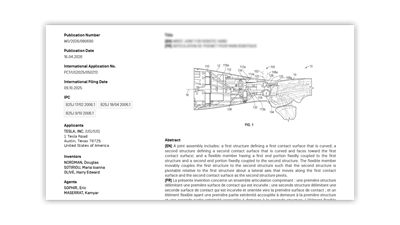
Take a look at Elon Musk’s new patent below…
Because it protects a new invention that could rewrite the future of wealth forever.
I’m talking about a radical new form of AI I call “M.A.G.I.”
One so revolutionary that Elon called it an “infinite money glitch.”
Click here to see the details because he believes this is a once-in-a-generation opportunity to create wealth on a scale most people can’t even comprehend.
What’s the upside potential here?
I know this is going to sound crazy…
But Elon is projecting growth of over 7,000,000%.
Let that sink in.
That’s enough to turn $100 into more than $7 million.
This sounds absolutely insane.
But then again… everything Elon has ever done sounded insane at first.
Self-driving cars.
Reusable rockets that land themselves.
Brain chips that let paralyzed people control computers with their minds.
Crazy ideas.
But he turned them into trillion-dollar realities.
So here’s the real question…
Will you watch Elon build another empire from the sidelines…
Or will you finally position yourself to potentially become one of the winners in his next trillion-dollar revolution?
Click here to get the details because I believe Elon will flip the switch on this new invention by the end of this month.
We have so much to look forward to,
Jeff Brown
Founder & CEO, Brownstone Research
Uncle Sam’s Chip Trick: How the Government Built a Silicon Moat
Written by Jeffrey Neal Johnson. Publication Date: 8/18/2026.

Key Points
- U.S. trade restrictions on foreign memory suppliers and surging AI-driven demand for high-bandwidth memory are jointly reshaping the economics of the semiconductor industry.
- Micron Technology posted nearly $41.5 billion in quarterly revenue, a 346% year-over-year increase, with net profit margins expanding to nearly 56% amid strong pricing power.
- Institutional investors have poured roughly $119 billion into Micron over the past year as analysts, including Bank of America, project earnings could exceed $230 per share by fiscal 2030.
- Special Report: Everyone wanted SpaceX. Smart money wants this.
Investors analyzing what's driving semiconductor stocks should consider how two forces—trade policy and the demands of artificial intelligence—are reshaping institutional portfolios. Traditional cyclicality in the memory segment is giving way to something steadier and more structural.
This shift is being propelled by federal protectionist policies and a tightening supply ceiling as high-performance computing (HPC) clusters consume global foundry capacity, fundamentally resetting the industry's long-term margin profile.
Why Trump really wants Greenland (Ad)
The petrodollar arrangement that anchored the US dollar for 50 years quietly expired in June 2024. Since then, China has cut its Treasury holdings by 45% from their peak, and BRICS nations offloaded $47 billion of American debt in a single month.
The Trump administration has responded with a $12 billion critical minerals stockpile called Project Vault, equity stakes in miners like MP Materials and Lithium Americas, and a push to secure resources from Greenland to Ukraine.
Porter Stansberry lays out the full story in a new documentary, including five companies positioned at the chokepoints of what he calls Trump's New Dollar.
Watch the full documentary before December's economic summit in MiamiWashington is working to insulate critical technology supply chains, effectively establishing a federally guarded protectionist moat. At the same time, hyperscaler data center demand is consuming global silicon wafer capacity, creating a structural shortage in advanced memory.
This combination grants domestic producers unprecedented pricing power over hardware developers. Instead of competing on thin margins against subsidized foreign producers, domestic manufacturers are securing multiyear, high-margin supply agreements. Investors who understand how this geopolitical shield feeds directly into wider margins can spot these structural shifts before the market fully prices them in.
Washington Cuts Off Cheap Foreign Chips
This policy shift is most evident in consumer hardware, where major technology companies face shrinking flexibility in component sourcing. A prime example occurred when federal trade officials cautioned consumer electronics leader Apple Inc. (NASDAQ: AAPL) against purchasing lower-cost memory components from foreign, state-subsidized suppliers, including Yangtze Memory Technologies Corp. and ChangXin Memory Technologies.
With hardware gross margins under pressure from rising component costs, mega-cap buyers naturally sought cheaper alternatives overseas. However, the U.S. Department of Commerce made its position explicit: sourcing core memory components from blacklisted or foreign military-linked enterprises poses unacceptable national security risks. This regulatory stance removes low-cost foreign producers from the domestic supply chain, stripping buyers of their traditional negotiating leverage.
Consequently, technology companies must rely on domestic and allied suppliers for their needs. Domestic manufacturers are capturing these guaranteed order volumes by investing heavily in reshoring production.
Micron Technology (NASDAQ: MU) committed approximately $250 billion to constructing megafab facilities across Idaho and New York. These capital commitments align directly with federal industrial policy, creating a captive-customer dynamic in which domestic equipment manufacturers must secure long-term, noncancelable supply agreements at prices that favor suppliers.
How AI Accelerators Consume Global Silicon Capacity
While trade restrictions establish a regulatory barrier, the physical supply of silicon memory is undergoing an equally dramatic contraction. The primary driver is the surge in demand for high-performance computing platforms built by chipmakers such as NVIDIA Corporation (NASDAQ: NVDA) and Advanced Micro Devices, Inc. (NASDAQ: AMD).
To power modern artificial intelligence models, advanced graphics processors require large stacks of high-bandwidth memory (HBM). The physics of semiconductor manufacturing reveals the broader economic impact: producing one bit of HBM requires roughly three times the silicon wafer capacity of standard DRAM. As foundries convert conventional manufacturing lines to specialized packaging, global wafer capacity for standard consumer memory dries up.
This wafer-conversion ratio creates a rising tide that expands pricing power across all memory categories. Manufacturers report that 100% of their 2026 HBM production capacity is fully allocated under noncancelable long-term agreements. Because chipmakers such as NVIDIA Corporation consume vast amounts of available foundry capacity, traditional hardware makers must compete for a shrinking pool of conventional memory, cementing high contract pricing across the hardware ecosystem.
Financial Data Demonstrates Memory Pricing Power
Recent financial data from Micron provides concrete evidence of how this protectionist moat and supply deficit have translated into fundamental outperformance. In its Q3 fiscal year 2026 earnings report, Micron reported revenue of nearly $41.5 billion, representing a year-over-year increase of nearly 346%, and exceeded consensus earnings expectations with earnings of $25.11 per share. Management subsequently issued fourth-quarter earnings guidance of $30 to $32 per share, exceeding Wall Street estimates.
Beyond top-line momentum, the true story lies in profitability and cash generation. Net profit margins expanded to nearly 56%, demonstrating that memory producers are no longer price takers. Analysts at Bank of America recently revised their long-term structural models, projecting that Micron's earnings could surpass $230 per share by fiscal 2030 as high-margin contracts replace low-margin commodity DRAM.
Even with MU trading around $1,015 per share and carrying a market capitalization approaching $1.15 trillion, its forward price-to-earnings ratio sits at a modest 13 to 14 times. Institutional investors have taken notice, driving roughly $119 billion in gross institutional inflows into the stock over the trailing 12 months. This institutional accumulation reflects growing recognition that domestic protectionism is fundamentally altering the long-term earnings baseline.
Semiconductor Exposure: Positioned for the Protectionist Shift
The convergence of federal trade mandates and supply deficits has altered semiconductor economics. By restricting foreign, state-subsidized supply, Washington has underwritten a domestic protectionist moat that nearly guarantees captive demand for Western manufacturers.
While fundamental tailwinds remain powerful, investors should account for potential risks, including broader pullbacks in the technology sector, executive profit-taking following steep stock rallies, and delays in the construction of new domestic fabs.
Those evaluating exposure to the sector might consider monitoring domestic memory manufacturers during short-term market consolidation, focusing on companies with significant HBM production exposure, and tracking changes in federal trade policy as key indicators for long-term position management.
Marzetti Stock Confirms Reversal on Earnings Strength, Dividend Growth
Written by Thomas Hughes. Publication Date: 8/26/2026.

Key Points
- Marzetti shares rose after fiscal Q4 results confirmed a head-and-shoulders chart reversal following a prolonged decline.
- Revenue slipped 2.2% to $465 million, but margin improvements drove adjusted earnings growth of 9% for the quarter.
- Strong institutional buying, a 3.45% dividend yield as a Dividend King, and steady buybacks support the stock's potential recovery.
- Special Report: Everyone wanted SpaceX. Smart money wants this.
The Marzetti Company’s (NASDAQ: MZTI) stock screamed buy after the company's fiscal Q4 release, advancing to confirm a head-and-shoulders reversal. The stock had declined in the quarters leading up to the release, but the Q4 report proved Marzetti’s true strength: its ability to generate cash flow.
While the company is temporarily pressured by a recent acquisition, the results showed better-than-expected profitability and improved capacity for capital returns. Capital returns are the primary factor, as The Marzetti Company is a Dividend King on track to increase its distribution annually for many years to come.
Why Trump really wants Greenland (Ad)
The petrodollar arrangement that anchored the US dollar for 50 years quietly expired in June 2024. Since then, China has cut its Treasury holdings by 45% from their peak, and BRICS nations offloaded $47 billion of American debt in a single month.
The Trump administration has responded with a $12 billion critical minerals stockpile called Project Vault, equity stakes in miners like MP Materials and Lithium Americas, and a push to secure resources from Greenland to Ukraine.
Porter Stansberry lays out the full story in a new documentary, including five companies positioned at the chokepoints of what he calls Trump's New Dollar.
Watch the full documentary before December's economic summit in MiamiThe head-and-shoulders reversal pattern is one of the stronger signals a chart can provide. It marks the end of a downtrend and the start of a new trend. The only question is whether the change will be from down to up or from down to sideways, as may be the case with Marzetti. The company has proved its worth; now it needs to regain traction and reinvigorate market appetite.

Marzetti’s Earnings Growth Accelerates as Margins Improve
The Marzetti Company had a decent quarter despite its mixed results. The top line came in at $465 million, down 2.2% from last year and slightly below consensus. However, the comparison was affected by two factors. First, the prior-year period included a nonrecurring contract. Second, analyst coverage and revision activity remain limited. There simply aren’t many analysts covering the stock, and activity over the past year has been tepid at best. Reasons for the limited coverage include Marzetti's relatively unexciting business model, which focuses on selling branded sauces and frozen bread products to retail outlets, and its market cap of only $3.2 billion.
Organically, the business is improving. The company reported a 0.4% systemwide gain, underpinned by a 0.9% increase in the Retail channel, which was further supported by the acquisition. The Food Service segment was the weak link, down 5.3% on a reported basis but only 0.1% on an adjusted basis. This highlights both the potential lumpiness of the results and the strength of the diversified model. When consumers aren’t dining out, they turn to in-store versions of their favorite restaurant brands, including Chick-fil-A, Olive Garden, and Texas Roadhouse (NASDAQ: TXRH).
Margin news was the bright spot in the release. The company’s cost-cutting efforts and operational improvements expanded gross margin by more than 200 basis points. Higher SG&A and operating costs partially offset those gains, but much of that impact is linked to the acquisition and integration and is expected to diminish over time. The takeaway is that adjusted earnings grew by 9% despite top-line softness, setting the stage for continued earnings growth in upcoming quarters.
Institutions Signal Bottom for Marzetti Stock
Institutional activity is as robust as analyst coverage is tepid. Institutions signal high confidence in the stock’s long-term outlook, dividend, and value by owning more than 65% of the shares and buying aggressively in 2026. MarketBeat data reveals virtually no selling over the trailing 12 months—only buying—with purchases spiking alongside major price declines.
Institutional activity ahead of the Q4 release was especially telling, reaching a multiquarter high in alignment with the head-and-shoulders pattern. The likely outcome is that these investors will continue to support the stock, potentially leading the market into a full reversal by year’s end. The catalyst for a reversal will likely come in the next earnings release and could include further margin improvement.
Marzetti’s Dividend, Buybacks, and Balance Sheet Support Upside
The dividend is attractive. Not only is this company a Dividend King, having proven its ability to pay consistently through business cycles, but it also offered a historically high yield of 3.45% as of late August and has grown its dividend at a mid-single-digit compound annual growth rate (CAGR).
Balance sheet highlights show no red flags aside from a slight increase in debt related to the Bachan’s acquisition. Even so, the increase is minimal, leaving leverage at approximately 0.2x equity. The company also has a strong cash position and improving equity.
The added bonus is share buybacks. The company is not an aggressive repurchaser of its own shares, but it reduces the share count incrementally each quarter. This adds leverage to earnings and supports the outlook for a rebound in the stock price.
It will take some time, but Marzetti’s cash flow and capital returns suggest that its stock price will recover over time. When consumer trends improve, the recovery could accelerate.
The company's biggest risks are fluctuations in commodity costs, which can pressure margins, and food product recalls.
Recalls, especially those tied to foodborne illness, can hurt brand sales and impair long-term revenue and margins. Competition and private-label products also pose risks, but to a lesser degree.
This email communication is a sponsored message from Brownstone Research, a third-party advertiser of MarketBeat. Why did I get this email content?.
If you need assistance with your subscription, please email MarketBeat's South Dakota based support team at [email protected].
If you would no longer like to receive promotional emails from MarketBeat advertisers, you can unsubscribe or manage your mailing preferences here.
© 2006-2026 MarketBeat Media, LLC. All rights reserved.
345 N Reid Place, Sixth Floor, Sioux Falls, S.D. 57103-7078. USA..