| Unsubscribe |
Dear Reader,
I screened 23,281 publicly traded companies looking for something almost impossible to find.
I wanted huge operating profits. Double-digit revenue growth. Rapid dividend growth. And a market valuation so cheap it looked completely disconnected from the underlying business.
Only one American company survived every test.
One.
It generates more than $3 billion in operating income. Its revenue growth tops 15%. Its dividend growth exceeded 20% over the previous three years.
Yet its entire market capitalization remains below $8 billion.
That combination should not exist.
This is not an unprofitable AI startup hoping to make money someday. It is an established American energy producer sitting directly in the path of the AI electricity boom.
It also pays a dividend more than 300% larger than the S&P 500 average.
And while individual investors have largely ignored it, Wall Street institutions already own approximately 88% of the shares.
That is why I call it my Ultimate Stock Unicorn: wildly profitable, insanely cheap and almost completely unknown outside professional investing circles.
But out of 23,281 stocks, I found only one company with this exact financial profile.
I believe waiting until everyone recognizes it could mean surrendering the price advantage.
Click here now to learn about the only American stock that passed my screen.
Yours in smart speculation,
Karim Rahemtulla, Head Fundamental Tactician
Monument Traders Alliance
P.S. I checked 23,281 stocks. Only one American company delivered this combination of profits, growth, dividend expansion and a sub-$8 billion valuation.
Once the crowd discovers why it passed, today's price may be history - click here now and learn about the Ultimate Stock Unicorn.
Rocket Lab Lands a Wave of Contracts Ahead of Earnings
Reported by Ryan Hasson. First Published: 8/6/2026.
Key Points
- Rocket Lab secured three major contracts in under two weeks, including a $397 million Space Force award and a record $266 million launch deal, ahead of its Aug. 10 earnings report.
- Investors should watch for updates on revenue growth, backlog size, and the Neutron rocket's development timeline, which remains on track for a fourth-quarter 2026 debut.
- Despite a more than 50% drop from its May high and a rich valuation exceeding 70 times trailing sales, analysts maintain a Moderate Buy rating with 48% implied upside.
- Special Report: Forget SpaceX. Buy the company Musk can't replace.
Rocket Lab (NASDAQ: RKLB) has spent the past two weeks doing exactly what a company wants to do heading into an earnings report: winning business. After a brutal correction that saw the stock fall more than 50% from its May high, a rapid succession of major contract awards has refocused attention on the fundamentals. The stock jumped 5.75% on Tuesday to close at $74.48, and with Q2 results due Aug. 10, the timing of these wins could hardly be better.
A $397 Million Space Force Award
The largest of the recent wins landed Monday. Rocket Lab announced a $397 million contract from the U.S. Space Force under the Space-Based Airborne Moving Target Indicator, or SB-AMTI, program. The award was part of a larger $615 million allocation split among three companies, with Rocket Lab taking the lion's share.
#1 Stock After New Cancer Vaccine Announcement (NOT Moderna or Merck) (Ad)
Moderna's stock doubled in a single day after its cancer vaccine hit key Phase 3 goals, and Merck jumped too. But according to a former Steve Cohen fund manager, the next big opportunity is not Moderna or Merck.
It is a different kind of company tied to a technology already backed by Elon Musk, Sam Altman, Jeff Bezos, and Peter Thiel. Nvidia's Jensen Huang says it will have a dramatic impact on daily life, while Anthropic's CEO believes it could unlock a century of medical progress in just ten years.
Nature Magazine estimates its potential value at $367 trillion globally, and it is already rolling out across the United States.
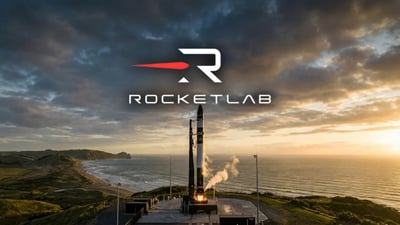
Click here to learn about this new era of medical technologyUnder the deal, the company will develop, launch and operate multiple next-generation “Flatellites”—flat satellites optimized for large constellations and equipped with space-based sensors designed to detect and track airborne threats in real time. Critically, those satellites will fly on Rocket Lab's upcoming Neutron rocket, adding a marquee national security customer to Neutron's manifest before the vehicle has even flown.
A Record $266 Million Launch Contract
Just days earlier, on July 27, Rocket Lab secured what it called the largest launch contract in company history: a $266 million agreement with the U.S. Space Force for 12 dedicated suborbital launches supporting missile defense, with options for six more.
The missions will primarily fly from Rocket Lab's new Pacific Spaceport Complex in Kodiak, Alaska, expanding the company's growing launch footprint. The agreement is a powerful signal of the government's confidence in Rocket Lab's ability to deliver responsive, high-cadence launch capability for urgent national security needs.
A Commercial Win, Too
The momentum has not been limited to defense. On July 30, Rocket Lab announced a multi-launch deal with Japanese Earth-imaging company iQPS for three dedicated Electron missions. The agreement underscores the continued strength of Rocket Lab's core Electron business, which remains the world's second-most-active launch vehicle, even as the company expands into larger and more strategic programs.
Together, these three awards in less than two weeks reinforce a business winning across commercial, civil and national security markets simultaneously.
What to Watch on Aug. 10
With the contract news setting a positive tone, attention now turns to the Q2 report. Investors should focus on several key areas. First is revenue relative to guidance. Rocket Lab posted record Q1 revenue of $200.35 million, up 63.5% year over year, and the market will want to see that growth trajectory continue. Second is backlog. The figure stood at a record $2.2 billion last quarter, and the recent contract haul should push it meaningfully higher, providing one of the clearest reasons to tune in.
Third, and most important, is Neutron. The medium-lift rocket remains on target for its debut in the fourth quarter of 2026, and CEO Peter Beck has cited flight hardware reaching the test stands as a key marker of progress. Any update on that timeline could move the stock.
Finally, investors will want commentary on the pending $8 billion Iridium acquisition, which is expected to close in mid-2027 and would transform Rocket Lab into a vertically integrated space company with a recurring-revenue satellite network.
The Setup Into the Print
The backdrop remains a study in contrasts. While the stock is back in positive territory for the year, it remains below a flattening 200-day simple moving average. The new area of support the bulls will need to defend is July's low near $60, which has formed a major support level across higher timeframes.
Rocket Lab still trades at a rich valuation—more than 70 times trailing sales—and is not yet profitable. That is precisely why the stock corrected so sharply alongside the broader space sell-off. Yet the consensus rating among 22 analysts remains Moderate Buy, with an average price target of $110.29, implying nearly 48% upside from current levels.
The recent flurry of contract wins does not resolve the valuation debate, but it does answer the more important question of whether demand for Rocket Lab's services is real and growing. Heading into Aug. 10, the business is executing at a high level, and the order book is the proof. Now, the earnings need to match the momentum.
Microsoft's Sell-Off May Be a Gift, Not a Warning
Reported by Chris Markoch. First Published: 8/21/2026.
Key Points
- Microsoft has pulled back after a sharp post-earnings rally, putting the stock’s recent recovery back under scrutiny.
- Azure growth, a large contracted backlog and aggressive AI infrastructure spending remain central to the Microsoft investment case.
- Investors are weighing whether the recent dip is a healthy reset or the start of a deeper reassessment of the stock.
- Special Report: Forget SpaceX. Buy the company Musk can't replace.
Microsoft (NASDAQ: MSFT) stock surged roughly 30% in the three weeks following its Q4 report for fiscal year 2026 (FY2026).
That made it one of the biggest winners of the tech earnings season and reversed a sell-off that had felt overdone.
My next big call (under $1) (Ad)
17,556% on KDA. Here's what I'm buying now.
It's a coin under $1.00 that most investors have never heard of. But the world's largest bank is already building on it. It has a deflationary burn mechanism tied directly to institutional usage.
Click to see my #1 pick.However, MSFT has now given back part of its August rally. Shares are down nearly 8% from a recent high near $520.
For anyone who watched the stock rise from $440 to $520 in three weeks and felt like the train had left the station, this dip looks like an opportunity.
Microsoft Stock's Pullback Looks Worse Than the Business
Price action drives headlines faster than earnings reports. That's the perception-versus-fundamentals gap in action. Microsoft stock has pulled back sharply from its all-time closing high near $538, and the recent slide from around $520 adds a fresh layer of anxiety for anyone who bought the August breakout.
But a pullback in a stock and a pullback in the underlying business are two different things. Right now, only one of them is actually happening.
Microsoft's Fundamentals Keep Getting Stronger
Microsoft's Q4 FY2026 results gave bulls almost everything they could ask for. Revenue hit $90 billion, up 18% year over year, while Azure crossed $100 billion in annual revenue for the first time. Contracted backlog reached $678 billion, giving investors more visibility into future AI spending than most rivals can offer. Azure itself grew 43% in the quarter, and Microsoft 365 Copilot surpassed 30 million paid seats.
That backlog number is perhaps the most important. It jumped by roughly $51 billion in a single quarter and represents signed revenue waiting to convert. Companies don't commit $190 billion to capital expenditures (CapEx) on hope.
Management has repeatedly said demand for AI-enabled cloud capacity is outpacing what the company can currently supply. A company that is supply-constrained in its fastest-growing product isn't the one investors should worry about.
Microsoft's AI Spending Is a Hyperscaler-Wide Concern
Free cash flow has compressed as Microsoft plows record sums into GPUs and data centers, and that's the number bears keep circling. It's a legitimate metric to watch, but it isn't unique to Microsoft.
Every hyperscaler is running the same playbook. Alphabet (NASDAQ: GOOGL), Amazon (NASDAQ: AMZN) and Meta Platforms (NASDAQ: META) have all raised their own 2026 capital spending guidance in recent months.
Credit market noise adds to the confusion. Hyperscalers, including Microsoft, have more than doubled their collective debt load over the past year to fund the buildout. Bond investors are paying closer attention, and demand for hyperscaler bonds has thinned somewhat from earlier in the year.
But analysts covering this debt are largely consistent on one point: These companies aren't in financial distress. The financing is simply moving further off balance sheet, into private credit and leasing structures that are harder for the average investor to see. That's a sector-wide question worth monitoring over the next several years, but it says nothing specific about whether Microsoft's core Azure business is healthy today.
MSFT Chart Shows a Constructive Setup
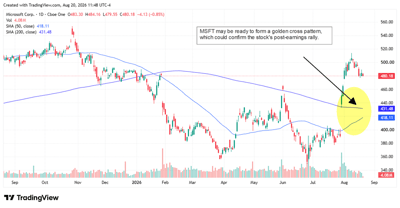
Zoom out on the chart, and the sell-off looks less like a breakdown and more like digestion after a sharp recovery. Microsoft's 50-day moving average sits at $418.11, still below the 200-day at $431.48, but the gap has narrowed sharply since the stock's April lows near $345.
If the 50-day continues climbing at its current pace, a golden cross—the 50-day moving above the 200-day—is a realistic setup over the coming weeks. That crossover doesn't guarantee anything on its own, but it typically confirms an intermediate-term trend shift rather than just a headline-driven price bounce.
Just as important, this week's pullback found support right around the $480 level, which had acted as resistance in June and July. Old resistance becoming new support is a classic technical signal that the breakout above it was rooted in real demand.
Microsoft's Pullback Could Give Investors a Second Chance
Investors who sat out Microsoft's April-to-August recovery watched the stock nearly double off its lows and understandably felt like they'd missed the move. A stock that runs hard without you creates a very human urge to wait for the next dip, only to talk yourself out of buying it when the dip arrives because the headlines sound worse than they did during the run.
This week is that dip. The business didn't get worse between last Thursday and today. Azure demand still exceeds supply. The backlog is still growing faster than the stock can price it in. The CapEx concerns are real, but they belong to the entire hyperscaler cohort, not to Microsoft alone.
This email content is a paid sponsorship provided by Monument Traders Alliance, a third-party advertiser of InsiderTrades.com and MarketBeat.
This ad is sent on behalf of The Oxford Club. 105 W Monument St, Baltimore, Maryland 21201. If you would like to optout from receiving offers from The Oxford Club please click here
If you need help with your newsletter, please contact MarketBeat's U.S. based support team at [email protected].
If you no longer wish to receive email from InsiderTrades.com, you can unsubscribe.
© 2006-2026 MarketBeat Media, LLC. All rights protected.
345 N Reid Place, Suite 620, Sioux Falls, S.D. 57103. USA..