Over the past year, his managers executed more than 20,000 stock transactions.
CNN ran the whole list against his Truth Social feed and found at least 44 purchases across 21 companies – bought within a week of him publicly praising those exact companies, their products, or their CEOs:
Intel up 307%
Dell up 271%
AMD up 201%
Micron up 134%
GE Aerospace up 96%
Nvidia up 91%
The White House says the President’s account is in a third-party trust and he has no idea what's being bought. Maybe that's true. And maybe Jeffrey Epstein did kill himself. And maybe the sun will rise in the West tomorrow.
It isn't coincidence and it isn't corruption either.
These companies are all connected to a new economic and political doctrine – a playbook this administration has secretly adopted and that I believe is about to change everything in America
How you work, transact, save, and invest is all being fundamentally shifted as this new doctrine replaces the ideals of our Founding Fathers and unless you know what it means… you’ll be caught off guard.
Once you see the list, however, you know exactly where the money is going next.
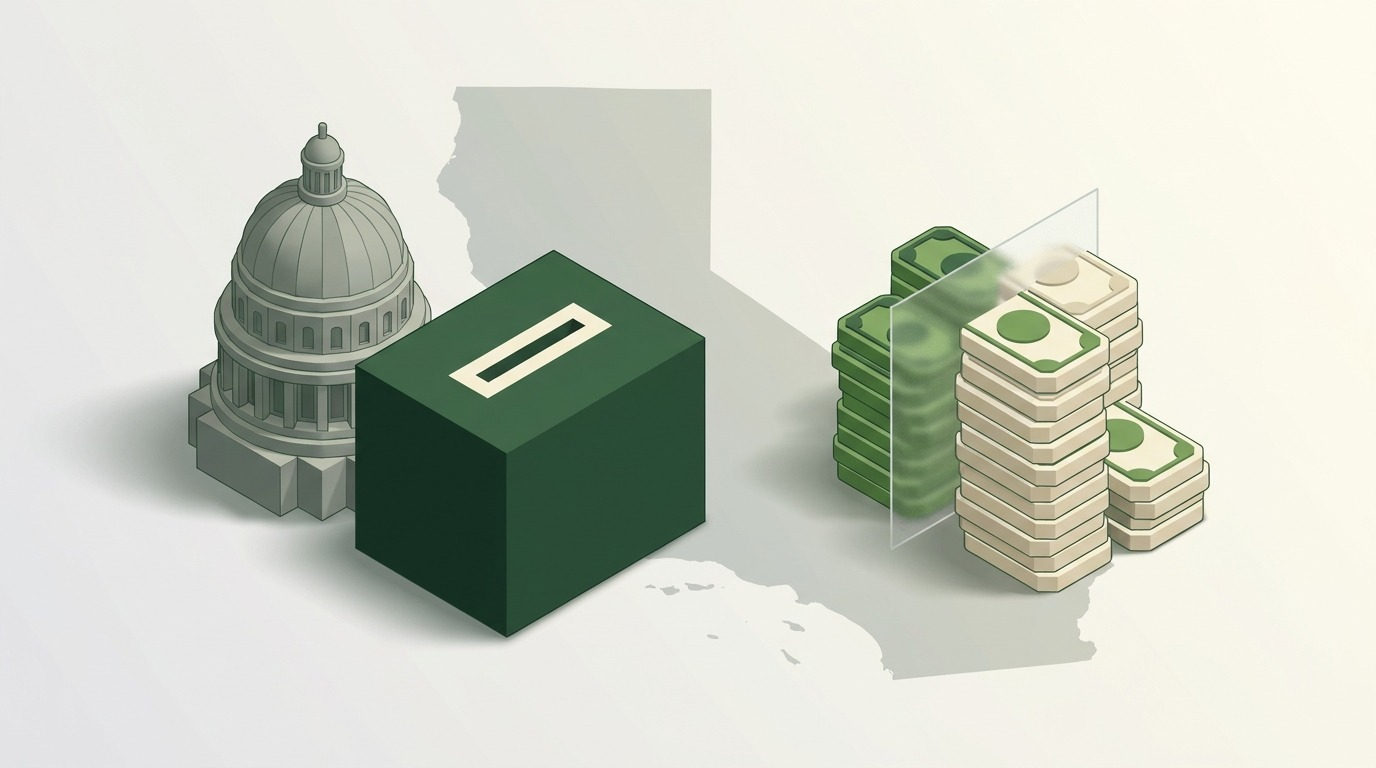
California's Proposition 40 is a combined constitutional amendment and state statute set to appear on the state's Nov. 3, 2026 ballot. If voters approve it, California's billionaires would pay a one-time 5% tax on their accumulated wealth, with the revenue directed mostly toward state healthcare programs, along with smaller shares for food assistance and public education.
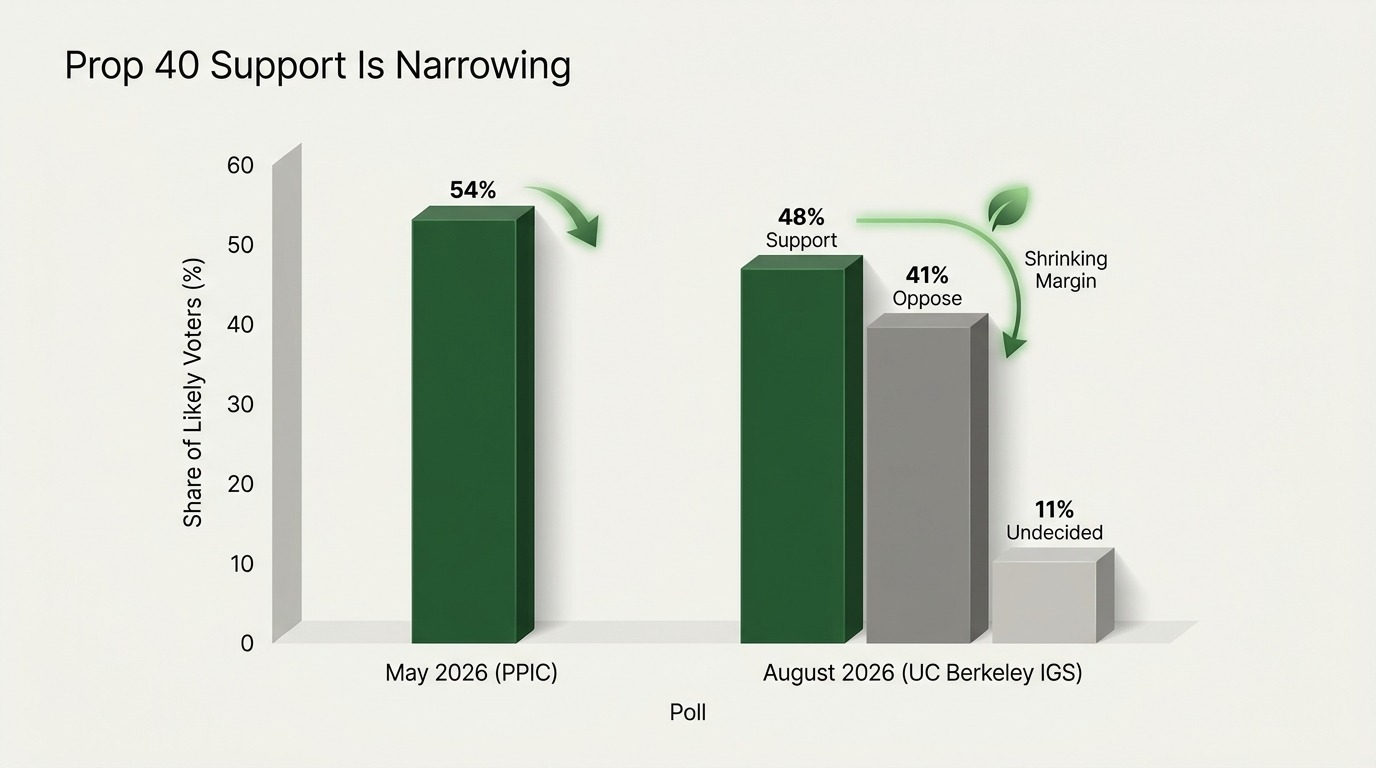
A new poll from the University of California, Berkeley's Institute of Governmental Studies, released Aug. 17, found 48% of likely voters supporting the measure and 41% opposed, with 11% still undecided. That represents a narrowing from a Public Policy Institute of California poll conducted May 14-18, which had found 54% support, including 76% support among Democrats.
The UC Berkeley poll also found that 72% of voters say they have already heard of the initiative — a notably high awareness figure for the middle of summer, well before the kind of campaign advertising that typically dominates the weeks before a general election. That level of early recognition typically reflects sustained news coverage and advocacy-group messaging rather than paid campaign advertising, which for most ballot measures does not ramp up in earnest until closer to Labor Day.
Why It Matters
A Familiar Partisan Divide, Tightening
The polling breaks down largely along familiar partisan lines. Democrats and self-described liberals back Proposition 40 by wide margins, while Republicans and conservatives are strongly opposed, according to both polls. What has changed between May and August is not the direction of that split but its size — the six-point drop in overall support suggests that some voters in the middle, or some Democrats who initially leaned supportive, have moved toward opposition or undecided as the measure has gotten more attention.
A ballot measure that most voters have already heard of by mid-summer has already survived its easiest phase — the fight over the undecided is what's left.
That fight matters because of who the tax targets and how visible those targets are in California specifically. The state is home to a concentrated share of the country's technology and venture-capital wealth, meaning any framing battle over Proposition 40 will inevitably become a referendum on how voters view that particular slice of the ultra-wealthy, not billionaires in the abstract. A one-time 5% levy sounds narrow on paper, but the campaign fight over it is likely to turn on broader arguments about whether concentrated wealth in the state should be taxed differently at all — an argument that tends to harden existing positions rather than move persuadable voters, at least in a campaign's early innings. Because the tax is structured as one-time rather than recurring, supporters can frame it as a limited, one-off measure tied to a specific funding need, while opponents can just as easily frame any one-time wealth tax as a precedent that later becomes permanent — both framings can be argued from the same ballot language.
By The Numbers
What Happened
What It Means
What's on the Ballot
A one-time 5% wealth tax on California billionaires, mostly funding state healthcare programs.
August 2026 Poll (UC Berkeley IGS)
48% support, 41% opposed, 11% undecided among likely voters.
May 2026 Poll (PPIC)
54% support, including 76% among Democrats — support has since narrowed by 6 points.
Voter Awareness
72% of voters say they've already heard of the initiative, unusually high for mid-summer.
Support for Proposition 40 has narrowed from 54% in May to 48% in August, with opposition and undecided voters both growing.
Reader Question
California's Proposition 40 would impose a one-time 5% wealth tax on the state's billionaires to help fund healthcare, food assistance and education, and its support has narrowed from 54% in May to 48% in August. Do you support a targeted, one-time wealth tax on billionaires to fund public programs, or do you think it sets a troubling precedent for how wealth gets taxed going forward?
Hit reply — one line is enough.
What to Watch Next
What Could Move the Needle Before November
Money is the first thing to watch. Ballot measures of this size typically draw heavy outside spending from both proponents — often labor and healthcare-advocacy groups, given where the revenue would go — and opponents, frequently business associations and individuals who would be directly subject to the tax. How much each side spends, and how early, will shape whether the current 11% undecided bloc breaks toward support or opposition.
The next test will be whether additional polling through September and October shows the gap continuing to narrow or stabilizing near its current level. A measure sitting at 48%-41% with 11% undecided is not a settled outcome in either direction — ballot measures on tax policy have historically been vulnerable to erosion in support as a campaign progresses and opposition spending increases, a pattern this measure would need to buck to pass in November. California's own ballot-measure history includes examples of tax initiatives that polled comfortably ahead in summer surveys only to finish much closer, or to fail outright, once general-election advertising began in earnest — a comparison worth keeping in mind given how far Proposition 40's support has already moved before that phase of the campaign has even started.
What to Watch Next
1 · Independent Expenditure Filings
Disclosures of spending by both campaigns will show how much financial firepower is being deployed to move the remaining undecided voters.
2 · September/October Polling
Additional polls will show whether support keeps narrowing toward a toss-up or stabilizes near the current 48%-41% split.
3 · National Attention on Similar Measures
Other states weighing wealth-tax proposals may look to California's result as an early signal of what a targeted billionaire tax can achieve at the ballot box.
The Bottom Line
Proposition 40 remains ahead in the polls, but its lead has narrowed by six points in three months, and a measure sitting at 48% support with 11% still undecided has real room to move in either direction before November.
Because the measure targets a small, highly visible group of California residents concentrated in the technology and venture-capital world, the campaign fight ahead is likely to be less about the specific 5% number and more about broader arguments over how the state should treat concentrated wealth — an argument that tends to entrench existing views rather than persuade new ones. High voter awareness this early suggests both sides have already begun shaping that argument, well before the traditional fall campaign season.
The undecided 11% of voters, not the current partisan divide, will determine whether California becomes the first state to pass a targeted billionaire wealth tax at the ballot box.
One More Question
Most readers of this newsletter are not California billionaires, but ballot measures like this one often become templates other states study closely, and the healthcare and public-program funding at stake would touch millions of residents regardless of income level. If a similar wealth-tax measure appeared on the ballot where you live, would the funding it promised change your vote, or would the precedent concern you more?
TraderInsightMedia.com brought to you by Media One Marketing LLC. This editorial email with educational news was sent to [email protected].
Please add our email address to your contact book (or mark as important) to guarantee that our emails continue to reach your inbox.
Thank you for your comments and inquiries, which are greatly appreciated by Media One Marketing LLC.
Please note that we are unable to provide personalized financial advice. This email does not constitute financial advice, and any investment decisions you make are solely your own responsibility.
Having trouble with the unsubscribe link? Just reply to this email with “Unsubscribe,” and we’ll take care of it. If you have a moment, tell us what you didn’t like — your feedback would be very helpful to our team.