

|
|
|
Q&A WITH THE TEAM IN DRC
As the Ebola outbreak approaches the three-month mark since it was officially declared in the Democratic Republic of Congo, it has become the second largest on record, with more than 4,500 confirmed cases and over 2,100 deaths. These numbers signal that the systems and trust needed to contain this virus are being pushed to their limits. Two Mercy Corps leaders closest to the response share what they are seeing and what it will take to stop this outbreak. Onesphore Bangenza is Mercy Corps’ Ebola Response Team Leader, based in Bunia, at the epicenter of the outbreak. Rose Tchwenko is Mercy Corps’ Country Director for DRC, overseeing the full response. Q: What is it like on the ground right now in Bunia? Onesphore: "What we are seeing now feels very familiar from 2018, only this time we are working in a more constrained response environment. We are still hearing from some people who do not believe Ebola is a disease, or who believe it can be treated through prayer or traditional medicine rather than medical care. That kind of delay is dangerous." Rose: "The question is not whether DRC can fight Ebola. It can, and it has. The country has faced Ebola before — but this time is different. Ebola is landing in a humanitarian response already forced to prioritize the most urgent needs. Health workers are being asked to do more with less. Gaps in water and sanitation infrastructure are making prevention harder. Communities already pushed to the brink by hunger, conflict, and displacement are now facing this too. After 18 months of drastic cuts, the aid system is still reeling." Q: What is Mercy Corps doing differently this time? Onesphore: "The lesson from 2018 is that communities do not change because they are told once what to do. They change when people they trust are part of the response. In 2018, survivors speaking on local radio helped people believe that Ebola was real — because they were hearing from people who had been sick, received care, and survived. That is still true now. Local leaders, religious leaders, women and youth groups, local health workers, transport workers, and survivors can help families seek care early and accept safe burial without feeling their dignity has been taken away."
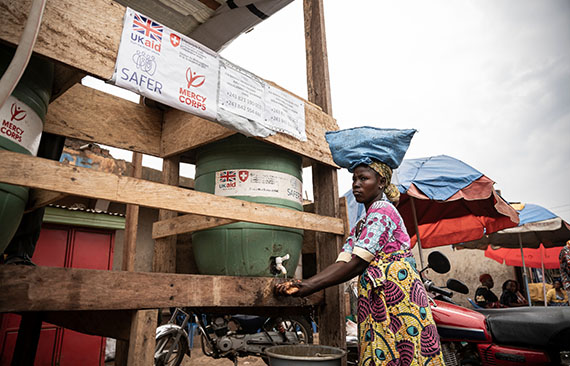
July 2026, Bunia, Democratic Republic of the Congo (DRC). A woman washes her hands at a hand‑washing station as part of efforts to prevent the spread of the Ebola virus disease in Bunia province of Ituri, epicenter of the outbreak in Eastern Democratic Republic of Congo.
Rose: "Preparedness is more than a stockpile, a lab test, or a response plan. It is the trust between health workers and families seeking care, between local leaders and community members, and between a survivor’s testimony and someone afraid to seek care. When those relationships are strong, the response moves faster. When they are weak, fear fills the gap — and Ebola gets more time to spread." Q: What do you need from donors and the global community right now? Rose: "Donors and response partners must fund the full chain of containment. That means fast, flexible support for frontline health workers, surveillance, testing, contact tracing, infection prevention, clean water, safe access, local responders, and community engagement to rebuild trust and restore confidence. Underfunding one pillar of the response slows progress in every pillar." Onesphore: "In an outbreak where we still do not fully know how far the virus has spread, losing trust means losing time. And losing time gives the virus more room to spread." Mercy Corps has worked in DRC since 2007, supporting communities by improving access to clean water, strengthening livelihoods, promoting good governance, and enhancing emergency response. Today, our Ebola response in Bunia and surrounding areas reaches health facilities, schools, markets, and transport hubs — the places where transmission risk meets daily life. With gratitude, The Mercy Corps Team
|
|
||||||||||