| Unsubscribe |
Dear Reader,
If watching the frenzy around SpaceX left you thinking, 'Why did nobody show me a way in earlier?'... read this carefully.
History may be preparing to repeat itself.
The company is Anthropic, creator of Claude.
I am revealing that name because the REAL secret is not the company anymore.
Look at what is happening before the public listing even arrives.
CNBC reports that Riot Platforms has struck a 20-year agreement tied to Anthropic for 191 megawatts of data-center capacity. Reported value: $9.1 billion.
Money this large does not wait for the public to catch up.
Meanwhile, regular investors are being trained to wait.
Wait for the IPO filing. Wait for the television coverage. Wait for every broker, commentator and social-media account to scream the same name.
That is exactly when popularity becomes your enemy.
I refuse to wait for the stampede.
I found a publicly accessible vehicle that lists Anthropic as its largest holding, according to the promotion research. It is available through a regular brokerage and does not require accredited-investor status.
No one can promise Anthropic goes public on a specific date.
But I can tell you this:
If Anthropic becomes the next private-company obsession, waiting until everybody knows the ticker defeats the entire point of getting there early.
The window is open now. I do not expect it to stay quiet forever.
LEARN ABOUT THE BACKDOOR ANTHROPIC ACCESS
Good investing,
Alexander Green
Chief Investment Strategist, The Oxford Club
P.S. The crowd did not ignore SpaceX; it arrived too late to get easy access.
RIOT Platforms $9.1 billion deal with Anthropic is an infrastructure signal that the next frenzy may already be forming.
You can wait for everyone else to discover the backdoor, or you can move first.
Why Analysts Are Bullish on a Stock That's Down 20%
Reported by Chris Markoch. Published: 8/6/2026.
Key Points
- Booking Holdings shares rose 6% after Q2 2026 earnings beat estimates on revenue, EPS and adjusted EBITDA despite softer Q3 guidance.
- Room night growth slowed to 5% in Q2 and is guided to just 3% to 5% in Q3, partly due to Middle East conflict effects on travel.
- BKNG's RSI near 69 suggests the stock is approaching overbought territory after its sharp post-earnings rally.
- Special Report: Forget SpaceX. Buy the company Musk can't replace.
Booking Holdings Inc. (NASDAQ: BKNG) was recently down 20% in 2026. However, BKNG has been climbing steadily from a base that formed in May, and the company’s latest earnings report is helping sustain that momentum.
Soft Guidance, But Growth Remains Intact
BKNG rose 6% the day after the company delivered its Q2 2026 earnings report.
Small Colorado Company (Backed by Sam Altman) Could Save U.S. Power Grid (Ad)
A small Colorado company has secured rights to technology that could prevent the U.S. public power grid from collapsing — and billionaire Sam Altman is now an investor.
This under-the-radar firm is drawing serious attention from those watching the energy infrastructure space closely.
Click here to learn this company's name for free todayThe company beat expectations on both the top and bottom lines, confirming strong travel demand during the quarter. Forward guidance was cautious, but it requires context.
The company guided to Q3 revenue of $9.4 billion to $9.55 billion, below analysts’ estimates of $9.71 billion.
However, even at the low end, that range would represent a 3.9% year-over-year (YOY) increase.
Booking's Q2 Earnings Show Travel Demand Remains Strong
Revenue came in at $7.35 billion, up 8% YOY and above the high end of the company’s own 4% to 6% guidance range. Gross bookings grew 9% to $51 billion, driven by 5% room-night growth and an approximately 2% lift from constant-currency average daily rates. Adjusted earnings per share (EPS) of $2.54 topped analyst estimates and marked a 15% increase from the year-ago quarter.
Adjusted EBITDA rose 9% to $2.65 billion, outpacing revenue growth because of leverage across fixed operating expenses. Free cash flow of $3.6 billion was up 16% YOY, and the company returned a record $4.1 billion to shareholders through buybacks and dividends.
Margin Expansion Helps Offset Softer Revenue Guidance
Guidance may have come in below consensus, but the company’s underlying profitability is arguably the more important story for investors. Adjusted EBITDA grew 9% in the quarter, outpacing 8% revenue growth. The primary reason was that adjusted fixed operating expenses grew just 6%, slower than the top line.
Management also raised its expected annual run-rate savings from its ongoing Transformation Program, increasing the target from roughly $550 million to $650 million. That suggests the company sees additional room to cut costs even as it continues to invest in AI and mobile.
Capital returns reinforced that discipline. Booking returned $4.1 billion to shareholders during the quarter, a company record, including $3.7 billion in buybacks and $0.3 billion in dividends. Free cash flow of $3.6 billion was up 16% year-over-year, giving the company ample room to continue repurchasing shares aggressively.
Slowing Room-Night Growth Keeps the Bear Case Alive
None of this erases the deceleration visible in the underlying numbers. Room-night growth slowed to 5% in Q2, down from 6% in Q1 and 9% a year ago. Management attributed part of that softness to the ongoing conflict in the Middle East, which continues to weigh on long-haul international travel demand.
Q3 guidance calls for room-night growth of just 3% to 5%, the lowest range the company has posted in recent memory. That is the part of the story that may be getting glossed over. A stock that traded down 20% for a reason does not necessarily deserve a full reversal after just one quarter.
There’s another angle worth considering. Much of the post-earnings pop looks less like genuine excitement and more like relief that the results weren’t worse. Expectations had been lowered so significantly that a modest beat, paired with a cautious but not disastrous outlook, was enough to trigger a rally. That is different from a stock re-rating driven by renewed conviction in the growth story.
Booking's Results Don't Tell the Whole Travel Story
The BKNG results aren’t necessarily an industry-wide story. Investors may recall that in its last quarter, Trip.com Group (NASDAQ: TCOM) delivered mixed results and tumbled by as much as 18%. Like Booking, Trip.com offered soft guidance for the current quarter.
Bulls could counter by noting that TCOM was up more than 13% in the 30 days ending Aug. 5. That could indicate that institutions anticipated Booking’s results and believe Trip.com will post similar results in August.
BKNG Stock Nears Overbought Level After Earnings Rally
From a technical perspective, the sharp rally raises the risk of a near-term pullback. BKNG’s 14-day relative strength index (RSI) sits at about 69, just below the traditional overbought threshold of 70. Momentum indicators such as RSI tend to mean-revert once they enter that zone, and BKNG has approached it several times over the past year without sustaining a breakout above it.
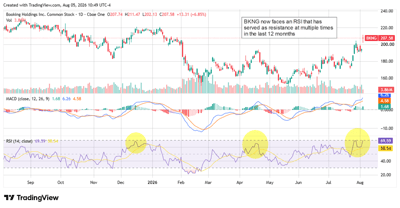
This does not necessarily mean the rally is over. However, it suggests that some near-term consolidation—or even a modest giveback of the post-earnings gains—would not be surprising, given how far and how quickly the stock has moved.
Can Booking Holdings Stock Extend Its Post-Earnings Rally?
Booking’s Q2 report didn’t change the long-term travel-demand story. It did change the market’s view of how bad conditions actually were. The stock’s 20% decline through late June reflected significant pessimism surrounding the Middle East conflict, slowing room-night growth and softer long-haul travel.
Tuesday’s results suggest that pessimism was overdone, at least for now. Whether that view holds through Q3, with room-night growth guided as low as 3%, will be the real test of whether this rally has staying power or is simply a relief rally that runs out of room.
Tesla's Robotaxi Reality Check: Time to Deliver
Reported by Jeffrey Neal Johnson. Published: 8/12/2026.

Key Points
- Tesla's automotive margins have compressed to 1.4% amid price cuts, pushing quarterly free cash flow negative to $1.09 billion as capital expenditures exceed $25 billion annually.
- Tesla's valuation, trading at over 300 times trailing earnings, now hinges on Robotaxi deployment data proving unit economics near 81 cents per mile.
- Options market signals caution with a 1.18 put-to-call ratio and elevated implied volatility, while roughly 70 million shares remain sold short amid regulatory scrutiny.
- Special Report: Forget SpaceX. Buy the company Musk can't replace.
The market is watching an industrial sector powerhouse attempt to rewrite its fundamental DNA in real time. Tesla, Inc. (NASDAQ: TSLA) is aggressively pivoting from a traditional electric vehicle manufacturer into an autonomous mobility and AI network. This ambitious transition comes with an immediate financial reckoning. With full-year capital expenditures tracking above $25 billion, quarterly free cash flow recently turned negative, reaching $1.09 billion.
Strip away the futuristic narrative, and Tesla's core automotive business is facing severe pressure. Price reductions across key global markets continue to squeeze profitability.
Small Colorado Company (Backed by Sam Altman) Could Save U.S. Power Grid (Ad)
A small Colorado company has secured rights to technology that could prevent the U.S. public power grid from collapsing — and billionaire Sam Altman is now an investor.
This under-the-radar firm is drawing serious attention from those watching the energy infrastructure space closely.
Click here to learn this company's name for free todayOperating margins compressed to a razor-thin 1.4% during the second quarter of 2026, while adjusted EBITDA came in at approximately $3.27 billion. Adjusted earnings reached 33 cents per share, missing Wall Street expectations, even as top-line quarterly revenue showed resilience at approximately $28.24 billion.
What does a 1.4% operating margin mean for a heavy manufacturing operation? It leaves almost no room for error. Unit-volume growth is no longer sufficient to preserve net margins or returns on equity. The entire valuation thesis now rests almost entirely on software monetization and progress in physical AI. Tesla is actively decommissioning traditional assembly lines at its Fremont facility to build dedicated Optimus robotics lines while funneling billions into Gigafactory Texas for Cybercab tooling.
Wall Street Demands Proof of the Robotaxi Flywheel
High-conviction institutional investors demand concrete operational proof points rather than forward-looking guidance. Morgan Stanley (NYSE: MS) recently issued notes highlighting that long-term institutional confidence hinges on tangible progress in the Robotaxi division. The market needs to see actual vehicle deployment density in active metropolitan areas and exponential growth in unsupervised driverless miles.
The ultimate goal is to demonstrate the unit economics of the Robotaxi network, targeting an operating cost of approximately 81 cents per mile.
If Tesla hits or beats this metric, its high valuation multiple could be justified by the sheer scale of the global transportation market. If deployment data fails to demonstrate scalable cash flow, the narrative premium built into the stock could begin to evaporate.
There is a highly lucrative bright spot in the current software transition. Full Self-Driving attach rates on new North American deliveries reached approximately 55%, significantly outpacing early Wall Street projections. Converting these software subscriptions into high-margin driverless mobility remains the central hurdle, but this level of consumer adoption proves that direct-to-consumer software monetization is accelerating.
Software revenue carries exceptionally high margins, which is exactly the lifeline the balance sheet needs to offset the brutal physical electric vehicle price war. The current environment presents a race against the clock. Tesla needs to scale its higher-margin software revenue fast enough to bridge the gap left by falling automotive profits.
Energy Storage Offers a Much-Needed Revenue Buffer
While automotive margins are in decline, the commercial energy storage division continues to scale as a vital secondary growth driver. The Megapack business provides a non-automotive revenue stream that helps offset the elevated capital expenditures required for AI.
Commercial execution was recently highlighted by SpaceX's (NASDAQ: SPCX) purchase of approximately $300 million in Megapacks to supply power for dedicated data center infrastructure. This internal cooperation showcases a broader blueprint for meeting AI data center energy demand, demonstrating that Tesla has viable, high-margin revenue streams beyond selling consumer vehicles. Energy generation and storage now represent critical stabilizers for the bottom line, helping keep the autonomous dream funded while the core auto segment fights a grueling war of attrition.
A 300x Multiple Teeters on Deployment Metrics
Trading at more than 300 times trailing earnings, Tesla's valuation assumes substantial future cash flows from high-margin software revenues. For context, legacy automakers generally trade at single-digit multiples. This valuation gap creates a highly volatile, data-dependent environment. If upcoming Robotaxi operational data fails to confirm scalable unit economics, the stock could face a severe downward re-rating toward a multiple more typical of the automotive sector.
The options market reflects this exact vulnerability. Options positioning for Tesla leans heavily toward downside protection, with a put-to-call ratio near 1.18. Traders currently hold significantly more put contracts—used to bet on or protect against a price drop—than call contracts. The options' max-pain level is anchored around $320. Max pain is the price at which the most options contracts expire worthless, and it often acts as a magnetic anchor for the stock price as expiration approaches. Thirty-day implied volatility remains elevated at nearly 44%, suggesting that market makers are pricing in severe price swings ahead.
Short interest currently sits at roughly 70 million shares, representing nearly 3% of the available float. While some short covering occurred recently, this level of bearish betting indicates that a well-capitalized portion of the market expects the autonomous pivot to stumble over regulatory or manufacturing hurdles. The National Highway Traffic Safety Administration recently initiated recalls and preliminary investigations concerning potential suspension safety issues, adding regulatory friction to the operational headwinds.
The Autonomy Gamble Reaches Its Tipping Point
The transition from bending metal to deploying scalable artificial intelligence requires unparalleled capital. Expanding commercial Robotaxi operations across a dozen target states by year-end could burn cash rapidly. The market is currently forgiving the negative free cash flow because it believes in the autonomous payoff.
Upcoming deployment data will likely act as a binary valuation trigger. Strong data confirming the 81-cent-per-mile unit economics could force short sellers to cover and validate Tesla's high price-to-earnings multiple. Weak data could strip away the technology premium, leaving Tesla priced as a struggling automaker fighting for market share in a fierce price war.
Investors holding long positions might consider maintaining their exposure while closely monitoring the rollout density and unit economics of the Cybercab fleet. Those looking to deploy new capital may prefer to wait for clear cash flow metrics from the autonomous network before taking a heavy position.
Given the high implied volatility, options traders could find strategic opportunities by hedging against sudden downside re-ratings while keeping upside exposure open for potential deployment breakthroughs. The next few quarters will determine whether Tesla secures its future as a dominant software network or faces a harsh reversion to automotive realities.
This message is a sponsored email provided by The Oxford Club, a third-party advertiser of Earnings360 and MarketBeat.
This ad is sent on behalf of The Oxford Club. 105 W Monument St, Baltimore, Maryland 21201. If you would like to optout from receiving offers from The Oxford Club please click here
If you have questions or concerns about your newsletter, don't hesitate to email MarketBeat's South Dakota based support team at [email protected].
If you no longer wish to receive email from Earnings360, you can unsubscribe.
Copyright 2006-2026 MarketBeat Media, LLC. All rights protected.
345 N Reid Place #620, Sioux Falls, S.D. 57103. U.S.A..