If you have $500,000 in a 401(k), this matters.
Most people move their retirement money the default way.
They request a check.
And that’s where the problem starts.
Because having an eligible 401(k) distribution paid directly to you can mean:
- $100,000 automatically withheld
- A 60-day rollover clock
- A potential tax bill — and possibly an additional 10% tax
What many retirees don’t realize is that retirement funds may be moved differently.
With a properly completed direct rollover, eligible funds can move from a 401(k), IRA, or TSP directly into a Gold IRA – without the mandatory 20% withholding that generally applies when an eligible employer-plan distribution is paid to you.
But timing matters.
Once the check is made payable to you, the 60-day clock starts ticking.
Cedar Gold Group created a free guide explaining:
- The #1 rollover tax trap
- Why $100,000 could be withheld from a $500,000 distribution
- How to move eligible retirement funds into physical gold correctly
Download your FREE Wealth Protection Playbook here.
Because the most expensive rollover mistake…
May happen before the check even reaches you. | | | |
|
|
Today's Market Update For You |
Goldman Just Pushed the Next Fed Rate Cut to 2027 |
Quick Take | The Quick Take The Federal Reserve held its benchmark rate at 3.50%-3.75% on July 29, the fifth straight meeting without a change. Three regional Fed presidents dissented in favor of raising rates instead — the first three-way hawkish dissent since September 2016. Goldman Sachs has pushed its forecast for the next rate cuts to June and December 2027, giving that scenario only a 30% probability. July's Consumer Price Index rose 3.4% from a year earlier, still well above the Fed's 2% target — the reason the three dissenters cited for wanting a hike. | | |
Elon Musk Drops Bombshell During SpaceX Earnings Call |
Body | What Happened A Fifth Hold, and a Rare Hawkish Split On July 29, the Federal Open Market Committee — the Federal Reserve's rate-setting group, known as the FOMC — voted 9-3 to hold the federal funds rate at a target range of 3.50% to 3.75%. It was the fifth consecutive meeting without a change, extending a pause that has now run for most of the year. The notable part of the vote was not the hold itself but the dissent. Three regional Federal Reserve Bank presidents — Beth Hammack of Cleveland, Neel Kashkari of Minneapolis and Lorie Logan of Dallas — voted against holding rates, but not in the direction dissents usually take. All three wanted to raise the target range by a quarter of a percentage point instead of leaving it unchanged. A three-person dissent in favor of a hike had not happened since September 2016, according to the Fed's own meeting records. The dissenters' stated reasoning centered on inflation. The Consumer Price Index rose 3.4% year over year in July, according to the Bureau of Labor Statistics — still well above the Fed's 2% target, and part of a stretch of above-target readings that has now run for more than five years. Core inflation, which strips out volatile food and energy prices, rose 0.2% for the month and 2.5% over the year; shelter costs alone, up 0.1% in July, accounted for roughly two-thirds of the monthly increase in the broader index. For three sitting regional presidents, that combination was reason enough to argue for tightening policy further rather than waiting for more data. | | Why It Matters Wall Street Moves Its Own Timeline The hawkish dissent landed alongside a separate signal, this one from Wall Street rather than the Fed itself. Goldman Sachs has pushed back its forecast for the next Federal Reserve rate cuts to June and December 2027 — well beyond the 2026 timeline many investors were pricing in earlier this year. The bank now assigns only a 30% probability to that two-cut scenario, down from 40% previously, and has doubled its own estimate of the odds of a rate hike to 20%, up from 10%. | | Goldman Sachs chief U.S. economist David Mericle said a rate hike remains unlikely because inflation appears "less likely to become self-sustaining" than it did earlier this year — even as the bank raised its own odds of that very outcome. That combination — a hawkish dissent inside the Fed alongside a major bank pushing its own cut forecast out by roughly a year — describes a policy path with a genuinely wide range of outcomes, not a settled one. Separately, prediction markets have shown elevated odds that 2026 ends with no rate cuts at all, a read that lines up with Goldman's own repositioning even though the bank stops short of naming a hike its base case. The disagreement is not just about direction; it is about how much weight to put on five-plus years of above-target inflation versus the risk of slowing the economy further than necessary. | | By The Numbers | What Happened | What It Means |
|---|
| July 29 FOMC Vote | 9-3 to hold rates at 3.50%-3.75%; three presidents dissented in favor of a hike. | | Dissenting Presidents | Beth Hammack (Cleveland), Neel Kashkari (Minneapolis), Lorie Logan (Dallas) — the first three-way hawkish dissent since 2016. | | Goldman's Revised Forecast | Next rate cuts pushed to June and December 2027, with only 30% odds assigned to that scenario. | | July CPI | Up 3.4% year over year, still well above the Fed's 2% target. | | 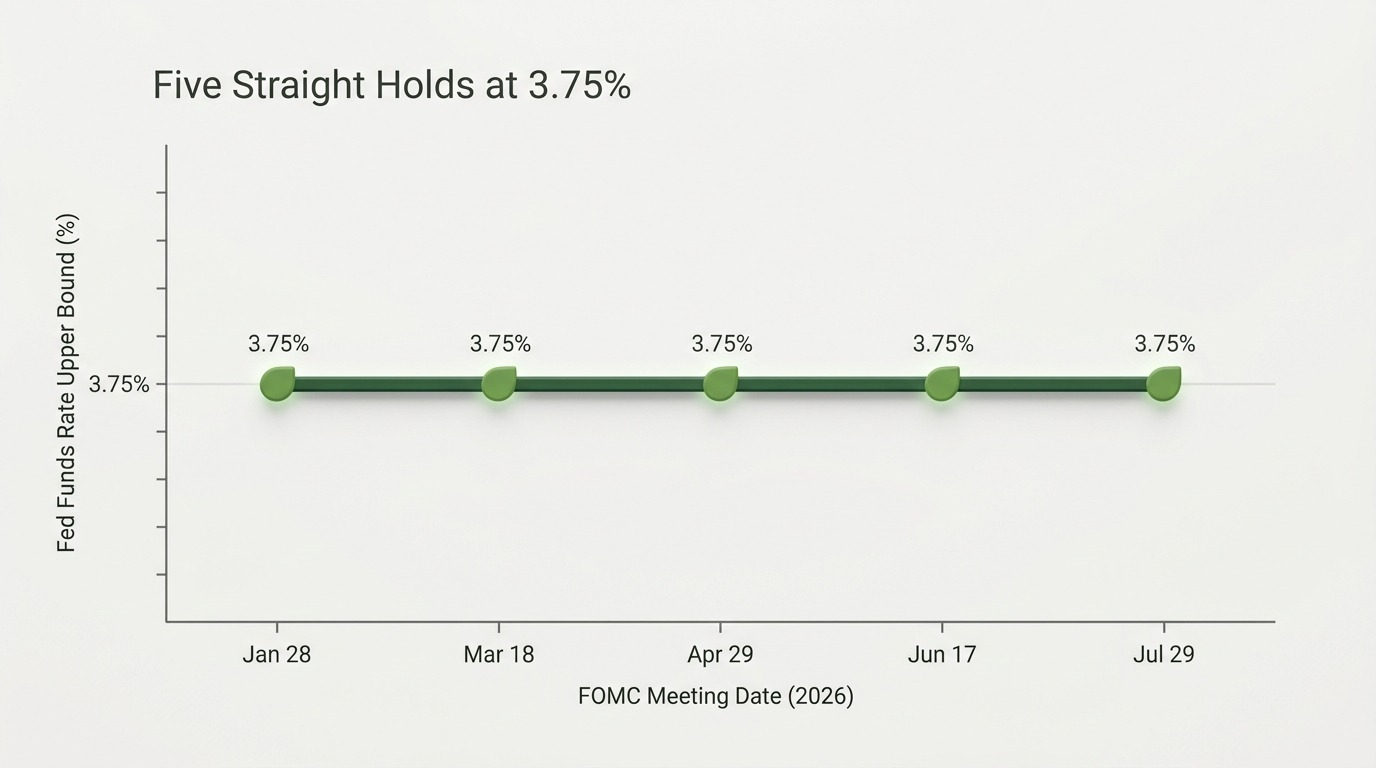 The federal funds rate has held at the same 3.75% upper bound for five straight FOMC meetings this year. | | Reader Question Three Federal Reserve presidents just went on record wanting to raise interest rates rather than hold them, arguing that inflation running above 3% for this long is a bigger risk than slowing the economy further. Do you think the Fed should be raising rates to bring inflation down faster, or holding steady to avoid tipping the economy into a slowdown? Hit reply — one line is enough. | | What to Watch Next The Next Two Data Points That Matter The next FOMC meeting is scheduled for Sept. 15-16, and it is one of four meetings this year that comes with an updated Summary of Economic Projections — the Fed's own dot plot of where individual officials expect rates to go. That update, more than any single official's public remarks between now and then, will be the clearest signal of whether this meeting's hawkish dissent was a one-time event or the start of a broader shift within the committee. Before that meeting, the Bureau of Labor Statistics is scheduled to release its August CPI report on Sept. 11. Because this year's dissent was explicitly built on inflation running too hot for too long, another reading above 3% would likely reinforce the case the three dissenting presidents already made. A meaningful cooldown, on the other hand, would give the committee's majority more room to hold its current position without further internal pushback. Shelter costs, which have driven most of the recent monthly increases, are the single line item most worth tracking in that report, since a slowdown there would do more to ease the committee's inflation concerns than movement in any other category. | | What to Watch Next 1 · September FOMC Meeting (Sept. 15-16) Comes with an updated dot plot — the clearest read on whether more officials are leaning toward the dissenters' hawkish view. 2 · August CPI Report (Sept. 11) A reading above 3% would reinforce the case for holding or hiking; a cooldown would ease pressure on the committee's majority. 3 · Additional Hawkish Dissents A repeat dissent in September from the same three presidents, or a fourth joining them, would be a stronger signal than this meeting alone. | | The Bottom Line A fifth consecutive hold was, by itself, unremarkable. A three-person hawkish dissent — the first since 2016 — signals real disagreement inside the Fed over whether current policy is tight enough to finish the job on inflation. Goldman's decision to push its own rate-cut forecast out to 2027, while separately raising the odds it assigns to a hike, shows that Wall Street is now treating higher-for-longer as the more likely path rather than a tail risk to hedge against. That is a meaningful shift from where consensus expectations sat earlier this year, when a 2026 cut was still the base case for many forecasters. The September dot plot, not any single official's comments between now and then, will show whether this meeting's hawkish dissent was an outlier or the start of a broader shift. | | One More Question Higher-for-longer interest rates affect more than the stock market — they keep mortgage rates, credit card rates and savings account yields anchored where they are for longer than many households were planning around. If the next rate cut really is pushed out to 2027, would that change any borrowing or saving decision on your calendar this year? Andrew reads every reply. | | |
|
|
2026-08-03 23:21:43 +00:00 IMG2408_605 - 18.08 (1N) 19458205 25456408 82167 102067 [2432440, 6943000] |
|
|
|