
| From | American Enterprise Institute <[email protected]> |
| Subject | Understanding the $1.5 Trillion Defense Pivot |
| Date | August 15, 2026 11:15 AM |
Links have been removed from this email. Learn more in the FAQ.
Links have been removed from this email. Learn more in the FAQ.
AEI's weekly digest of top commentary and scholarship on the issues that matter most
AEI This Week
AEI's weekly digest of top commentary and scholarship on the issues that matter most
TRANSFORMING DEFENSE
Understanding the $1.5 Trillion Defense Pivot
August 15, 2026
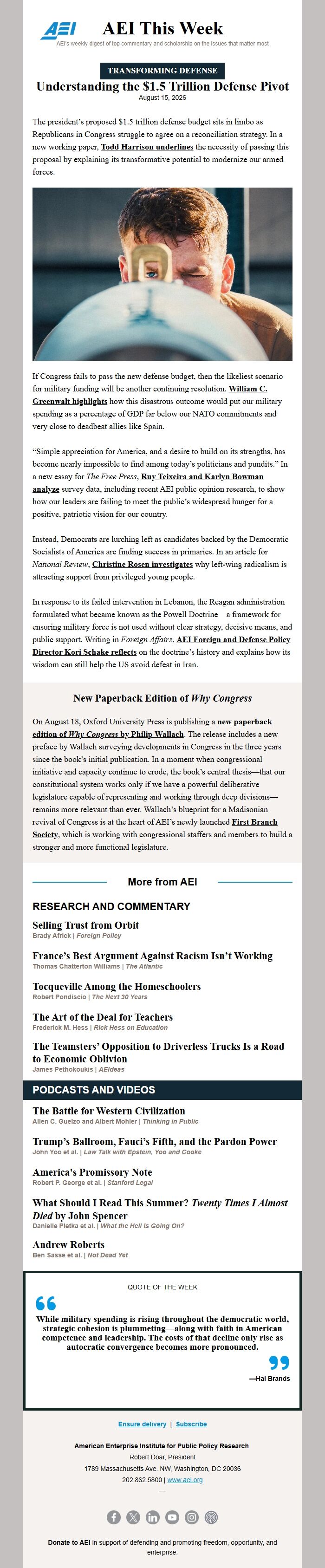
The president’s proposed $1.5 trillion defense budget sits in limbo as Republicans in Congress struggle to agree on a reconciliation strategy. In a new working paper, Todd Harrison underlines ([link removed] ) the necessity of passing this proposal by explaining its transformative potential to modernize our armed forces.
260811-Z-RH401-9451 ([link removed] )
If Congress fails to pass the new defense budget, then the likeliest scenario for military funding will be another continuing resolution. William C. Greenwalt highlights ([link removed] ) how this disastrous outcome would put our military spending as a percentage of GDP far below our NATO commitments and very close to deadbeat allies like Spain.
“Simple appreciation for America, and a desire to build on its strengths, has become nearly impossible to find among today’s politicians and pundits.” In a new essay for The Free Press, Ruy Teixeira and Karlyn Bowman analyze ([link removed] ) survey data, including recent AEI public opinion research, to show how our leaders are failing to meet the public’s widespread hunger for a positive, patriotic vision for our country.
Instead, Democrats are lurching left as candidates backed by the Democratic Socialists of America are finding success in primaries. In an article for National Review, Christine Rosen investigates ([link removed] ) why left-wing radicalism is attracting support from privileged young people.
In response to its failed intervention in Lebanon, the Reagan administration formulated what became known as the Powell Doctrine—a framework for ensuring military force is not used without clear strategy, decisive means, and public support. Writing in Foreign Affairs, AEI Foreign and Defense Policy Director Kori Schake reflects ([link removed] ) on the doctrine’s history and explains how its wisdom can still help the US avoid defeat in Iran.
New Paperback Edition of Why Congress
On August 18, Oxford University Press is publishing a new paperback edition of Why Congress by Philip Wallach ([link removed] ) . The release includes a new preface by Wallach surveying developments in Congress in the three years since the book’s initial publication. In a moment when congressional initiative and capacity continue to erode, the book’s central thesis—that our constitutional system works only if we have a powerful deliberative legislature capable of representing and working through deep divisions—remains more relevant than ever. Wallach’s blueprint for a Madisonian revival of Congress is at the heart of AEI’s newly launched First Branch Society ([link removed] ) , which is working with congressional staffers and members to build a stronger and more functional legislature.
More from AEI
RESEARCH AND COMMENTARY
Selling Trust from Orbit ([link removed] )
Brady Africk | Foreign Policy
France’s Best Argument Against Racism Isn’t Working ([link removed] )
Thomas Chatterton Williams | The Atlantic
Tocqueville Among the Homeschoolers ([link removed] )
Robert Pondiscio | The Next 30 Years
The Art of the Deal for Teachers ([link removed] )
Frederick M. Hess | Rick Hess on Education
The Teamsters’ Opposition to Driverless Trucks Is a Road to Economic Oblivion ([link removed] )
James Pethokoukis | AEIdeas
PODCASTS AND VIDEOS
The Battle for Western Civilization ([link removed] )
Allen C. Guelzo and Albert Mohler | Thinking in Public
Trump’s Ballroom, Fauci’s Fifth, and the Pardon Power ([link removed] )
John Yoo et al. | Law Talk with Epstein, Yoo and Cooke
America's Promissory Note ([link removed] )
Robert P. George et al. | Stanford Legal
What Should I Read This Summer? Twenty Times I Almost Died by John Spencer ([link removed] )
Danielle Pletka et al. | What the Hell Is Going On?
Andrew Roberts ([link removed] )
Ben Sasse et al. | Not Dead Yet
QUOTE OF THE WEEK
While military spending is rising throughout the democratic world, strategic cohesion is plummeting—along with faith in American competence and leadership. The costs of that decline only rise as autocratic convergence becomes more pronounced.
—Hal Brands ([link removed] )
Ensure delivery ([link removed] ) | Subscribe ([link removed] )
American Enterprise Institute for Public Policy Research
Robert Doar, President
1789 Massachusetts Ave. NW, Washington, DC 20036
202.862.5800 | www.aei.org ([link removed] )
Unsubscribe from the link below. ([link removed] )
Facebook ([link removed] )
X ([link removed] )
LinkedIn ([link removed] )
YouTube ([link removed] )
Instagram ([link removed] )
Podcast Logo New_Gray ([link removed] )
Donate to AEI ([link removed] ) in support of defending and promoting freedom, opportunity, and enterprise.
This message is for: [email protected] | Manage preferences or Unsubscribe ([link removed] )
AEI This Week
AEI's weekly digest of top commentary and scholarship on the issues that matter most
TRANSFORMING DEFENSE
Understanding the $1.5 Trillion Defense Pivot
August 15, 2026
The president’s proposed $1.5 trillion defense budget sits in limbo as Republicans in Congress struggle to agree on a reconciliation strategy. In a new working paper, Todd Harrison underlines ([link removed] ) the necessity of passing this proposal by explaining its transformative potential to modernize our armed forces.
260811-Z-RH401-9451 ([link removed] )
If Congress fails to pass the new defense budget, then the likeliest scenario for military funding will be another continuing resolution. William C. Greenwalt highlights ([link removed] ) how this disastrous outcome would put our military spending as a percentage of GDP far below our NATO commitments and very close to deadbeat allies like Spain.
“Simple appreciation for America, and a desire to build on its strengths, has become nearly impossible to find among today’s politicians and pundits.” In a new essay for The Free Press, Ruy Teixeira and Karlyn Bowman analyze ([link removed] ) survey data, including recent AEI public opinion research, to show how our leaders are failing to meet the public’s widespread hunger for a positive, patriotic vision for our country.
Instead, Democrats are lurching left as candidates backed by the Democratic Socialists of America are finding success in primaries. In an article for National Review, Christine Rosen investigates ([link removed] ) why left-wing radicalism is attracting support from privileged young people.
In response to its failed intervention in Lebanon, the Reagan administration formulated what became known as the Powell Doctrine—a framework for ensuring military force is not used without clear strategy, decisive means, and public support. Writing in Foreign Affairs, AEI Foreign and Defense Policy Director Kori Schake reflects ([link removed] ) on the doctrine’s history and explains how its wisdom can still help the US avoid defeat in Iran.
New Paperback Edition of Why Congress
On August 18, Oxford University Press is publishing a new paperback edition of Why Congress by Philip Wallach ([link removed] ) . The release includes a new preface by Wallach surveying developments in Congress in the three years since the book’s initial publication. In a moment when congressional initiative and capacity continue to erode, the book’s central thesis—that our constitutional system works only if we have a powerful deliberative legislature capable of representing and working through deep divisions—remains more relevant than ever. Wallach’s blueprint for a Madisonian revival of Congress is at the heart of AEI’s newly launched First Branch Society ([link removed] ) , which is working with congressional staffers and members to build a stronger and more functional legislature.
More from AEI
RESEARCH AND COMMENTARY
Selling Trust from Orbit ([link removed] )
Brady Africk | Foreign Policy
France’s Best Argument Against Racism Isn’t Working ([link removed] )
Thomas Chatterton Williams | The Atlantic
Tocqueville Among the Homeschoolers ([link removed] )
Robert Pondiscio | The Next 30 Years
The Art of the Deal for Teachers ([link removed] )
Frederick M. Hess | Rick Hess on Education
The Teamsters’ Opposition to Driverless Trucks Is a Road to Economic Oblivion ([link removed] )
James Pethokoukis | AEIdeas
PODCASTS AND VIDEOS
The Battle for Western Civilization ([link removed] )
Allen C. Guelzo and Albert Mohler | Thinking in Public
Trump’s Ballroom, Fauci’s Fifth, and the Pardon Power ([link removed] )
John Yoo et al. | Law Talk with Epstein, Yoo and Cooke
America's Promissory Note ([link removed] )
Robert P. George et al. | Stanford Legal
What Should I Read This Summer? Twenty Times I Almost Died by John Spencer ([link removed] )
Danielle Pletka et al. | What the Hell Is Going On?
Andrew Roberts ([link removed] )
Ben Sasse et al. | Not Dead Yet
QUOTE OF THE WEEK
While military spending is rising throughout the democratic world, strategic cohesion is plummeting—along with faith in American competence and leadership. The costs of that decline only rise as autocratic convergence becomes more pronounced.
—Hal Brands ([link removed] )
Ensure delivery ([link removed] ) | Subscribe ([link removed] )
American Enterprise Institute for Public Policy Research
Robert Doar, President
1789 Massachusetts Ave. NW, Washington, DC 20036
202.862.5800 | www.aei.org ([link removed] )
Unsubscribe from the link below. ([link removed] )
Facebook ([link removed] )
X ([link removed] )
LinkedIn ([link removed] )
YouTube ([link removed] )
Instagram ([link removed] )
Podcast Logo New_Gray ([link removed] )
Donate to AEI ([link removed] ) in support of defending and promoting freedom, opportunity, and enterprise.
This message is for: [email protected] | Manage preferences or Unsubscribe ([link removed] )
Message Analysis
- Sender: American Enterprise Institute
- Political Party: n/a
- Country: United States
- State/Locality: n/a
- Office: n/a
-
Email Providers:
- HubSpot