| Unsubscribe |
Dear Reader,
Two CNBC headlines appeared within 24 hours.
Put them together and the message is explosive.
One headline shows where the next wave of money and infrastructure could be moving. The other shows what can happen when too much wealth crowds into the same familiar names.
I am not betting against AI. I am betting against arriving late.
Because Anthropic is still private. Most investors still cannot buy its shares directly.
And once a public IPO is announced, millions of people could attempt to force their way through the same narrow door.
I refuse to wait for that stampede.
I have uncovered a publicly traded vehicle whose largest holding is Anthropic.
Not Nvidia. Not Riot. Not another company merely selling equipment to the AI boom.
This is a potential backdoor into the private company creating that demand. It also offers exposure to Databricks and Anduril and can be purchased through an ordinary brokerage account.
Before the next major Anthropic headline puts millions of new eyes on the opportunity.
Click here to learn more about the ticker before the next headline hits.
Good investing,
Alexander Green
Chief Investment Strategist, The Oxford Club
P.S. One headline says Anthropic is locking up 191 megawatts for 20 years.
The other says today's $2 trillion market machine may be far more fragile than it looks.
I know which side I want exposure to before the IPO stampede.
Learn more about the mystery ticker now.
Grab Holdings Stock Forms Bottom After Strong Beat-and-Raise Quarter
Reported by Thomas Hughes. Published: 8/4/2026.

Key Points
- Grab Holdings shares surged more than 5% after a strong Q2 report, with chart patterns suggesting a double bottom and potential price recovery.
- Analysts maintain a Moderate Buy consensus with 82% Buy-side bias among 11 analysts, indicating roughly 50% upside potential as of early August.
- Grab raised full-year guidance to 22% to 23% revenue growth and about 46% adjusted EBITDA margin, while expanding its buyback authorization to $1.75 billion.
- Special Report: SpaceX is offering you shares. Don't take them.
If the market response is any indication, it is indeed time to grab onto Grab Holdings (NASDAQ: GRAB) and prepare for a bullish ride. After several quarters of weakness linked to macroeconomic headwinds, insider selling, regulatory changes and margin concerns, the bottom appears to be in, indicating a potential price recovery.
This well-positioned stock still has hurdles to overcome, but it is on track to deliver on its long-term targets, including steady growth, healthy margins and profitability.
Hormuz tanker traffic collapses as the oil crisis deepens (Ad)
Tanker traffic through Hormuz has plunged from 110-130 daily transits to near zero, while 17% of Qatar's LNG capacity remains offline after missile strikes.
Goldman Sachs named the UK the developed economy most exposed to a jet-fuel crunch, citing critically low reserves and a gutted refining base. Dow Chemical has already doubled polyethylene prices overnight.
Garrett Goggin, CFA, CMT, points to four gold miners positioned for what comes next.
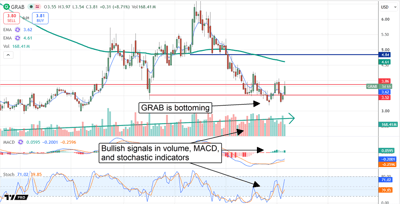
See the four gold miners Garrett Goggin is watching nowThe chart action is textbook, reflecting the potential for a double bottom as of early August. The stock surged more than 5% following the Q2 earnings report, signaling market appetite as shares traded near long-term lows.
Both the MACD and stochastic indicators signal a potential price recovery. Each is bullish on its own, and together they form a textbook bottoming pattern, diverging from recent lows and turning bullish as the price formed its two bottoms.
The likely outcome is that GRAB completes its reversal. The only questions are how long it will take and how much upside potential remains.
Analyst and Institutional Support Point to Sustained Upside for Grab
The analyst trends were cautiously optimistic ahead of the release, with coverage increasing and sentiment firming even as price targets declined. However, further reductions are unlikely to continue. Initial reactions reaffirmed the consensus, which stands at Moderate Buy, with an 82% Buy-side bias among the 11 analysts tracked.
The consensus indicates 50% upside as of early August, and price targets could rise over time as Q2 results prompted a positive analyst response. The likely outcome is that Grab continues taking market share in the coming quarters, sustaining the bullish analyst trend and strengthening its upside potential.
Institutional activity reflects a cautious stance, with institutions selling in early Q3 ahead of the Q2 report. However, the strength of the results could accelerate institutional activity. Institutions own more than 55% of the U.S.-listed shares and have accumulated shares over the trailing 12 months and longer, setting the stage for continued institutional support.
Institutional activity and generally strengthening market support are reflected in the chart, with average volume steadily rising over the trailing three-year period. Volume could continue to increase in the coming quarters due to short covering. Short interest was not astronomical ahead of the release, at only about 8%, but more than eight days to cover suggests that buyable shares could be scarce.
Grab Holdings Delivers Beat-and-Raise Quarter
Grab Holdings' Q2 results revealed the strength of its model and market, with revenue growing 22% year over year and exceeding consensus estimates on strength across segments. On-demand gross merchandise volume grew 21%, underpinned by deliveries and the rapidly growing GrabMart division. This metric reflects the growing number of verticals and stock-keeping units (SKUs) available through Grab’s network, with transactions and SKUs increasing by 54% and users growing by 42%.
Margin news was also a catalyst. The company is driving profitability through scale, leveraging its position to deliver a 54% increase in adjusted quarterly EBITDA, along with positive earnings and free cash flow. The only bad news is that earnings and free cash flow are down year over year, but the decline is mitigated by its cause. The company is investing in long-term growth and accelerating its shift to electric vehicles to insulate itself and its drivers from oil price volatility.
Grab Raises Guidance: Cautious Outlook Sets Stage for Q3 Outperformance
Looking ahead, the company expects these strengths to continue. Full-year guidance was raised, with the previous high-end targets becoming the new low-end targets. The new forecast calls for 22% to 23% revenue growth and widening margins, with adjusted EBITDA of approximately 46%. Given the prevailing trends, the likely outcome is that Q3 results outperform expectations.
One near-term overhang has already cleared: recently announced regulatory changes in Indonesia are expected to hamper Grab’s margin only modestly and do not appear to be a major problem, leaving the company free to execute its strategy.
Grab’s primary risks are regulatory, given its expansive network and cross-border operations. These risks include commission caps, such as those in Indonesia, as well as acquisition scrutiny and project delays. The impact on the stock will likely be volatility, as these issues affect the quality and timing of revenue and earnings while also creating potential catalysts, with approvals and business expansion still expected. Investors should also be aware that Grab Holdings’ cash flow enables aggressive share buybacks. Q2 highlights included an additional $750 million authorization, bringing the total to $1.75 billion, which is expected to be executed over the next two years.
AST SpaceMobile Sets Launch Date Ahead of Key Q2 Earnings Test
Reported by Jessica Mitacek. Published: 8/3/2026.

Key Points
- AST SpaceMobile plans to launch BlueBird satellites 11, 12, and 13 on Aug. 5, advancing its goal of 45 satellites in orbit by early 2027.
- The company will report second-quarter earnings on Aug. 10, with investors seeking improvement after a Q1 miss on both earnings and revenue expectations.
- Shares remain highly volatile with a beta of 2.69 and heavy short interest, though institutional inflows have significantly outpaced outflows over the past year.
- Special Report: SpaceX is offering you shares. Don't take them.
Space-based cellular broadband network provider AST SpaceMobile (NASDAQ: ASTS) has officially set the launch date for its next cohort of satellites as the company continues pursuing its goal of putting 45 BlueBirds into low Earth orbit (LEO) by early 2027.
On Tuesday, July 28, the SpaceX (NASDAQ: SPCX) rival announced that it is targeting Wednesday, Aug. 5, for the liftoff of BlueBirds 11, 12, and 13—the latest three LEO satellites to join its direct-to-device (D2D) constellation.
Hormuz tanker traffic collapses as the oil crisis deepens (Ad)
Tanker traffic through Hormuz has plunged from 110-130 daily transits to near zero, while 17% of Qatar's LNG capacity remains offline after missile strikes.
Goldman Sachs named the UK the developed economy most exposed to a jet-fuel crunch, citing critically low reserves and a gutted refining base. Dow Chemical has already doubled polyethylene prices overnight.
Garrett Goggin, CFA, CMT, points to four gold miners positioned for what comes next.
See the four gold miners Garrett Goggin is watching nowAccording to AST SpaceMobile, the successful June launch of BlueBirds 8, 9, and 10 will be followed by BlueBirds 11, 12, and 13. Satellites 14 through 16 are already being prepared, while production has advanced through satellite 42.
With another satellite launch and its Q2 business update scheduled just days apart, AST SpaceMobile is approaching two important tests of whether its expanding constellation can support commercial service and justify the stock’s volatile valuation.
AST SpaceMobile’s Next Launch Tests Its Deployment Progress
As a group, space stocks have been dragged down over the past month as the fallout from SpaceX’s IPO continues.
AST SpaceMobile is no exception, with shares having plummeted more than 30% over the past 30 days. Since hitting their all-time high on May 28, the shares have lost nearly 56%.
But the company remains focused on accelerating its launch schedule to meet its 2026 targets. That effort begins with next Wednesday’s tentatively planned deployment.
According to Scott Wisniewski, president of AST SpaceMobile, the orbital launch, “combined with expanded manufacturing capacity and the recent successful launch and deployment of BlueBird satellites 8, 9, and 10, position [the company] for beta services later this year with our space-based cellular broadband coverage.”
That service rollout will be aided by AST SpaceMobile’s numerous strategic partnerships, including AT&T (NYSE: T), Verizon Communications (NYSE: VZ), Vodafone Group (NASDAQ: VOD), American Tower (NYSE: AMT), Alphabet (NASDAQ: GOOGL), and Rakuten (OTCMKTS: RKUNY). The company also has agreements with more than 50 mobile network operators and separately serves U.S. government applications and contracts.
Notably, this next group of BlueBird satellites is expected to deliver nearly double the peak download speeds achieved by AST SpaceMobile’s Block 1 BlueBirds, which boast peak D2D download speeds of 98.9 Mbps directly to smartphones.
Although it is not a direct comparison with AST SpaceMobile’s direct-to-smartphone network, SpaceX’s Starlink satellites report download speeds of 45 Mbps to 280 Mbps for its terminal-based satellite internet service.
Q2 Earnings Could Clarify AST SpaceMobile’s Funding and Commercial Timeline
The week after its next planned launch date, AST SpaceMobile will host its Q2 earnings call at 5 p.m. EST.
Investors will be hoping that the company can rebound from its galactic Q1 double miss, when it reported a loss of 66 cents per share versus analyst expectations for a loss of 23 cents per share. Revenue came in at just $14.74 million, compared with forecasts of $39.01 million.
Shareholders will also be looking for clarity on a recent private offering that has raised the specter of potential dilution and whether speculation about the issuance of $1 billion in senior convertible notes was aimed at acquiring or investing in a rocket launch services provider.
Those notes will mature on Feb. 1, 2034, unless converted or repurchased earlier. They are also eligible, at AST SpaceMobile’s discretion, for conversion into cash, Class A common stock, or a combination of the two.
Volatility, Short Interest, and Funding Risks Remain Elevated
Despite the recent crash in ASTS’ share price, the stock has been clawing back. On Thursday, July 30, it gained more than 10% and was nearly 64% higher than its 52-week low on Sept. 9, 2025.
Shareholders have grown accustomed to ASTS’ inherent unpredictability, though. With a current beta of 2.69, the stock’s volatility is approaching three times that of the broader market.
That, in part, is why analysts have been hesitant to upgrade the stock—which carries a consensus Hold rating—despite the average 12-month price target implying nearly 50% upside potential.
That elevated volatility has also contributed to outsized attention from bears. Current short interest stands at more than 19% of the float, or a little more than 59 million shares out of the 388 million shares outstanding. In dollar terms, $3.94 billion worth of ASTS is currently being sold short.
Revenue is scaling quickly, but profitability and operating cash flow remain under pressure. For investors, the more meaningful test will be whether AST SpaceMobile can convert its expanding satellite network into recurring commercial revenue while managing its substantial capital requirements.
Despite those financial risks, institutional activity has remained heavily tilted toward buyers. Over the past 12 months, inflows of nearly $2.4 billion have dwarfed outflows of less than $483 million.
This email communication is a paid advertisement from The Oxford Club, a third-party advertiser of Earnings360 and MarketBeat.
This ad is sent on behalf of The Oxford Club. 105 W Monument St, Baltimore, Maryland 21201. If you would like to optout from receiving offers from The Oxford Club please click here
If you need assistance with your account, please contact MarketBeat's South Dakota based support team at [email protected].
If you no longer wish to receive email from Earnings360, you can unsubscribe.
Copyright 2006-2026 MarketBeat Media, LLC. All rights protected.
345 N Reid Place, Suite 620, Sioux Falls, South Dakota 57103-7078. U.S.A..