
| From | AEI DataPoints <[email protected]> |
| Subject | What Happens After Art School? |
| Date | August 13, 2026 1:29 PM |
Links have been removed from this email. Learn more in the FAQ.
Links have been removed from this email. Learn more in the FAQ.
Also: Gen Z Politics and Chinese Chips
AEIDataPoints-Banner ([link removed] )
Expert analysis made easy. Breaking down the news with data, charts, and maps.
Edited by Carter Hutchinson and Lexi Baker
Happy Thursday! In today’s newsletter, we examine the payoff of art degrees, a growing Gen Z gender divide, and the price of semiconductors.
Don’t forget—subscribe ([link removed] ) and send DataPoints to a friend!
For inquiries, please email [email protected] (mailto:[email protected]) .
1. College Degrees Don’t Pay Off Equally ([link removed] )
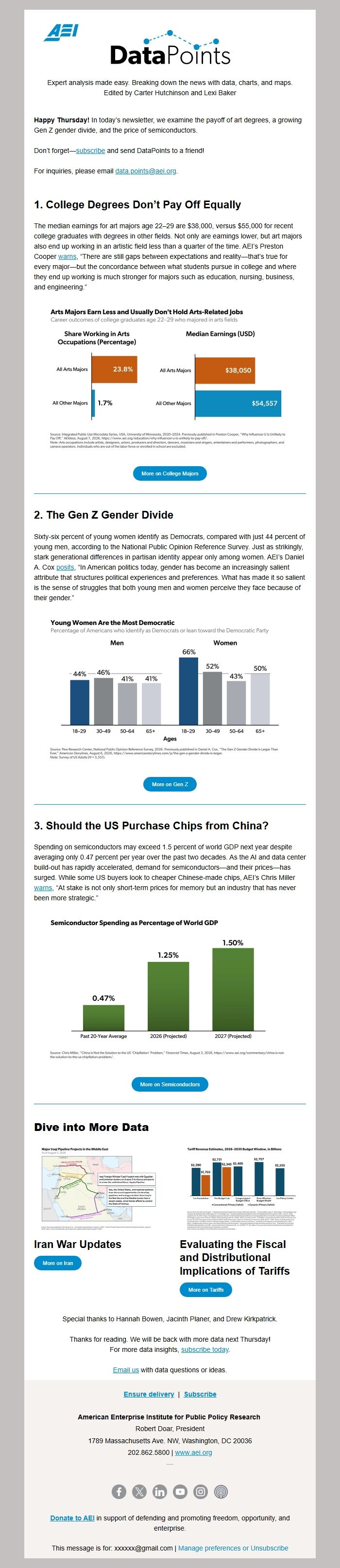
The median earnings for art majors age 22–29 are $38,000, versus $55,000 for recent college graduates with degrees in other fields. Not only are earnings lower, but art majors also end up working in an artistic field less than a quarter of the time. AEI’s Preston Cooper warns ([link removed] ) , “There are still gaps between expectations and reality—that’s true for every major—but the concordance between what students pursue in college and where they end up working is much stronger for majors such as education, nursing, business, and engineering.”
08.13_Cooper ([link removed] )
More on College Majors
([link removed] )
2. The Gen Z Gender Divide ([link removed] )
Sixty-six percent of young women identify as Democrats, compared with just 44 percent of young men, according to the National Public Opinion Reference Survey. Just as strikingly, stark generational differences in partisan identity appear only among women. AEI’s Daniel A. Cox posits ([link removed] ) , “In American politics today, gender has become an increasingly salient attribute that structures political experiences and preferences. What has made it so salient is the sense of struggles that both young men and women perceive they face because of their gender.”
08.13_Cox ([link removed] )
More on Gen Z
([link removed] )
3. Should the US Purchase Chips from China? ([link removed] )
Spending on semiconductors may exceed 1.5 percent of world GDP next year despite averaging only 0.47 percent per year over the past two decades. As the AI and data center build-out has rapidly accelerated, demand for semiconductors—and their prices—has surged. While some US buyers look to cheaper Chinese-made chips, AEI’s Chris Miller warns ([link removed] ) , “At stake is not only short-term prices for memory but an industry that has never been more strategic.”
08.13_Miller ([link removed] )
More on Semiconductors
([link removed] )
Dive into More Data
08.13_CTP ([link removed] )
Iran War Updates ([link removed] )
More on Iran
([link removed] )
08.13_Pomerleau ([link removed] )
Evaluating the Fiscal and Distributional Implications of Tariffs ([link removed] )
More on Tariffs
([link removed] )
Special thanks to Hannah Bowen, Jacinth Planer, and Drew Kirkpatrick.
Thanks for reading. We will be back with more data next Thursday!
For more data insights, subscribe today ([link removed] ) .
Email us (mailto:[email protected]) with data questions or ideas.
Ensure delivery ([link removed] ) | Subscribe ([link removed] )
American Enterprise Institute for Public Policy Research
Robert Doar, President
1789 Massachusetts Ave. NW, Washington, DC 20036
202.862.5800 | www.aei.org ([link removed] )
Unsubscribe from the link below. ([link removed] )
Facebook ([link removed] )
X ([link removed] )
LinkedIn ([link removed] )
YouTube ([link removed] )
Instagram ([link removed] )
Podcast Logo New_Gray ([link removed] )
Donate to AEI ([link removed] ) in support of defending and promoting freedom, opportunity, and enterprise.
This message is for: [email protected] | Manage preferences or Unsubscribe ([link removed] )
AEIDataPoints-Banner ([link removed] )
Expert analysis made easy. Breaking down the news with data, charts, and maps.
Edited by Carter Hutchinson and Lexi Baker
Happy Thursday! In today’s newsletter, we examine the payoff of art degrees, a growing Gen Z gender divide, and the price of semiconductors.
Don’t forget—subscribe ([link removed] ) and send DataPoints to a friend!
For inquiries, please email [email protected] (mailto:[email protected]) .
1. College Degrees Don’t Pay Off Equally ([link removed] )
The median earnings for art majors age 22–29 are $38,000, versus $55,000 for recent college graduates with degrees in other fields. Not only are earnings lower, but art majors also end up working in an artistic field less than a quarter of the time. AEI’s Preston Cooper warns ([link removed] ) , “There are still gaps between expectations and reality—that’s true for every major—but the concordance between what students pursue in college and where they end up working is much stronger for majors such as education, nursing, business, and engineering.”
08.13_Cooper ([link removed] )
More on College Majors
([link removed] )
2. The Gen Z Gender Divide ([link removed] )
Sixty-six percent of young women identify as Democrats, compared with just 44 percent of young men, according to the National Public Opinion Reference Survey. Just as strikingly, stark generational differences in partisan identity appear only among women. AEI’s Daniel A. Cox posits ([link removed] ) , “In American politics today, gender has become an increasingly salient attribute that structures political experiences and preferences. What has made it so salient is the sense of struggles that both young men and women perceive they face because of their gender.”
08.13_Cox ([link removed] )
More on Gen Z
([link removed] )
3. Should the US Purchase Chips from China? ([link removed] )
Spending on semiconductors may exceed 1.5 percent of world GDP next year despite averaging only 0.47 percent per year over the past two decades. As the AI and data center build-out has rapidly accelerated, demand for semiconductors—and their prices—has surged. While some US buyers look to cheaper Chinese-made chips, AEI’s Chris Miller warns ([link removed] ) , “At stake is not only short-term prices for memory but an industry that has never been more strategic.”
08.13_Miller ([link removed] )
More on Semiconductors
([link removed] )
Dive into More Data
08.13_CTP ([link removed] )
Iran War Updates ([link removed] )
More on Iran
([link removed] )
08.13_Pomerleau ([link removed] )
Evaluating the Fiscal and Distributional Implications of Tariffs ([link removed] )
More on Tariffs
([link removed] )
Special thanks to Hannah Bowen, Jacinth Planer, and Drew Kirkpatrick.
Thanks for reading. We will be back with more data next Thursday!
For more data insights, subscribe today ([link removed] ) .
Email us (mailto:[email protected]) with data questions or ideas.
Ensure delivery ([link removed] ) | Subscribe ([link removed] )
American Enterprise Institute for Public Policy Research
Robert Doar, President
1789 Massachusetts Ave. NW, Washington, DC 20036
202.862.5800 | www.aei.org ([link removed] )
Unsubscribe from the link below. ([link removed] )
Facebook ([link removed] )
X ([link removed] )
LinkedIn ([link removed] )
YouTube ([link removed] )
Instagram ([link removed] )
Podcast Logo New_Gray ([link removed] )
Donate to AEI ([link removed] ) in support of defending and promoting freedom, opportunity, and enterprise.
This message is for: [email protected] | Manage preferences or Unsubscribe ([link removed] )
Message Analysis
- Sender: American Enterprise Institute
- Political Party: n/a
- Country: United States
- State/Locality: n/a
- Office: n/a
-
Email Providers:
- HubSpot