
|
 |
Politics as mass delusion
The accelerating global climate catastrophe should be driving decisions at the local, national, and international level—yet neither elected leaders, nor journalists, nor even voters seem to care
|

| |||||||||||||||


Apologists for the status quo, including the president, have long argued that climate change is a “hoax.” Events unfolding around the world should convincingly disprove them, but even as related calamities continue to destroy lives and communities, America’s corporate political parties continue to drag humanity towards a meteorological abyss with limitless risks to human life & health.
A whole way worse than the sum of its parts
At the same time that Asia is confronting catastrophic flooding driven by typhoons strengthened by global climate patterns, others—particularly the Pacific Northwest and western Europe—are battling unprecedented wildfires.
Either of these patterns would be bad enough. China has evacuated over a million people fleeing floods inundating major cities including Shanghai, while wildfires burning near Madrid and Paris have prompted alarm and anxiety across Europe.
The juxtaposition, however, suggests a whole far worse than the sum of its parts.
International agencies and non-profit organizations have spared no alarm. The United Nations Environment Programme, for instance, has noted that “The world may soon cross some potentially disastrous tipping points,” and powerfully depicted the scale of climate chaos through data visualizations.
Yet, while these globally interlinked unfolding disasters have attracted worldwide attention and concern, the pattern that connects them continues to be effectively ignored by elected leaders and journalists across the United States.
 |
A war making everything worse
The war in Iran is offensive for many reasons. The sheer imbecility that enabled it will be remembered by whatever vestiges of human civilization survive the next generation.
Its damage to the global economy continues to mount by the day.
But the relationship between war and the acceleration of climate chaos is, in fact, the dumbest thing about the whole sordid endeavor. Ultimately, the Pentagon is the Earth’s leading institutional consumer of fossil fuels, while its actions—particularly in the Middle East over the past six months—have made fossil fuels more scarce, and less secure to extract or ship.
Beyond this long applicable global analysis of the Pentagon’s carbon footprint, Trump’s war on Iran has also sparked an acute global fertilizer shortage over the past six months, which has already done incalculable damage to crop yields and the global food supply.
Don’t look up
Severe weather events are an indication of climate change, but are not themselves the underlying problem. Like the election of the president, they are severely problematic examples of dysfunction driven by systems besieged by long festering crises: corruption & money in politics helped enable the president, while a series of interrelated feedback loops have consistently accelerated climate change over the past generation.
Looking beyond the planetary symptoms to consider the underlying pathology leads to a further set of challenges that few in positions of institutional leadership have adequately considered.
Many stories, published by any number of news sources, have explored the unfolding El Nino in the South Pacific. Some have even considered its disturbing implications. Few, however, have placed it within the broader context of the climate crisis, considering it not only as a driver of predictable weather calamities, but as a reflection of shifting ocean currents that themselves hold massive implications for the longer term future.
Oscillations in the world’s oceans are responsible for much of the movement that carries water and heat across them. Yet two of the most significant: the Atlantic Meridional Overturning Circulation (AMOC) in the North Atlantic, and the Antarctica Circumpolar Current (ACC) near Antarctica, appear to be weakening due in large part to climate chaos.
As Dr. Morgan Sinclair recently observed on this platform:
Together these currents run a global “conveyor belt” of ocean water that both cools and warms the planet—releasing excess heat near the Arctic Circle while simultaneously warding off the next ice age by keeping the world warm enough that it doesn’t freeze.
Worldwide, north and south, the circulation of the seas is slowing down. That’s trouble.
Dr. Sinclair goes on to explain in some detail how the AMOC and the ACC function, and why they matter so much.
Put simply, melting polar ice reduces the salinity of ocean water, which traditionally grew as water near the poles froze into ice. As the polar salinity pump diminishes, so does the force with which cold, salty water descends to the bottom of the ocean.
Scientists have long warned of the severe consequences of the ocean currents stalling. Hollywood directors have dramatized those consequences (for instance, in The Day After Tomorrow, and Waterworld). Millions of young people around the world, driven by their awareness of preventable crisis, have taken to the streets to voice their demands for faster and more meaningful climate action.
Yet Washington stumbles in circles, while the AMOC and ACC continue to weaken, threatening crops & food supplies around the world.
Strap in
Despite all the mounting attention to it, the El Niño brewing in the South Pacific will likely prove more destructive than anyone can possibly describe, only because its effects will cascade long beyond the season is over.
Mark Roberts recently explained that:
An El Niño is not a storm. It does not arrive with wind and fury and then recede. It is a reorganization of where rain falls on Earth, a slow, hemisphere-spanning transfer of moisture away from the croplands of Southeast Asia, southern Africa, Central America, and northeastern Brazil, and toward places that cannot use the rain to produce food such as the open Pacific, the deserts of coastal Peru, the flood plains of the Horn of Africa. The warm water is only the mechanism; the failed harvests are what people will actually live through. Since the global food system runs on a handful of staple crops grown in a handful of climate-exposed regions, a sufficiently large El Niño is not a weather anomaly at all. It is going to be a global food shock on a twelve-month fuse.
This should be the lead story in every news publication on Earth. It should remain on the front page every day until elected leaders who have ignored this long-festering crisis are finally replaced.
To its credit, the Guardian at least publishes opinion articles about the crisis. Today, Peter Gleich wrote:
At any given moment, there are always places around the world suffering from droughts or floods or experiencing water scarcity – a normal consequence of the natural variability of our climate and weather.
But what we’re experiencing now is not normal; it is the direct consequence of accelerating human-caused climate changes, on top of decades of neglect and underinvestment in our water institutions and infrastructure.
For years, climate scientists have warned that continued emissions of greenhouse gases from burning fossil fuels and other human activities would alter the planet’s climate, raise temperatures, disrupt weather patterns and worsen extreme events, raise sea levels, and accelerate the spread of disease vectors. Those warnings were ignored, dismissed, downplayed. And now we are reaping what we’ve sown.
Yet our politicians continue to prevaricate, refusing to take actions to protect water resources; or worse, rolling back earlier efforts.
Every day, journalists cover some aspect of the accelerating global climate catastrophe. Yet, even as eyes around the world turn towards some portion of the climate disaster forcing future generations into misery, the phenomenon as a whole—and its disturbing implications—seems to escape polite conversations, especially among policymakers.
Apologists for corporate rule within the Democratic party, for instance, imagine that climate is a divisive issue that is electorally inconvenient. But there is no more important issue to discuss.
The urgency of decisions that should have been made 20 years ago to protect the future grow increasingly insufficient as our leaders continue to bury their hands in the sand, and double down on a fossil fuel paradigm that threatens life on Earth.
27

10
On the one hand, many institutions have grappled with the implications of climate chaos. The British insurance industry, for instance, conducted an analysis that predicted 4 billion deaths—amounting to literally half of humanity—in the next century.
Meanwhile, major news outlets fawn over the president’s vanities rather than issues that will dramatically affect (or even end the lives of) billions of people.
Hands in the air
I’ll be honest: I have no idea how to overcome these patterns.
After dedicating years to direct action organizing, and more than half a decade to promoting better policies as a candidate for Congress, I learned the hard way that our system does not permit meaningful change. I’ve watched journalists and voters decide to preserve documented corruption at the cost of their own grandchildren’s survival.
As far as I can tell, America’s elected leaders, and the journalists who create cults of personality surrounding them, are oblivious. So, too, are voters who continue to send the same corporate shills back to Washington as if they hadn’t engineered a preventable calamity that makes every other unfortunate event in human history look like a blessing by comparison.
As a writer and former candidate for public office, I’ve tried my best to offer hope to people concerned about the future. But trying to conjure hope for young people, in particular, has grown painfully futile. Many are more aware of the future crises that corrupt elected leaders have contrived than those leaders themselves.
I’ve been relatively publicly silent lately. But that’s not because I can’t find issues to write about.
Sadly, every day offers new horrors that have led me to start dozens of half-drafted articles. The problem constraining me is that, as a writer, I have always offered my ideas with an eye towards a broader process. My aims have included informing people, inspiring them, and building grassroots social movements to force our shared concerns into political institutions.
But America’s corruption makes that process appear like a cruel joke. I wish I could offer you hope. But I have a hard time lying.
That said, I can at least share a little information, and a few ideas that could still make a difference.
None of this is rocket science
Faced with catastrophic risks to life on Earth, a sane civilization might consider alternatives that would lead to greater sustainability.
Capitalism, however, is not sane. Capital is rapacious, even to the point of destroying the people who wield it.
Given the relationship between the Pentagon and climate chaos, the very first thing we might do to address the climate catastrophe would be to stop investing in its expansion. Reducing the military budget is a long overdue no-brainer.
Shifting some of those resources recovered from the military budget to climate resilience would make even more sense. Among the many possibilities that come to mind—such as organizing controlled burns during the winter season to reduce the propensity of severe fires in the summer and fall, municipal composting systems to reduce waste and reuse bio-resources, and a youth jobs corp dedicated to cultivating local permaculture & sustainability projects—few seem as pressing as simply paying firefighters what they’re worth.
Across the country, firefighters are currently confronting the leading edge of the climate crisis. Like military servicemembers, they spend weeks or months on the road, facing severe risks to their life and health while away from their families.
Many work without adequate support from local, state, or federal governments. Some are forced to buy their own equipment.
On the one hand, federal firefighters received a long overdue raise last year. On the other hand, a recruiting crisis continues across the country, suggesting that resources currently funding weapons, or military recruitment—or local policing, for that matter—could find better uses.
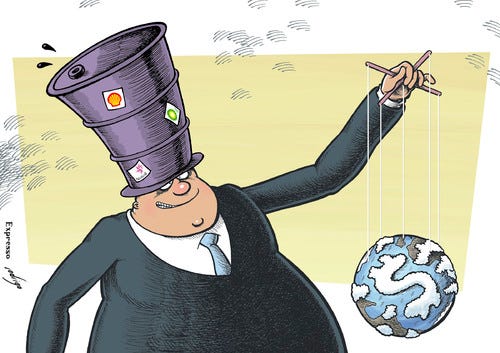
Finally, nationalizing the fossil fuel industry is a crucial step in removing the powerful incentive of corporate profit from the scale. I’ve argued before that allowing the extraction of non-renewable resources for profit forces the future to subsidize the present. It is a recipe for civilizational self-destruction.
Nationalizing the sector—by allowing extraction only by public agencies that do not pursue profit—should have happened decades ago. Of course, any other country that has attempted to pursue that path has faced a CIA coup in retaliation, so I have little hope that Washington will permit that policy to see the light of day in the U.S.
But the future of life on Earth increasingly depends on it. As long as capital is allowed to profit from fossil fuel extraction, human beings will all remain reduced to its fodder.
You're currently a free subscriber to Chronicles of a Dying Empire. For the full experience, upgrade your subscription.
| ||||||||||


