 If we’ve learned anything from President Trump’s second term, it’s that his jokes have a funny way of happening. When he floated putting his own face on American currency, it sounded like just another one of his vain musings. The U.S. Mint is now striking $1 coins bearing his portrait – the first living president to appear on American money since Abraham Lincoln. When he boasted about hosting a UFC cage fight on the White House lawn, late-night hosts had a field day. Then the octagon went up on the South Lawn. And when recently asked point-blank whether Greenland would be under U.S. control by the end of his term. His answer: "Yeah, you should make that bet, actually." Again, the press laughed it off as another Trump provocation – a quip to agitate Brussels and rattle NATO. But I believe Trump’s declaration to control Greenland is not only real, it’s part of something far bigger and more consequential for all of us. This strange story has resurfaced again and again since 2019, in defiance of every diplomatic embarrassment it causes. There is a reason for that persistence – and once you see it, you will start to see the same reason behind a dozen other stories the press has been reporting as separate events. Greenland sits on one of the largest untapped deposits of rare-earth minerals on the planet – the metals without which not a single advanced semiconductor, AI data center, or American fighter jet can be built. Its deposits contain dozens of the minerals Washington officially classifies as critical to national security. Now hold that thought, and look at what else this administration has been doing. Trump has signed an executive order creating a $12 billion strategic stockpile of critical minerals. The administration calls it Project Vault. The government has taken direct equity stakes in American mining companies – MP Materials, Lithium Americas, Trilogy Metals. Washington now co-owns the miners. Trump secured $500 billion in mineral rights from Ukraine as a condition of continued American support. Shuttered nuclear plants are being reopened across the country, and permitting for new reactors has been slashed from years to months – because the AI buildout requires more electricity than the American grid can currently produce. The CEOs of Nvidia, Apple, Microsoft, and BlackRock have been shuttling between Washington, Riyadh, and Beijing alongside the President – cutting deals that have committed more than a trillion dollars of Gulf money to American AI infrastructure. And on December 12, 2025, representatives of 13 nations quietly signed a pact at the State Department that almost no one in the financial press has covered. The tariffs… The threats to annex Canada… The strike on Venezuela… The obsession with Greenland… They are not separate stories – they are one story. Every single one of these moves secures the same thing: American control over the critical resources and energy that the next century's economy will run on. The materials Russian President Vladimir Putin was talking about when he said whoever leads in this sphere will "become the ruler of the world." And the reason Trump is moving this fast, this aggressively – and on this many fronts at once – is the biggest part of his grand plan, the part that connects all of it: He needs these resources to instigate an emergency reset of the U.S. dollar. For 50 years, America's currency has been anchored to Saudi oil – the petrodollar arrangement Henry Kissinger struck in the desert in 1974. That arrangement quietly expired in June 2024. Since that expiration, Central banks have been dumping U.S. Treasuries at a pace not seen in decades. China has cut its holdings by 45% from their peak. The BRICS nations offloaded $47 billion of American debt in a single month earlier this year. And the dollar's share of global reserves has sunk to its lowest level this century. 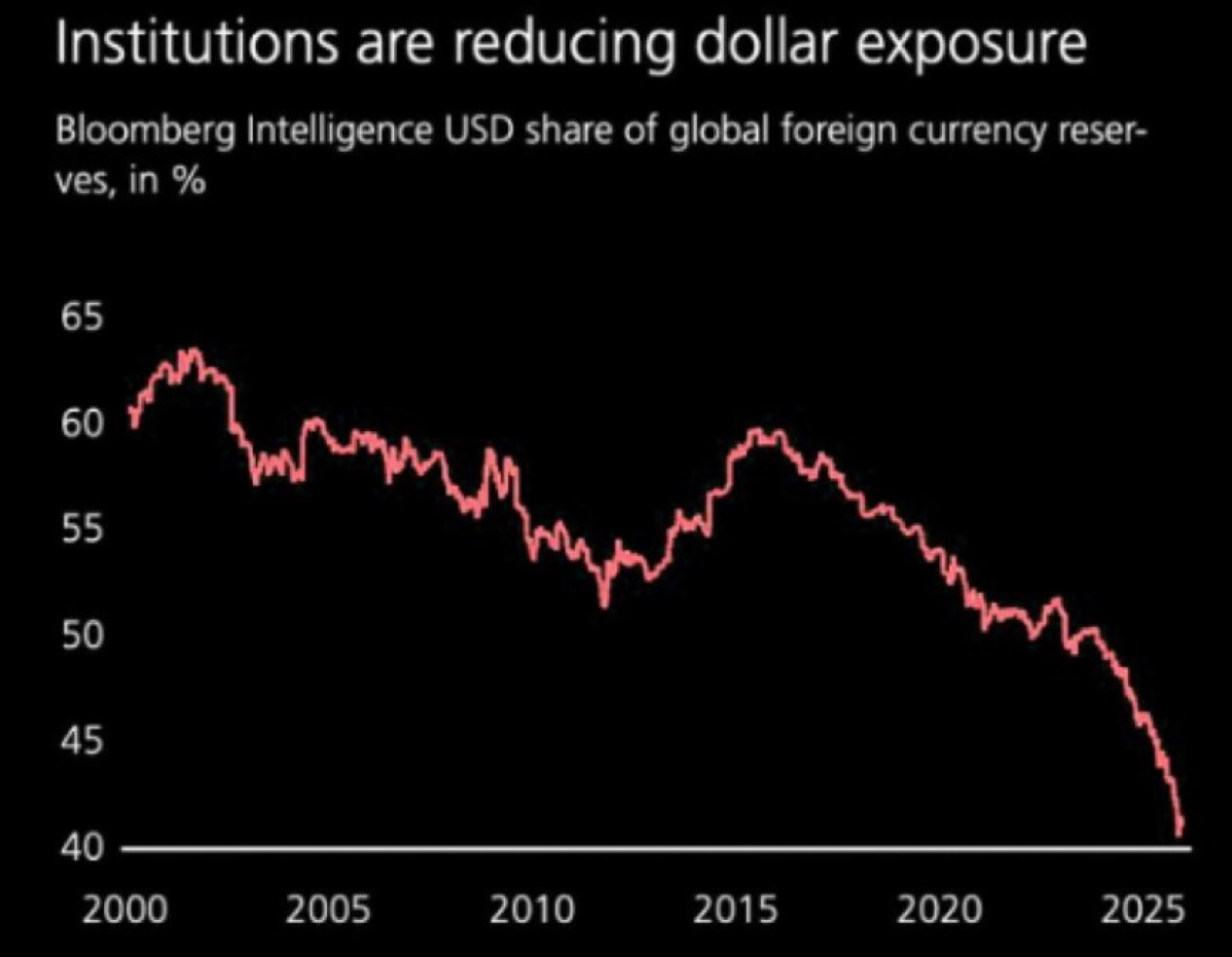
Source: Bloomberg
Everything about our way of life – the low interest rates, the cheap mortgages, the government's ability to borrow trillions without collapsing – all of it rests on one privilege: the world's willingness to hold our money. Take that away, and the entire American standard of living is in peril. The Trump administration is painfully aware of this. It is the crisis lurking behind every move I've just described and why they are moving heaven and earth to give the world a new reason to need the dollar. What's being assembled is a new monetary order – anchored not to oil, but to the critical minerals, energy, and AI infrastructure this administration is now racing to lock up on every continent. A reset already signed and sealed in the back rooms of Washington, bypassing Congress entirely. I call it Trump's New Dollar. 
And it is the first reset of America's money in half a century. When Kissinger struck that deal with the Saudis, it minted more than a thousand new millionaires a day for 50 years – and quietly hollowed out the savings of the millions who never understood what was happening. I've laid out the whole story in my new documentary – including the five companies sitting at the chokepoints of the new monetary order, and one move to gain immediate exposure to what's unfolding. And I'd urge you to watch it soon… because this December, when the leaders of the world's 20 largest economies gather at Trump's own resort in Miami, I believe the President could unveil his new monetary order to the world. The dividing line is being drawn now and which side of it you end up on may depend on what you do before then. Watch the full story here. Good investing, Porter Stansberry
This Week's Bonus Article McKesson's Compounding Keeps Adding UpReported by Peter Frank. Article Posted: 7/31/2026. 
Key Points- McKesson closed fiscal 2026 with $403.4 billion in revenue, up 12%, and adjusted EPS of $39.11, an 18% increase that topped its own targets.
- The company issued fiscal 2027 adjusted EPS guidance of $43.80 to $44.60, projecting 12% to 14% growth, while expanding its share-repurchase authorization to $7.7 billion.
- Analysts hold a consensus Moderate Buy rating with roughly 11% average upside, though McKesson's stock trades at a valuation that already reflects strong expected growth.
- Special Report: Trump’s emergency move imminent
McKesson (NYSE: MCK) keeps moving medicines around the country—and that keeps the money coming in. The company operates in the unglamorous middle of healthcare. It distributes enormous volumes of pharmaceuticals, serves specialty medical practices and, behind the scenes, has been reshaping its business mix. This combination of steady operations and strategic focus has made McKesson one of the market’s more consistent winners over the past several years. Analysts and investors have taken notice. The company’s continued growth, strong cash flow and expanding earnings have not gone unnoticed. For new investors, the question is how patient they are and whether the remaining upside is worth it. Strong Results ContinueMcKesson closed out fiscal 2026 as strongly as it began. Its fourth quarter, ended March 31, showed revenue of $96.3 billion, up 6% but below analysts’ expectations. Earnings per diluted share reached $13.71, an increase of $3.70. Growth was driven by higher prescription volumes in its North American Pharmaceutical operations and continued expansion in Oncology & Multispecialty. Adjusted earnings per diluted share rose 16% to $11.69, exceeding analysts’ expectations. For the full fiscal year, McKesson delivered consolidated revenue of $403.4 billion, up 12%, while earnings per share (EPS) climbed to $38.38. Adjusted EPS reached $39.11, an 18% increase that exceeded the company’s previously announced long-range growth targets. Cash Flow Fuels GrowthAs a distributor, McKesson also generates substantial cash. During the quarter, the company produced $3.4 billion in cash flow from operations and approximately $3.2 billion in free cash flow after $185 million in capital expenditures. For the year, McKesson generated $6.2 billion in cash flow from operations. That free cash flow provides ample funding for investments in oncology and specialty capabilities, as well as continued share repurchases. Indeed, the company said it launched a $2.25 billion accelerated share-repurchase program. The board also approved a $5 billion increase to the overall repurchase authorization, bringing total buyback capacity to $7.7 billion as of April. Guidance Keeps RisingGiven these results, the company raised its forward guidance again. In February, McKesson raised and narrowed its fiscal 2026 adjusted EPS guidance to a range of $38.80 to $39.20, up from an earlier range of $38.35 to $38.85. When announcing its latest results in May, the company went a step further, issuing fiscal 2027 guidance of $43.80 to $44.60 in adjusted earnings per diluted share, implying growth of 12% to 14%. It also reaffirmed its long-term adjusted EPS growth target of 13% to 16%. The Business Keeps EvolvingAs McKesson looks ahead, it is also reviewing its business mix and actively reshaping parts of its operations. In February, the company completed the sale of its Norwegian retail and distribution businesses to NorgesGruppen as part of a plan to exit European operations entirely. Earlier in the fiscal year, McKesson also took controlling interests in PRISM Vision Holdings and Core Ventures, expanding its footprint in ophthalmology, oncology and specialty practice support. These investments continue the company’s focus on a higher-value business mix rather than simply moving pharmaceuticals. Wall Street Stays BullishGiven its track record, McKesson has attracted considerable support on Wall Street. The 17 analysts following the stock have a consensus Moderate Buy rating, with 14 recommending Buy and three suggesting Hold. With a 12-month average price target of $962.67 per share, the potential upside is moderate given the shares’ persistent strength. The highest target is $1,085 per share, while the lowest is $812. Shares suffered a setback earlier this year when the stock pulled back from its 52-week high near $1,000. The decline came primarily from market sentiment and likely some profit-taking. Its price-to-earnings ratio of roughly 23 remains in line with similar companies in the medical sector, including Cencora (NYSE: COR), yet remains well below that of Cardinal Health (NYSE: CAH). McKesson pays a quarterly dividend and recently raised it 15% to 94 cents per share, marking the company’s 17th consecutive annual increase. However, the yield of just 0.4% means McKesson is not primarily an income investment. Steady Growth Carries Some RisksInstead, investors turn to McKesson for its consistency and steady appreciation. The company combines a massive distribution business with a growing specialty platform, strategic acquisitions, substantial free cash flow, aggressive buybacks and a history of guidance pointing to disciplined, long-term growth. Risks include payment defaults, policy shifts, supply disruptions and competition, all of which can surface unexpectedly. The stock price itself is also no bargain, having priced in an expectation of growth that could be challenging to sustain. Even so, investors looking to avoid cyclical stocks in a market that rewards operational consistency may want to keep McKesson on their lists. . | 
