 Something strange is happening to your money. It wasn't voted on. It wasn't debated in the Senate. And most Americans have no idea it's even taking place but… President Trump is replacing the U.S. dollar. Not with crypto. Not with a digital currency. Something far bigger than that – and it's already been signed and sealed in the back rooms of D.C., ready to be issued by the U.S. Treasury. Bypassing every legal and political channel under the guise of "national security," Trump has enacted this total money reset using a landmark executive order (14241). Whether you’re a Democrat or Republican, whether you support this new money or not, it doesn't matter. Soon, every U.S. citizen will be forced to use Trump's New Dollar to fill their gas tank, buy groceries, and pay medical bills. Which is why I've produced a critical new documentary laying out exactly what Trump's New Dollar means for your savings, your investments, and your family's financial future. Detailing three important steps you can take today to prepare – including the name of a core band of assets connected to Trump’s initiative that could surge as a result. As you’ll see in my briefing, the last time America reset its money like this – under Richard Nixon’s presidency in the 1970s – it created one of the greatest wealth divides in the history of our nation. On one side, it minted an average of 1,300 new millionaires a day for over half a century. And on the other… the folks left behind, drowning in debt, with no idea how to use America’s new money to create wealth. As Trump rolls out his new dollar, the question is: Which side will you be on? 
Good investing,
Porter Stansberry PS. If you’re wondering what Trump’s new money will look like, when it will be issued, what it means for your investments – all of those questions are answered in my briefing.
Additional Reading from MarketBeat.com Caterpillar’s Record Quarter May Have Reset the Stock’s CeilingAuthor: Thomas Hughes. Originally Published: 8/5/2026. 
Key Points- Caterpillar’s record Q2 results were supported by strength across construction, resources, and power and energy.
- Caterpillar’s AI data center exposure could continue to support revenue, backlog and analyst sentiment.
- Caterpillar’s capital returns and institutional support may help limit downside risk, though tariffs and project delays remain risks.
- Special Report: Trump’s emergency move imminent
Numerous factors underpin Caterpillar's (NYSE: CAT) stock price uptrend and its potential to reach $1,200, including analyst sentiment trends. As of early August, consensus suggests the stock is fairly valued, but the trend is what matters. Those trends could strengthen in Q3 following Q2 outperformance. Increasing coverage, firming sentiment and rising price targets could provide a robust tailwind, creating a high-end price range that tops $1,200. In this scenario, Caterpillar’s robust guidance increase is a cautious estimate, suggesting potential outperformance in Q3 and the possible continuation of bullish analyst sentiment and price-target trends. 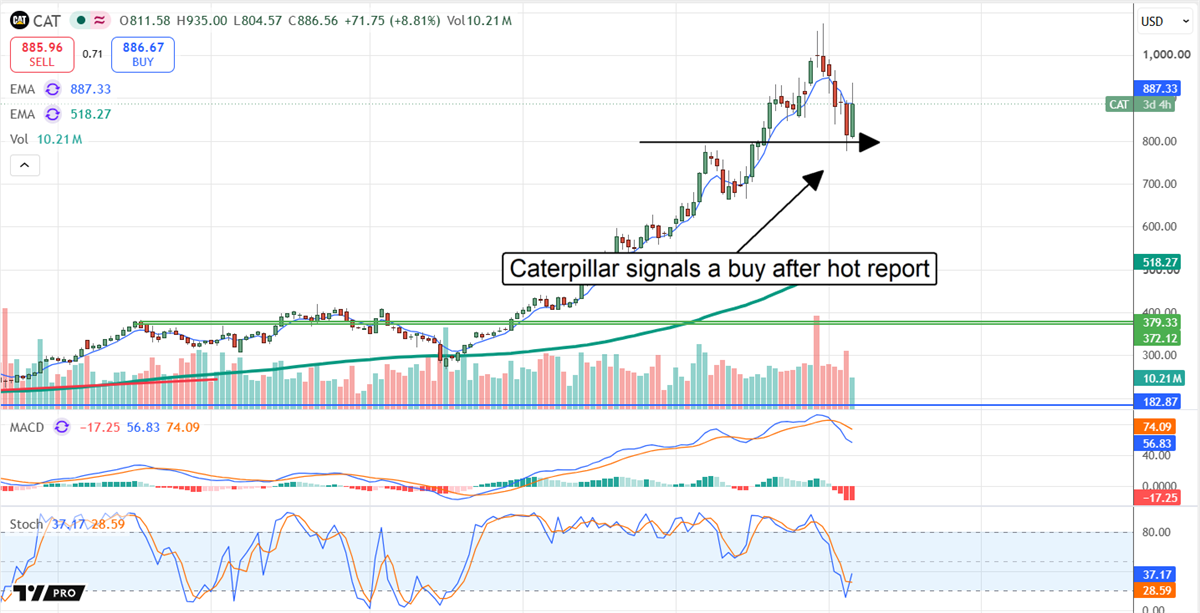
Caterpillar Is AI-Critical, and Its Other Businesses Are Also StrongCaterpillar had a robust Q2, growing revenue to a record $20.5 billion on strength across all primary categories and operating regions. The growth was underpinned by demand for AI data centers, as massive construction projects require heavy equipment. More importantly, the top line outpaced MarketBeat’s consensus by more than 650 basis points (bps), while order and backlog growth pointed to strength in the current and upcoming quarters. Segmentally, Construction Industries sales rose 35%, Resource Industries sales rose 20%, and Power & Energy sales rose 17%. Margin expansion is another positive factor in the stock's outlook. Caterpillar widened its margins at all levels through revenue leverage and improved operational performance, driving a nearly 400-bps improvement in operating profit margin and accelerating earnings growth. Critical details include $4.4 billion in operating cash flow and $8.17 in adjusted earnings per share (EPS), nearly 75% above last year’s figure and $2 above the consensus forecast. That performance was more than sufficient to cover capital returns while supporting investment in growth. Guidance is also a catalyst for Caterpillar, and perhaps the most important one, because it affirms the broad-based data center buildout and capital spending required to support it. The meaningful improvement in Caterpillar’s guidance underscores the market’s mispricing of AI capital spending this year. Guidance was lifted from the low double digits to the mid-to-high teens, representing a 500- to 700-basis-point improvement at the midpoint of the range, and it may prove cautious. With strength across segments and regions and data center construction ongoing—potentially accelerated by the launch of Advanced Micro Devices (NASDAQ: AMD) MI450 and Helios racks—Caterpillar is well positioned for growth. Capital Returns and Institutional Investors Limit Risk in 2026Capital returns and the institutional support they attract underpin Caterpillar’s uptrend and stock price while limiting risk for investors. The dividend is little more than a token, at approximately a 0.7% yield as of early August. It remains safe and reliable; the company expects to increase the distribution annually, while buybacks drive its growth. Buyback activity more than doubled the dividend’s value in Q2, contributing to a 1.9% trailing 12-month (TTM) share-count reduction in the first half. The company expects this activity to continue in the upcoming quarters. Investors have an opportunity to enter the market now, while prices are lower than their early 2026 peaks and before buyback activity increases. Institutional support is solid. Institutions own more than 70% of the stock and have been aggressively accumulating shares, with a TTM accumulation-to-selling ratio of nearly 2-to-1. They accelerated their activity in late Q2 2026 and early Q3 ahead of the earnings report and are likely to continue buying in its wake. Price action on the chart reflects buying following the report, signaling support at a critical technical level and the potential for the rally to continue. CAT's stock price presents a 10% near-term opportunity in this scenario, expanding to roughly 30% upon reaching new highs. Caterpillar’s biggest risks are tariff- and regulatory-related. The company anticipates that tariffs will surpass $2.2 billion this year, potentially reducing profits if price pass-through and efficiency gains do not offset the impact. The more pressing problem, however, is the effect on construction timelines. Environmental, energy and local hurdles are delaying project timelines across the hyperscale universe, and Caterpillar’s stock price could be affected if they result in an extended time to build. This year’s catalyst is the backlog. AI, data center and general construction demand have pushed the backlog to record levels above $72 billion. All the company needs to do is deliver the products to drive growth, and it is working to expand capacity to meet demand. The market is mistaken in viewing the early 2026 market top as a cyclical peak; instead, it could be a stepping stone to higher price points. Structural tailwinds, including the U.S. Infrastructure Act, a global rare-earth mining rush and the AI revolution, point to a multiyear cycle for Caterpillar and other industrial names. . | 