| Unsubscribe |
There's a Quiet Plan to Shrink Your Dollar — And It Has a Name
What if we told you there's a plan in Washington to make your dollar worth less—and it's already in motion?
Sounds crazy. But it's real. And it has a name.
It's being called the "Mar-a-Lago Accord."
The idea is to weaken the dollar on purpose—to make American exports cheaper and bring factory jobs back home.
Here's how: tariffs on imports, pressure on other countries to lift their currencies, and a dollar pushed lower by design. That's the strategy. The trouble is what it costs you.
Because a weaker dollar means every dollar you've saved buys less.
Think your savings are safe? Think again.
This won't hit like a crash. No headline, no warning. Your dollar just buys less… then less… until a lifetime of work quietly slips away—and you never see a single withdrawal.
That's the part nobody's warning you about. By the time most people feel it, it's already too late.
But you don't have to stand for it. Smart Americans are already moving to get their wealth out of the dollar's path—before the slide picks up speed.
See the plan—and how to fight back—before it's too late.
Inside, you'll get the 3 secret strategies you can put in place starting today—so a weaker dollar doesn't decide what your money is worth tomorrow.
Rio Tinto’s Results Make the Case for Looking Beyond Tech in the AI Trade
Authored by Chris Markoch. Originally Published: 8/2/2026.
Key Points
- Rio Tinto’s first-half results showed strong cash flow, higher earnings and a larger interim dividend.
- Copper, aluminum and lithium are becoming more important to the company as AI infrastructure, electrification and grid demand grow.
- Iron ore remains a major cash generator, but investors still need to watch commodity prices, currency pressure and geopolitical risks.
- Special Report: Everyone wanted SpaceX. Smart money wants this.
Rio Tinto (NYSE: RIO) just delivered a first-half report with numbers that support a broader thesis rooted in a major shift: Physical assets are entering a multiyear period of outperformance. Higher bond yields, oil supply concerns, and an artificial intelligence (AI) infrastructure buildout are converging, and Rio Tinto sits at the intersection of all three trends.
Rio Tinto posted EBITDA of $14.8 billion, up 28% year over year. Free cash flow nearly doubled, jumping 75% to $3.8 billion, while underlying earnings rose 43% to $6.9 billion. The board responded with a $3.4 billion interim dividend, up 43% from a year ago.
Elon’s big $266,000 per second purchase (Ad)
Elon Musk bought Super Bowl ad time at $266,000 per second - something he has never done before. 125 million Americans watched, but Whitney Tilson, former manager of a $200 million hedge fund, says most investors missed what it actually means.
With 1 in 3 Super Bowl viewers using buy-now-pay-later services and 40% of Americans carrying more credit card debt than savings, Tilson believes Elon's message reveals a major economic current - and a clear signal for where smart money should be positioned.
Watch Tilson's free presentation to see what he thinks you should do nowHowever, the bigger story is why those results matter. It goes back to the broader thesis that hard assets are at the beginning of a multiyear bull cycle. Copper, aluminum, and lithium now generate more than half of Rio Tinto's EBITDA. That mix gives investors direct exposure to electrification, grid buildout, and AI-driven power demand. Meanwhile, iron ore continues to support the balance sheet through this transition.
Copper and Iron Ore Drive Rio Tinto's Diversified Growth
Copper EBITDA surged 84% to $5.7 billion, driven by the ramp-up at the company’s Oyu Tolgoi project and a 39% jump in average realized copper prices. Aluminum and lithium combined rose 38% to $3.3 billion. Iron ore stayed roughly flat at $6.8 billion, remaining the largest single contributor.
Here’s why that balance matters. Copper is needed in the AI and electrification trade, while iron ore is a steady cash generator. Together, they reduce Rio Tinto's dependence on any single commodity cycle. That level of diversification is rare among pure-play miners.
Management also flagged accelerating productivity gains. The company banked $870 million in savings during the first half, targeting a $1.8 billion annualized run rate by year-end. Lower unit costs mean margins can hold even if commodity prices soften later in the cycle.
Rio Tinto Stock Hasn't Caught Up to Strong Fundamentals
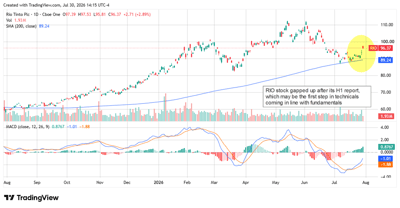
Despite the strong results, RIO shares have pulled back from 2026 highs near $110. The stock now trades around $96, still well above its 200-day moving average near $89. It's also about 9% below its consensus price target of $105.50. That gap between fundamentals and price action is worth watching.
The daily chart shows a bullish MACD crossover forming in recent sessions, with the MACD line at 0.88 crossing above the signal line at -1.01. That's typically an early momentum signal. Shares are also up nearly 3% following the earnings release, suggesting the market is still digesting just how strong the results were.
The disconnect may reflect broader sentiment toward miners rather than concerns specific to Rio Tinto. Investors have spent much of 2026 rotating toward technology and away from commodities. That rotation looks increasingly mistaken given the factors driving demand for copper, aluminum, and lithium.
AI Infrastructure Is Driving Demand for Industrial Metals
Three forces are converging to favor hard assets over the next several years. Higher bond yields raise the cost of capital for speculative growth stories. Oil supply disruptions, including the Middle East tensions cited in the report, raise energy input costs across the board. Rio Tinto's diesel costs alone rose by $0.8 per ton year over year because of higher oil prices.
At the same time, AI infrastructure buildout requires enormous quantities of copper and aluminum. Data centers need grid capacity, transmission lines, and backup power, all of which are copper-intensive. Rio Tinto's guidance indicates that copper production will grow to 800,000 to 870,000 tons for the full year 2026.
This isn't a story about one commodity. It's about physical inputs becoming the bottleneck for the next phase of economic growth. Companies that own the mines, rather than just the technology layer, may capture outsized value.
Key Risks Investors Should Watch
Not every signal is favorable. Iron ore prices dipped modestly during the first half, and IOC production in Canada fell 22% year over year. The Oyu Tolgoi tax dispute with Mongolia, involving $443 million paid under protest, adds geopolitical risk to the copper growth story.
Currency headwinds were also present in the results. A weaker U.S. dollar against the Australian and Canadian dollars reduced underlying EBITDA by $700 million. If the dollar continues weakening, that pressure could persist. Investors should weigh these risks against the productivity and diversification tailwinds.
Rio Tinto Offers Long-Term Exposure to AI and Infrastructure
Rio Tinto's first-half results showed what a well-diversified physical-asset business can deliver in a favorable pricing environment. Free cash flow was up 75%, dividends rose 43%, and copper EBITDA nearly doubled — all of which support the underlying thesis. Hard assets are becoming harder to ignore.
For investors building portfolios around the next several years of higher rates, energy uncertainty, and AI infrastructure spending, Rio Tinto offers direct, diversified exposure. The stock's pullback from 2026 highs, despite improving fundamentals, may represent an entry point rather than a warning sign.
3 Unique AI Software Plays With Strong Analyst Support
Authored by Nathan Reiff. Originally Published: 7/29/2026.

Key Points
- Amid an ongoing AI market correction, three smaller AI software companies, Klaviyo, Similarweb, and Braze, have recently received analyst rating upgrades or price target increases.
- Klaviyo posted 28% year-over-year revenue growth and raised guidance, though it has fallen roughly 40% year to date despite about 65% analyst-projected upside.
- Similarweb and Braze both show strong fundamentals, with Similarweb landing $47 million in new contracts and Braze reporting 30% revenue growth and expanding margins.
- Special Report: Everyone wanted SpaceX. Smart money wants this.
The AI market correction is an early and significant test of investors' resilience in the space. While even some of the biggest tech stocks with an AI footprint have lost ground in recent weeks, smaller and less-proven names may be particularly volatile.
For aggressive AI bulls who are unafraid to take on heightened risk amid the turbulence, there may be opportunities to buy the dip and eventually reap significant rewards.
Elon’s big $266,000 per second purchase (Ad)
Elon Musk bought Super Bowl ad time at $266,000 per second - something he has never done before. 125 million Americans watched, but Whitney Tilson, former manager of a $200 million hedge fund, says most investors missed what it actually means.
With 1 in 3 Super Bowl viewers using buy-now-pay-later services and 40% of Americans carrying more credit card debt than savings, Tilson believes Elon's message reveals a major economic current - and a clear signal for where smart money should be positioned.
Watch Tilson's free presentation to see what he thinks you should do nowLesser-known AI software companies may be a good place to start searching for potential candidates, although it helps to have some reassurance that these firms have strong fundamentals. Each of the companies below has recently received a ratings upgrade or price target increase from one or more Wall Street analysts.
Despite a Crowded Field of Competitors, Klaviyo Finds a CRM Niche
Klaviyo Inc. (NYSE: KVYO) operates a customer data platform and provides marketing automation software used by e-commerce businesses. The company's tools help clients personalize communications and customer support using AI. This makes Klaviyo a competitor to larger rivals like Salesforce (NYSE: CRM), although it caters more to smaller companies than those seeking enterprise customer relationship management (CRM) solutions.
Over the last several weeks, KVYO shares have received a new Buy rating from Goldman Sachs analysts and a $3 price target increase from Citigroup. The stock has a Moderate Buy rating overall, with 18 Buys compared with just three other ratings. Wall Street sees about 65% upside for KVYO, a significant turnaround after the stock shed roughly 40% year to date (YTD).
Klaviyo's fundamentals may support this growth, as shown in its Q1 2026 earnings report. Revenue climbed 28% year over year (YOY), while the firm achieved its highest-ever non-GAAP operating margin. Management also raised its full-year guidance for revenue and operating income, citing the strength of the company's AI-driven products, such as Composer and Customer Agent.
A catalyst from an upcoming earnings report could help reverse the recent decline, but Klaviyo must contend with carrier fees. The company has absorbed those fees so far, but they could pose a greater threat as its business grows.
A High-Risk, High-Reward Proposition in Similarweb
The smallest of these three companies and, in some respects, the riskiest for investors at this stage, Similarweb Ltd. (NYSE: SMWB) uses AI to collect and analyze data from internet traffic, app usage and other sources to provide customer analytics tools for businesses. Its proprietary dataset is a strong asset, as is its ability to serve clients across enterprise businesses, investor groups, government agencies and other organizations.
A major price target increase from Citigroup analysts in July may have helped raise SMWB's visibility among investors, but the stock remains a consensus Hold overall. Interestingly, it has largely bucked the AI industry dip and is down only about 5% YTD, while still retaining 17% upside potential.
In June, Similarweb announced two multi-year enterprise contracts representing a combined $47 million in total contract value over the coming three years. This is a major development for the company and a signal that it is gaining recognition for its ability to train large language models (LLMs). If it can maintain this trajectory, the company may be able to accelerate revenue growth beyond the 10% YOY improvement reported in the last quarter.
Braze Builds Stability Amid Growing Revenue, Margins, and Free Cash Flow
Braze Inc. (NASDAQ: BRZE) is also in the marketing automation business, like Klaviyo. While the companies take different approaches, Braze also faces threats from established competitors such as Salesforce. One thing that distinguishes Braze from Klaviyo is its focus on enterprise customers, which gives it a large addressable market. The company has also demonstrated strong customer retention.
Braze appears to have the strongest ratings profile of the three companies, with 19 Buys and just a single Sell. JPMorgan Chase analysts increased their price target earlier in July, bringing the potential upside based on a consensus price target of $34.76 to about 40%.
With $211 million in revenue last quarter, representing a 30% YOY improvement, Braze also has a solid sales foundation. Margins are improving, with management expecting a 400-basis-point expansion in operating margin for the full year. Free cash flow is also emerging, with Braze reporting $27 million in the latest earnings report. These results reflect strong customer momentum, net additions and the firm's standout AI products. While competition remains fierce, Braze is establishing itself as a solid option among smaller AI software providers.
This email content is a paid advertisement provided by Priority Gold, a third-party advertiser of MarketBeat. Why did I receive this message?.
This is an advertisement.
If you no longer wish to receive promotional messages from this advertiser, please unsubscribe here. Or write to: 5005 Lyndon B. Johnson Fwy. Suite 350 Dallas, TX 75244
If you need help with your account, please feel free to email our U.S. based support team at [email protected].
If you would no longer like to receive promotional emails from MarketBeat advertisers, you can unsubscribe or manage your mailing preferences here.
© 2006-2026 MarketBeat Media, LLC. All rights reserved.
345 N Reid Pl., Sixth Floor, Sioux Falls, South Dakota 57103-7078. United States..