 Dear Reader, I hope you have enjoyed the relative stability of the stock market during first half of 2026 to the fullest. Because two massive economic forces are colliding in real-time, and the result is set to upend everything we thought we knew about investing. The first force: We're living through the fastest rate of technological change in human history. AI isn't just disrupting a few tech companies — it's threatening to make the world we know unrecognizable in just a few years. The second force: Trade relationships and peace deals that have held our global economy together for decades are hanging by a thread. If that thread breaks, we're looking at an era of chaos that will make 2008 look like a minor correction. I call what's coming The Age of Chaos. And almost no one I talk to is prepared for it. Not yet anyway. The Age of Chaos isn’t just another market cycle where you will eventually see the light at the end of the tunnel. The Age of Chaos is a fundamental reshaping of the economic order. And when the dust settles, we'll be managing our money in a completely different investment landscape. The wealth transfers will be historic. People who are wealthy today could be penniless when this decade ends. While those who position themselves correctly right now could build massive wealth. The great restructuring of the stock market is already happening: Reliable, household-name companies that fund managers have loved for years are getting crushed in 2026: - Intuit: -57%
- Boston Scientific: -49%
- Tractor Supply: -40%
Meanwhile, a surge of dynamic companies positioned for this new world are exploding higher: - Sandisk: +573%
- Rackspace: +444%
- Atomera: +262%
This isn't random market volatility. This is the beginning of an irreversible economic division that's just getting underway. And here's the uncomfortable truth:Many of the companies that could fail in The Age of Chaos may already be sitting in your portfolio right now. Names that have seemed untouchable throughout history. Names that every "expert" tells you to buy and hold forever. Names that could rob you of your hard-earned savings if you don't act soon. But I didn't reach out to you today to spread doom and gloom. I wrote because there's a way to protect yourself and potentially profit from what's coming. It starts with understanding which companies are on the brink right now... and which are positioned to thrive in The Age of Chaos. I'll show you the names and tickers of specific companies I believe you should sell before they crater, including some that might shock you. These aren't fly-by-night operations. These are companies that have been market darlings for years – and are still overweight in many investors’ accounts. More importantly, I'll share the names and tickers of the companies you can upgrade to that could multiply your money in the coming months. Companies that aren't just surviving this transformation but driving it. For instance, while everyone's focused on whether Tesla will get a much-needed lifeline from Space X, I've identified a little-known company that was just tapped as Nvidia's self-driving partner, already putting them miles ahead of Tesla in the autonomous driving race. (Get the ticker FREE here.) I've also got details on what could be the biggest megadeal in the AI space this year – a potential rupturing of the company referred to as "the unseen winner of the AI race." This company could soon split up into three of the hottest new AI stocks of 2026. If it does, all you have to do to automatically get shares in all of them is buy this stock NOW. It's a once-in-a-blue-moon opportunity you do not want to let pass you by. I'm giving away all of this analysis completely freein this broadcast. No membership required. No credit card. Just the unvarnished truth about what I see coming and how to position yourself for it. The Age of Chaos isn't something that might happen. It's already underway. Knowing the names and tickers of these stocks could mean the difference between winning and losing in the months ahead. Stream my free presentation today right here– and get all my carefully selected buys and sells now. Sincerely, Marc Chaikin
Founder, Chaikin Analytics
Special Report SpaceX: Love the Company, But the Stock Is a Harder CallWritten by Thomas Hughes. Date Posted: 8/5/2026. 
Key Points- SpaceX posted strong quarterly revenue growth of 92% year-over-year, but persistent cash burn and heavy capital expenditures continue to pressure its financial outlook.
- The stock trades at over 200 times earnings and a $1.4 trillion valuation, leaving little room for error and significant downside risk even after its post-IPO decline.
- Upcoming insider lockup expirations, rising short interest, and exclusion from major indices like the S&P 500 present near-term risks that could outweigh analysts' optimistic price targets.
- Special Report: This tiny piece of glass could be bigger than GPUs
SpaceX (NASDAQ: SPCX) is a compelling company to follow and admire, as it is well-positioned in the global race to commercialize space. It offers numerous opportunities for humanity and investors, but now may not be the best time to buy the stock. Still suffering from its post-IPO malaise, the stock shows signs of forming a bottom but has yet to confirm one. In the current scenario, SPCX is just as likely to continue its downtrend as it is to recover, and there is more impetus to sell than to buy. Critical details from the initial earnings report include cash burn: SpaceX is effectively fueling its rockets with cash while launching more rockets at a faster pace each quarter. In this environment, short sellers are a risk that cannot be ignored, and early signs suggest they are leaning into the trade. MarketBeat’s data reveal that short interest as of July 15 was low, but it has risen steadily since the IPO and appears likely to continue rising until another catalyst emerges. 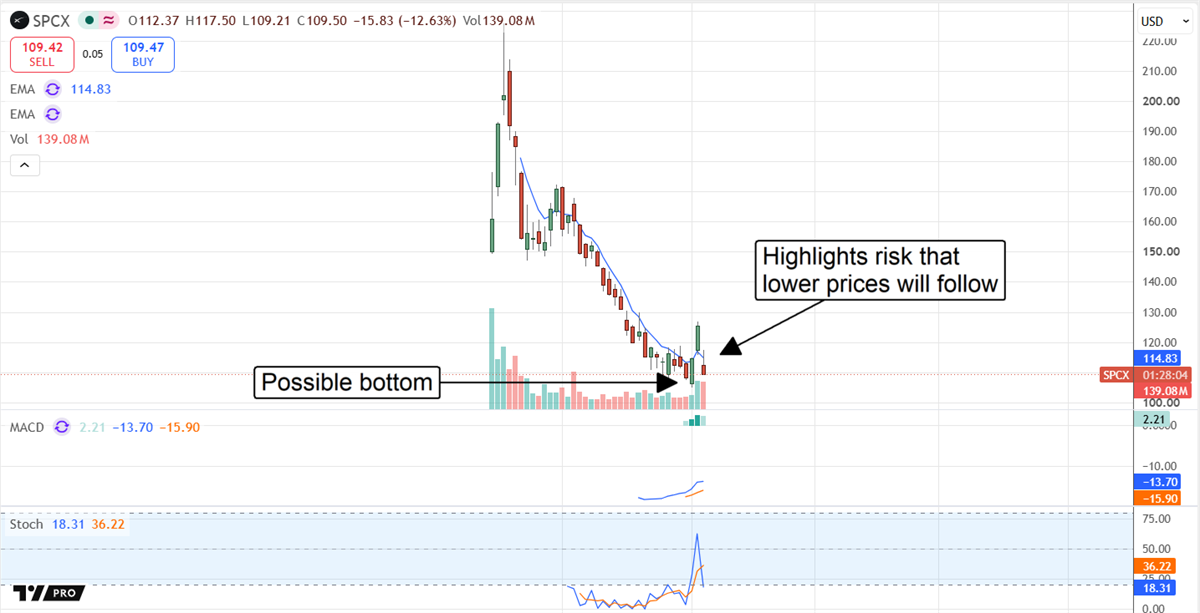
SpaceX Has a Great Quarter, but Cash Burn Remains a ProblemSpaceX had a great quarter, with growth across all segments. Systemwide, revenue increased 92% year over year, outpacing the consensus estimate by nearly $1 billion. The $7.8 billion reported was 1,300 basis points better than expected, underpinned by strength in AI. AI grew by more than 200%, while Connectivity grew by 66%, making them the two largest and most important segments. At nearly 88% of net revenue, they make the “Space” in SpaceX almost an afterthought—one that is absorbing profits from the other two segments. Margin details highlight the importance of Connectivity, the single largest segment, to the near-term outlook and AI to the long-term outlook. Connectivity, which includes Starlink, is the only profitable segment, and its profitability has so far been insufficient to offset losses in the others. The good news is that losses in the AI segment are tied to data center capacity that is expected to come online over the next few months and quarters. The segment should at least begin generating profits within the foreseeable future, while the Space segment may continue burning cash indefinitely. Guidance was optimistic but presents a hurdle for the market. The company says it is on track to reach a $100 billion annual run rate by year-end and $1 trillion in annual revenue by 2030. These updates signal that the capacity ramp is progressing smoothly, but the company must now meet those targets. The risk is that the targets will not be met and profits will fail to impress, given the high expectations and ongoing cash burn. CFO Bret Johnson says capital expenditures (CapEx) will remain similarly high in upcoming quarters, well above what market forecasts initially predicted. Analyst Optimism May Not Be Enough to Support Price ActionAnalysts are optimistic about SpaceX’s future and show a high level of conviction. The 39 analysts tracked rate the stock as a Moderate Buy, with a 72% Buy-side bias and triple-digit upside potential. However, they may begin tempering their outlook as expectations for cash burn increase. In this scenario, a downshift in analyst sentiment could send SPCX into a freefall, with the stock not recovering until earnings traction is regained. Institutional investors are likewise a risk, as they may remain on the sidelines until SpaceX offers them an incentive to buy—and spending money is not the way to do it. The Risks SpaceX Bulls Are UnderestimatingSpaceX’s biggest risk lies in its valuation. Even after the post-IPO sell-off, the company is valued at more than $1.4 trillion, with the market pricing in robust growth. Assuming SpaceX can execute its strategy, scale launches and expand margins, the stock trades at pennies on the dollar relative to the 2035 consensus estimate. However, that forecast is predicated on flawless execution, leaving the stock at a precariously high valuation today. At recent prices, the stock could shed another 50% and still be highly valued. There is upside potential for this market, but the risks far outweigh the rewards. What SpaceX bulls underestimate comes down to a handful of costs and risks: the immense expense of space development, the company’s parallel AI buildout, the drag that thin profitability puts on market dynamics and insider lockups set to expire on a staggered schedule. Those lockups are the sharpest near-term risk, as they open the door to billions in insider sales, with the first tranche unlocking alongside the second-quarter earnings report. Additionally, uncertain profitability is a barrier to institutional ownership, particularly from indices such as the S&P 500, which influence trillions of dollars in underlying investment. S&P Dow Jones denied the company early approval, choosing instead to enforce the 12-month listing and GAAP profitability requirements.
This ad is sent on behalf of Chaikin Analytics, 201 King Of Prussia Rd., Suite 650, Radnor, PA 19087. If you would like to optout from receiving offers from Chaikin Analytics please click here. | 
