Hello,
Welcome to our flagship newsletter, MarketBeat Daily Ratings.
We'll deliver the latest "Buy" and "Sell" ratings from Wall Street's top-rated analysts directly to your inbox each morning.
But first, we need you to do two quick things:
1. Hit reply, and send a simple "Yes." Just one word. This tells Google (and other emails providers) that you actually want to get our newsletter.
2. After that, this link to confirm your subscription. That will tell us that you received our welcome email and that we should start sending your daily report.
Confirm your subscription here.
After you have completed these two steps, we would like to gift you a free copy of one of our most popular investing reports: 7 Stocks to Buy and Hold Forever. You can download the report with this link.
Thank you again for subscribing. We look forward to being an important part of your investing journey

Matthew Paulson
Founder and CEO, MarketBeat.
P.S. If you didn’t intend to subscribe, no problem—you can unsubscribe with this link.
(ARReply-161)
Saturday's Bonus News Broadcom’s $200 Billion Samsung Deal Shows How Costly the AI Memory Race Has BecomeAuthor: Leo Miller. Posted: 7/29/2026. 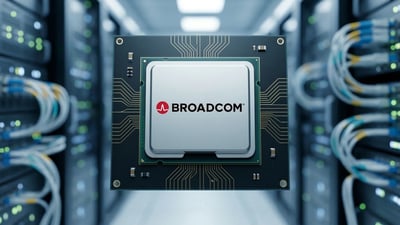
Key Points- Broadcom and Samsung Electronics announced a five-year, over $200 billion agreement under which Broadcom will purchase memory and other chips from Samsung.
- The deal secures Broadcom's supply of High Bandwidth Memory amid shortages and price spikes, supporting its AI accelerator growth and potentially limiting margin pressure.
- The agreement also covers Samsung's 2-nanometer foundry process and may extend to advanced packaging, offering Broadcom a potential alternative to TSMC's constrained capacity.
- Special Report: Forget SpaceX. Buy the company Musk can't replace.
Broadcom (NASDAQ: AVGO) is back in the news with another multibillion-dollar semiconductor deal. This time, however, Broadcom is not on the receiving end of the commitment. Broadcom and memory-chip giant Samsung Electronics (OTCMKTS: SSNLF) have announced a five-year agreement valued at more than $200 billion, under which Broadcom will purchase various chips from Samsung.
Although this represents money going out rather than coming in, there are still meaningful positives to take away from the deal. Most notably, the agreement will help Broadcom capitalize on demand for AI chips by securing the supply of a vital component. Let's examine the details and what the agreement could mean for Broadcom going forward.
Broadcom and Samsung’s Memory Pact: Securing Supply to Realize Growth
Gold is hitting record highs, but most investors are leaving income on the table. A $15 fund is quietly paying out up to $1,152 a month to regular investors - no mining stocks, no options, no physical metal required.
Chief Income Strategist Tim Plaehn calls it a breakthrough strategy that transforms gold's rally into reliable monthly payouts. The next distribution is just days away. Discover the gold income fund before the next payout date The deal contains two primary components, which Samsung outlines in the corresponding press release. The first relates to memory, with “Samsung and Broadcom plan to pursue a strategic collaboration for the supply of industry-leading memory solutions, including High Bandwidth Memory (HBM), supporting Broadcom’s next-generation AI accelerators.”
Broadcom is securing a supply of Samsung’s HBM, a critical component of AI accelerators. The agreement comes amid a severe shortage of HBM and other memory products. For Broadcom, investors can view this deal as a necessary expense as the company seeks to capitalize on its massive AI accelerator opportunity.
Notably, the firm expects its AI semiconductor revenue to grow by more than 200% year over year to $16 billion. With 10 gigawatts of data center commitments from large language model developers, Broadcom may have a path to generate $200 billion in AI semiconductor revenue in 2027 or beyond.
However, HBM is a non-negotiable component of AI accelerators. Without it, the vast majority of Broadcom’s AI semiconductor opportunity could disappear. As a result, Broadcom needs to secure HBM supply, particularly given NVIDIA's (NASDAQ: NVDA) massive HBM purchases.
Another potential benefit of the multiyear agreement with Samsung is that it could help shield Broadcom from HBM price volatility. Memory prices have seen dramatic increases, with HBM prices reportedly rising by 20% in the first quarter alone. The deal could potentially limit future price increases, helping prevent margin contraction at Broadcom.
Broadcom Follows in NVIDIA’s Memory Footsteps
Speaking of NVIDIA, the company recently announced a similar partnership. NVIDIA and SK hynix (NASDAQ: SKHY) entered a $500 billion deal that “allows NVIDIA to secure a stable supply of next-generation AI memory.” The deal also includes a two-gigawatt data center deployment, under which SK Group, SK hynix’s parent company, will use NVIDIA's Vera Rubin systems. In this sense, a significant amount of revenue may also flow to NVIDIA. However, the overwhelming majority of the deal is likely centered on NVIDIA’s purchase of HBM from SK hynix.
Broadcom is clearly not alone in recognizing the need to pay up for HBM, demonstrating that it is acting strategically to advance its interests.
Broadcom Eyes Samsung’s Advanced Packaging
The second part of the deal involves Samsung’s foundry, where it manufactures non-memory chips. The collaboration “focuses on Samsung’s 2-nanometer (nm) and below process technologies for Broadcom’s products, including Wireless Broadband Communications (WBC) solutions. The collaboration is expected to extend to advanced packaging technologies built on Samsung’s 2nm process, including 2.3D and 2.5D integration, to enable higher-performance and more power-efficient AI and networking silicon.”
The Wireless Broadband Communications component does not appear to be AI-related. Rather, it likely refers to Broadcom’s wireless and smartphone chip business. Producing these chips with Samsung may help Broadcom fulfill its $30 billion deal with Apple (NASDAQ: AAPL) to supply wireless chips.
However, the advanced packaging portion is AI-related. Advanced packaging is critical to building sophisticated AI chips because it combines HBM with computing components. This part of the agreement suggests that Broadcom is considering Samsung’s advanced packaging technology for its AI chips. However, the release only says that the agreement is “expected to extend” into advanced packaging, indicating that nothing is set in stone.
This is notable because Taiwan Semiconductor Manufacturing (NYSE: TSM) has dominated the advanced packaging market. TSMC's advanced packaging operations are also facing significant supply shortages. In this context, it makes sense for Broadcom to explore Samsung as an alternative advanced packaging supplier. If Samsung’s advanced packaging capabilities prove adequate for Broadcom’s needs, the company may be able to sell more chips than it otherwise could.
Broadcom and Samsung: Do the Advanced Packaging Stars Align?
Broadcom is taking the necessary steps to execute on its long-term data center opportunity. Going forward, investors may want to monitor whether Broadcom cites margin benefits from its long-term deal with Samsung. It is also worth watching whether Broadcom ultimately adopts Samsung’s advanced packaging technology and whether management believes it will benefit the firm’s growth. |