Hello,
Welcome to our flagship newsletter, MarketBeat Daily Ratings.
We'll deliver the latest "Buy" and "Sell" ratings from Wall Street's top-rated analysts directly to your inbox each morning.
But first, we need you to do two quick things:
1. Hit reply, and send a simple "Yes." Just one word. This tells Google (and other emails providers) that you actually want to get our newsletter.
2. After that, this link to confirm your subscription. That will tell us that you received our welcome email and that we should start sending your daily report.
Confirm your subscription here.
After you have completed these two steps, we would like to gift you a free copy of one of our most popular investing reports: 7 Stocks to Buy and Hold Forever. You can download the report with this link.
Thank you again for subscribing. We look forward to being an important part of your investing journey

Matthew Paulson
Founder and CEO, MarketBeat.
P.S. If you didn’t intend to subscribe, no problem—you can unsubscribe with this link.
(ARReply-161)
This Month's Exclusive Article Why SK hynix Could Be the Best AI Chip Stock to Buy NowSubmitted by Thomas Hughes. Article Published: 7/29/2026. 
Key Points- Analysts remain bullish on SK hynix despite a Q2 revenue miss, citing strong margin growth and over 100% upside potential across coverage.
- SK Hynix is expanding capacity through a major NVIDIA deal and doubling wafer output, driven by surging AI-related HBM and DRAM demand.
- Risks include execution and competition from Micron, but analysts argue the AI-driven memory upswing is structural and still in its early stages.
- Special Report: Everyone wanted SpaceX. Smart money wants this.
Given SK hynix’s (NASDAQ: SKHY) dominant position in digital memory—and high-bandwidth memory (HBM) in particular—it is a good stock to own, perhaps one of the best for 2026 and the next few years.
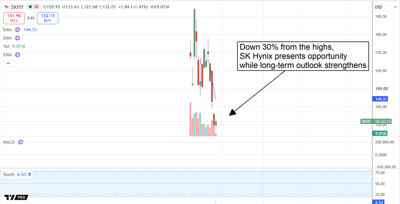
The biggest risk for U.S. investors is the hype and premium surrounding the recently listed American Depository Receipts (ADRs), which have impaired the risk-reward profile. As July comes to an end, however, the premium is eroding and opening the buying opportunity that smart money has been waiting for.
Analysts Stay Bullish on SK hynix Despite the Q2 MissWhitney Tilson of Stansberry Research has long recommended Berkshire Hathaway as a core retirement holding - but now he believes he's found something better.
This under-the-radar company sits at the intersection of America's two most important industries, including AI, pays massive dividends, and attracted a famous money manager who put 60% of his multi-billion-dollar fund into it. Tilson is revealing the name and ticker symbol completely free - no credit card or email required. Get the stock name and ticker symbol free of charge today Analyst sentiment remains firm, pointing to significant upside for the stock, both in the South Korean shares and the ADRs. Sentiment was not impaired by the weakness in Q2 earnings. The weaknesses were linked to timing, product mix, and shifts related to the launch of next-generation HBM products, which are scheduled to ramp in the second half of the year.
Analyst coverage of SKHY on MarketBeat is slim, with only three analysts tracked, but it is robust when combined with coverage of the South Korean market. Together, the 40 current reports reflect a Moderate Buy/Strong Buy consensus and more than 100% upside potential. The consensus among U.S.-listed analysts suggests 150% upside, a target echoed in coverage of competitor Micron (NASDAQ: MU).
SK hynix Misses a High Bar With a Robust QuarterSK hynix missed consensus revenue estimates, but the bar was set high: 100% of analysts had raised their targets since the last report, while whispers suggested growth of as much as 300% was possible.
The critical details from the release include a 257% year-over-year increase, sequential acceleration, and the margin strength those gains produced. Top-line results were underpinned by AI, with DRAM and HBM pricing compounding volume gains. Other end markets, including PCs and smartphones, were less robust but remain supply-constrained, a situation expected to improve over time.
SK hynix, aided by capital raised through its U.S. listing, aims to double chip wafer capacity within the next five years. A deal with NVIDIA (NASDAQ: NVDA) is also in the works, with the goal of scaling capacity across multiple production clusters to support AI infrastructure needs. Valued at more than $500 billion, the deal also secured years of future memory supply, cementing SK hynix’s growth trajectory and pricing power.
Q2 margin news was stellar. Surging demand, pricing power, and capacity utilization drove margin gains down the stack. Critical details included a 557% increase in operating profit and guidance that pointed to increasing and broadening demand tied to high-performance computing and inference needs. The company also mentioned 10 new long-term agreements with hyperscale clients, confirming a structural shift in the memory market. Memory is no longer a niche market constrained by quarterly pricing fluctuations; it is now a critical piece of digital infrastructure commanding multiyear contracts and greater price stability.
SK hynix’s Biggest Risks? Execution and CompetitionSK hynix’s biggest risks are execution and competition. Supply constraints, capacity expansion, and the risk of oversupply could limit growth prospects and set the market up for a massive correction. At the same time, competitors such as Micron are working hard to capture market share while expanding capacity to meet demand. That could threaten SK hynix’s future growth and increase the risk of market oversupply. The caveat is that AI spending plans have yet to be curtailed, leaving the fundamental story intact. In addition, signs suggest the AI memory upswing is only beginning.
This year’s catalysts include product launches. HBM4 began shipping in Q2, but the product ramp is slated for the second half of the year, which should unlock additional GPU supply chain capacity. HBM4 is critical to Vera Rubin production, which, in turn, is critical to AI data center buildout. Oracle’s (NYSE: ORCL) contracts, for example, are heavily back-ended and dependent on capacity and computing power yet to be unleashed. Other launches include industry-specific solutions for mobility and personal computing, which are forecast to drive growth.
AI Memory Demand Is Structural, Not CyclicalWhat the market gets wrong about SK hynix and other memory leaders is that AI is not a typical cyclical blip in the memory chip demand cycle. It is a structural shift that is gaining momentum. While the push for training infrastructure may slow, it is giving way to inference, which requires exponentially more memory. Each query requires a new memory dump, and the number of queries is growing daily as models become more complex. The takeaway is that the memory cycle is not ending, as some fear. Instead, it may be in its earliest phases and could accelerate over the next few quarters.
Dividends, Buybacks, and a Cash Flow StoryInvestors can also benefit from SK hynix’s cash flow. The company is committed to returning capital, paying a baseline dividend with contingencies to increase payments as income improves. The Q2 release reaffirmed that commitment and raised the stakes, indicating an intention to accelerate returns, potentially through share buybacks. ADR holders are entitled to a proportional share of distributions, which are expected to be paid each quarter. |