Hello,
Welcome to our flagship newsletter, MarketBeat Daily Ratings.
We'll deliver the latest "Buy" and "Sell" ratings from Wall Street's top-rated analysts directly to your inbox each morning.
But first, we need you to do two quick things:
1. Hit reply, and send a simple "Yes." Just one word. This tells Google (and other emails providers) that you actually want to get our newsletter.
2. After that, this link to confirm your subscription. That will tell us that you received our welcome email and that we should start sending your daily report.
Confirm your subscription here.
After you have completed these two steps, we would like to gift you a free copy of one of our most popular investing reports: 7 Stocks to Buy and Hold Forever. You can download the report with this link.
Thank you again for subscribing. We look forward to being an important part of your investing journey

Matthew Paulson
Founder and CEO, MarketBeat.
P.S. If you didn’t intend to subscribe, no problem—you can unsubscribe with this link.
(ARReply-161)
This Month's Exclusive Story Why These 3 Nuclear ETFs Are Getting a Fresh Look as AI Power Demand RisesWritten by Nathan Reiff. Publication Date: 7/19/2026. 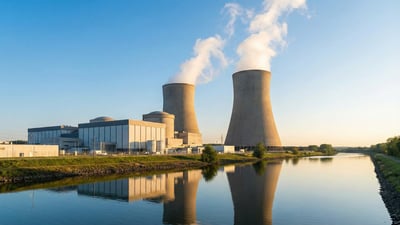
Key Points- Nuclear energy has gained renewed policy support as artificial intelligence and data center demand increase the need for reliable electricity.
- The VanEck Uranium and Nuclear ETF offers broad exposure to uranium miners, nuclear utilities, reactor services and related infrastructure companies.
- The Sprott Uranium Miners ETF and Global X Uranium ETF provide more targeted uranium exposure, though their portfolios and risk profiles differ.
- Special Report: The company SpaceX cannot operate without
More than a year after the federal government renewed its push toward nuclear energy, the industry is building momentum thanks to a streamlined process for reactor authorization, an ambitious goal of adding 300 gigawatts of capacity by 2050, and more. The timing is crucial, as demand for electricity from AI continues to grow, making low-carbon energy generation from nuclear facilities particularly appealing.
To be sure, challenges remain. Sourcing the high-assay low-enriched uranium (HALEU) necessary for some next-generation reactors is difficult, while supply chain and manufacturing limitations, workforce shortages, and the licensing process can all slow the industry's ability to deliver nuclear energy quickly. Still, as the industry continues to evolve and grow, a number of exchange-traded funds (ETFs) can provide investors with exposure to the potential growth opportunities in the nuclear industry. Now may be a good time to explore these options, as a 2026 sell-off following a previous successful run could present buy-in opportunities.
A Selective Basket of Global Nuclear StocksThe Wall Street Journal is already raising the alarm about a potential market crash, and Weiss Ratings research points to the first half of 2026 as a particularly rough stretch for certain holdings.
Some of America's most popular stocks could take serious damage as a radical market shift plays out. Analysts at Weiss Ratings have identified five names you may want to remove from your portfolio before this unfolds.
If any of these are in your portfolio, now is the time to review your positions. See the 5 stocks to avoid The VanEck Uranium and Nuclear ETF (NYSEARCA: NLR) is one of the oldest nuclear industry ETFs on the market, having launched in the summer of 2007. The fund's staying power may be due to its broad strategy within the industry, providing access to the full nuclear power generation process, from the sourcing and production of input materials to companies operating power plants and more.
NLR achieves this mix despite its fairly small basket of 32 stocks. With a targeted portfolio like this, investors should expect some names to receive sizable allocations; indeed, the largest positions each represent 8% or more. Still, given its global focus, NLR can direct its assets toward some of the most stable and strongest-performing nuclear stocks available worldwide, aiming to provide both breadth and quality.
Like many nuclear funds, NLR's year-to-date (YTD) performance is in the red: The ETF has declined by almost 12% in 2026. This valuation reset across the industry could provide an opportunity, although investors must be willing to accept NLR's 0.56% expense ratio while they wait for momentum to build again.
A Unique Play on Uranium Miners With a Commodities TwistFor a more targeted play on uranium itself, investors might consider the Sprott Uranium Miners ETF (NYSEARCA: URNM). This fund invests primarily in companies involved in the uranium mining industry, including those that explore, develop, produce, or hold physical uranium. This is a niche industry, and URNM has only 31 holdings based on a global screen. Given the significant overlap between URNM's portfolio and NLR's holdings, investors are unlikely to want to hold both funds at the same time.
Three positions in URNM's basket collectively make up nearly half of the fund's total assets. These include uranium providers Cameco Corp. (NYSE: CCJ) and NexGen Energy (NYSE: NXE), while the third stands out: a position in the Sprott Physical Uranium Trust, which holds physical uranium. Thus, URNM is partly a commodities play on uranium itself. This may help explain why the fund is somewhat more expensive than several of its nuclear peers, with an expense ratio of 0.75%.
Despite its YTD decline, URNM offers a dividend yield of 2.59%, providing a passive-income perk even as the nuclear industry undergoes a reset.
An Alternative Approach to Uranium With a Standout Dividend YieldA competitor of URNM, the Global X Uranium ETF (NYSEARCA: URA) also focuses on the material essential for nuclear power. However, URA accesses uranium through shares of companies involved in mining and production rather than through any type of direct investment in the commodity itself. URA has the broadest portfolio of these three ETFs, with about 56 holdings from developed markets around the world. Still, it is, in some ways, also the most concentrated: Cameco shares make up nearly a quarter of the fund.
URA's expense ratio of 0.69% lies between the fees of the two funds discussed above. It also has a solid asset base of $5.7 billion and hearty trading volume to match. This makes the fund appealing to investors seeking the flexibility to trade frequently without worrying about liquidity. It may also reflect the ETF's strong dividend yield of 5.26%. While URA has also slipped so far this year, it has held up better than the other uranium-focused funds on this list. |