ALERT: Drop these 5 stocks before the market opens tomorrow! 
UPS Just Gave Investors a Second Chance to Buy
Written by Thomas Hughes on July 29, 2026

Key Points
- UPS stock's post-earnings pullback appears to be a buying opportunity, as technical patterns suggest the shares have bottomed and could reverse higher toward $155.
- Analysts maintain a consensus Hold rating with a $111.50 price target, while institutions continue accumulating shares, holding more than 60% ownership and limiting downside risk.
- UPS yields about 6.1% and is expected to resume dividend increases, though a costly operational overhaul and flat near-term domestic demand remain key risks.
- Special Report: This tiny piece of glass could be bigger than GPUs

The market read UPS's Q2 earnings release as a reason to sell UPS (NYSE: UPS) stock. In reality, it looked more like a reason to buy.
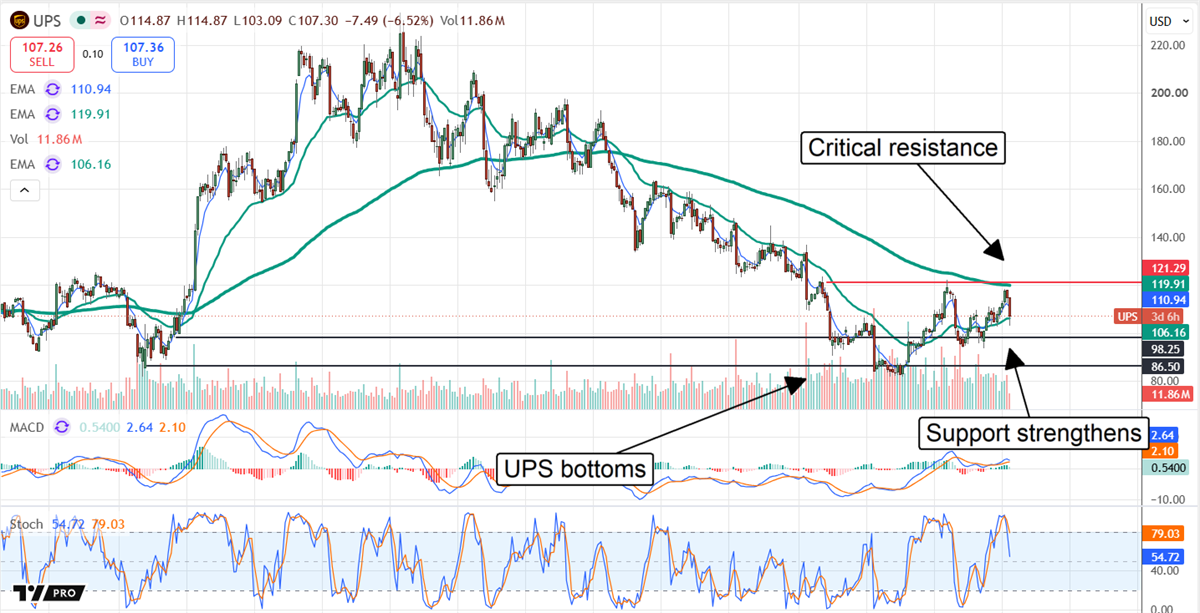
In this context, the approximately 5% pullback in the stock price is an entry point, coinciding with technical signals. After two years of recovering from the loss of its Amazon (NASDAQ: AMZN) contract, the impact on business, turnaround efforts, and a market reset, UPS stock has bottomed, and its market is in a reversal.
The pattern in play is a Head & Shoulders that is slowly gaining traction. The late-July price pullback suggests that consolidation is still underway; the upward bend in the 30-week exponential moving average says support is strengthening and an inflection is at hand.
The critical resistance point is near $120, aligning with the long-term 150-week EMA and the pattern's neckline, a technical pivot point that brings robust targets into play if crossed. In that scenario, a move to new highs confirms the signal, suggesting the neckline is a midpoint of a much larger move toward $155 or higher.
Apple just crossed a $5 trillion market value as shares climbed 25% this year, fueled by new product launches and rising interest in foldable phones.
Mode Mobile is building on top of that ecosystem with its EarnOS platform, already serving 490M+ users across 170+ countries and generating $115M+ in lifetime revenue.
Deloitte ranked Mode North America's number 1 fastest-growing software company in 2023 after 32,481% growth. Pre-IPO shares are available at $0.52 before the price changes on August 14. See how to invest in Mode Mobile before the August 14 deadline. Analysts Put Floor in UPS Market, Institution Offer Support
Analysts responded with cautious optimism, citing the top- and bottom-line strengths, but pointed to near-term headwinds, including the forecast for flat domestic business in the current quarter. No rating changes or price target adjustments were issued immediately after the release, leaving the trend intact.
The current trend includes firming sentiment and price targets following several quarters of downtrend, signaling a floor for traders. The 24 analysts tracked by MarketBeat assign a consensus Hold rating, with a $111.50 price target—only a modest upside but sufficient to keep this market well off of its 2026 lows.
The question now is how long it may take for analysts' sentiment to begin trending higher, and it may not be that long. UPS has successfully navigated its post-Amazon transition, returning to volume and pricing growth across segments.
The likely outcome is that Q3 guidance is overly cautious and outperformance will be logged. Either way, the Q2 strengths are expected to carry into the back half and underpinned management's decision to increase guidance.
Execs forecast more than $91 billion in full-year revenue, approximately 90 basis points (bps) more than expected, and adjusted earnings per share (EPS) targets are similarly strong.
Institutions are not getting this stock wrong. Their activity reflects solid ownership, with them holding more than 60% of the shares, and they are accumulating. MarketBeat data reveals an approximately $2 to $1 pace with early Q3 activity aligning with the trend. The likely outcome is that UPS’s late July price weakness sustains their appetite, limiting downside risk as the summer progresses.
UPS High-Yielding Dividend and Powerhouse Total Returns
UPS’ stock price recovery is tied to its capital return, which is reliable but came into question over the past year. While not in any real danger, management chose to freeze increases while it navigated its change. The two operational factors investors should be concerned with are that UPS stock yields about 6.1% with shares pulling back toward 2026’s lows, and dividend increases will be resumed. There is no indication of when, but this dividend powerhouse is on track to resume increases and may announce the intent at year’s end, producing a powerful catalyst for institutional investors, stock price gains, and investors' total returns.
UPS’ massive overhaul is among its biggest risks. Repositioning and workforce reductions led to over $800 million in quarterly charges in Q2 and may lead to additional charges in upcoming quarters. The offset is that repositioning and technology investment are reducing core operating costs and set the company up for margin expansion. CEO Carol Tomé intentionally built in what she calls the Bathtub effect, where front-loaded expenses impair GAAP results in the first half, but lead to margin expansion, cash flow, and free cash flow improvement in the back.
The balance sheet provides no red flags. While cash flow experiences strain, debt and leverage remain low and credit ratings firmly at investment grade. The risk here is with debt, but it was intentionally increased to help fund the company’s repositioning efforts. Execution delays won’t cause the company to fail, but they will be reflected in the stock’s price.
Other catalysts include peak-season price surges and expanding into healthcare. The company announced aggressive peak-season surcharges that are expected to drive revenue and margin, while healthcare acquisitions do the same. Healthcare presents a billion-dollar opportunity, as it requires highly specialized infrastructure, including climate control, and commands premium pricing.
Read this article online ›
Featured Articles

Did you learn something from this article?
 
| 