| Unsubscribe |
I've been trading for over 50 years.
And in all that time, the market has never stopped surprising me. New technologies, new products, new manias — the surprises are the job.
But here's what HASN'T changed in half a century: The same 4 scheduled events keep blowing up the same beginner trades, year after year after year. Different decades, different stocks, identical losses.
Not surprises. Scheduled events. Published in advance. Free to look up.
The traders who last learn to check those dates before every trade — it becomes as automatic as looking both ways at an intersection. The ones who don't... keep learning the same lesson at full price.
I finally put all 4 in one short report: What each event is, why it detonates options positions, and the 5-Minute Check that sweeps them all.
The Options Landmine Calendar. Normally $29.97. Free today.
Download it free here before your link expires.
Good Trading,
Bill Poulos
P.S. After 50+ years, I can tell you the most frustrating losses aren't the surprises. They're the ones that were on the calendar the whole time. Get the report free.
Peeling Out or Breaking Down? Ford’s High-Stakes Turnaround
Submitted by Jeffrey Neal Johnson. Article Published: 7/31/2026.

Key Points
- Ford beat adjusted earnings estimates and raised full-year guidance, but a $3.6 billion BlueOval SK impairment charge drove a GAAP net loss of about $1.3 billion.
- Ford Blue's profit surge came from price hikes on premium trucks despite an 8% volume decline, while Ford Pro's EBIT fell 26% due to aluminum supply disruptions and looming commodity headwinds.
- Ford Model e still expects a roughly $4 billion annual operating loss, and elevated leverage alongside a weak quick ratio raises questions about funding the costly EV transition.
- Special Report: The company SpaceX cannot operate without
When a legacy automaker reports a decisive earnings beat and raises its full-year guidance, the market naturally reacts with enthusiasm. The headline numbers from the second quarter paint an undeniable picture of operational momentum for Ford Motor (NYSE: F).
Management delivered adjusted earnings of 42 cents per share, handily beating consensus estimates of 33 cents, while revenue approached a robust $48.3 billion. Buoyed by these results, executives raised full-year adjusted EBIT guidance to a midpoint of roughly $10.5 billion.
He bet half his $9 billion on ONE stock (Ad)
One of the most successful fund managers of the past 50 years put more than $4.5 billion - over half his fund - into a single, little-known company. His firm then bought more shares for 61 straight trading days, and the former CEO of Google soon struck a nine-figure partnership with the same company.
This company controls nearly a million acres of scarce, irreplaceable minerals now protected by a White House executive order signed January 14, 2026. It has already outperformed Apple, Amazon, and the S-P 500 combined - and Whitney Tilson believes the biggest gains are still ahead.
Watch the free presentation and get the name and ticker nowOn the surface, these metrics suggest the automotive sector giant is successfully navigating a complex macroeconomic environment. Investors focused solely on adjusted operating profits and revenue beats might conclude that Ford is firing on all cylinders. A guidance increase often signals management's confidence in near-term demand and pricing stability. However, distinguishing adjusted operating metrics from a business's underlying cash-and-capital reality is critical to any stock analysis.
Lifting the Hood: Why GAAP Net Losses Matter
Beneath this non-GAAP optimism lies a much harsher reality. The headline adjustments obscure a GAAP net loss of roughly $1.3 billion for the quarter. The primary factor weighing on the bottom line was an impairment charge of about $3.6 billion related to the disposition of the BlueOval SK battery joint venture.
For fundamental investors, non-GAAP adjustments can provide management with a convenient way to minimize the impact of past miscalculations. Writing down billions of dollars in previous electric vehicle investments is not an accounting anomaly that can simply be ignored. It represents the loss of real shareholder equity and exposes severe capital misallocation in prior strategic initiatives.
Top-line resilience is currently masking structural margin vulnerabilities, a highly leveraged balance sheet and a capital-intensive strategy that has yet to prove its long-term viability. When management writes down an investment of this scale, it forces investors to question the return on invested capital for future projects.
The F-Series Lifeline: Squeezing Margins From Gas Trucks
To understand how Ford generated its adjusted earnings beat, investors must look directly at its legacy internal-combustion-engine division, Ford Blue. The segment is doing the heavy lifting right now, generating an approximately 72% year-over-year increase in EBIT to about $1.1 billion for the quarter.
The mechanics of this profit surge warrant close scrutiny. EBIT expanded even as wholesale volumes declined 8%. When profits soar while actual unit sales fall, it suggests that a business is extracting maximum margins from a shrinking pool of buyers. Ford achieved this through aggressive pricing and strong consumer demand for its most expensive trims, including F-Series hybrids, Raptor variants and Tremor packages.
This is a textbook example of price inelasticity at the top end of the consumer market. Affluent buyers are currently willing to absorb elevated prices for premium utility vehicles. Relying on peak pricing while macroeconomic headwinds pressure the broader consumer base is a fragile long-term strategy. If economic realities reduce demand for those upper-tier trims, the primary pillar supporting Ford's current margin structure could be severely compressed.
Commercial Fleet Cracks: Supply Chain Speed Bumps
The commercial fleet division, Ford Pro, has long been championed as the insulated growth engine that would fund the broader electrification transition. Yet second-quarter data revealed a sharp 26% year-over-year decline in EBIT for the segment, to around $1.7 billion.
Management attributed the contraction to a localized disruption in Novelis aluminum supply. While temporary supply-chain bottlenecks are a routine part of industrial manufacturing, the financial impact here is disproportionately severe. The disruption is expected to create a nearly $1.5 billion drag on operating leverage in 2026.
Beyond the immediate aluminum constraints, management is forecasting a broader commodity headwind of approximately $2 billion for the year, with most of that pressure concentrated in the second half. A segment margin near 9.7% appears robust in a vacuum, but escalating input costs and persistent supply-chain fragility threaten to compress that margin just as production is expected to accelerate. The recent addition of roughly 100,000 units of Super Duty capacity at the Oakville complex is designed to meet postponed fleet orders, but executing that volume ramp while absorbing heavy commodity inflation leaves little room for operational missteps.
Digital Horsepower: Monetizing the Connected Fleet
Bulls will correctly point to the rapid monetization of software and physical services as a stabilizing force for Ford. Total paid subscriptions grew by roughly 50% year over year to 1.6 million accounts. Establishing highly accretive, recurring revenue streams through Ford Pro Intelligence platforms and advanced driver-assistance systems such as BlueCruise is an excellent way to build durable margins over time.
Software ecosystems create sticky customer relationships and carry significantly higher gross margins than traditional vehicle manufacturing. Even if these software integrations eventually contribute an additional half-percentage point to enterprise margins, they cannot yet offset the multibillion-dollar capital consumption occurring elsewhere in the business. It is a promising growth narrative, but it will require patience to scale.
The EV Transition Toll: Burning Cash on the Electric Highway
The electric vehicle division, Ford Model e, continues to drain the balance sheet. While the segment narrowed its second-quarter EBIT loss by 31% to roughly $919 million, it is still guiding for an operating loss of about $4 billion for the full fiscal year. The recent quarterly improvement is primarily the result of deliberately reducing Gen-1 production volumes to match cooling consumer demand, rather than achieving structural cost breakthroughs on the manufacturing line.
Capital generated by the legacy combustion business is now being funneled into localized energy-storage capabilities through Ford Energy and the upcoming Universal EV platform. These initiatives require substantial, sustained capital expenditures.
Funding a multibillion-dollar industrial pivot requires a pristine balance sheet, which Ford currently lacks. The automaker is navigating this transition with a debt-to-equity ratio of roughly 2.84, a quick ratio below 1.0 and negative trailing net margins. Entering a major launch and investment cycle with elevated leverage exposes the business to significant financial risk, particularly if cash flows from its legacy automotive divisions begin to slow.
Value Trap or Yield Play? Ford's Next Mile
Investors can be easily lured by a dividend yield near 4.1% and the promise of free cash flow. A forward cash flow yield exceeding 10% often triggers a classic value rotation, attracting capital fleeing the broader contraction in pure-play electric vehicle equities.
Diligent market participants should weigh that yield against the underlying fundamental deterioration. A business heavily dependent on peak pricing for combustion trucks, grappling with severe supply-chain margin compression and funding a deeply unprofitable electric vehicle transition is operating with a razor-thin margin of error. Cautious investors may prefer to monitor the stabilization of commercial fleet margins and the true impact of second-half commodity headwinds before treating Ford as a reliable core portfolio holding.
DoorDash's Drone Certification Could Reshape Its Delivery Margins
Submitted by Jeffrey Neal Johnson. Article Published: 7/30/2026.
Key Points
- DoorDash obtained FAA Part 135 air carrier certification, joining Amazon Prime Air and Alphabet's Wing in operating certified commercial drone delivery fleets.
- Shifting inefficient three-to-five-mile delivery routes to drones could replace variable driver labor costs with fixed hardware depreciation, potentially expanding gross margins over time.
- Drone infrastructure may open higher-margin categories like pharmaceuticals and cold-chain retail, though heavy capital expenditures and a 94x price-to-earnings ratio raise valuation questions.
- Special Report: The company SpaceX cannot operate without
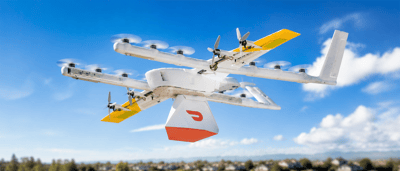
The logistics sector just crossed a critical regulatory threshold. DoorDash (NASDAQ: DASH) securing a Federal Aviation Administration Part 135 air carrier certification could fundamentally alter the unit economics of localized fulfillment.
This regulatory clearance transitions the company from a software intermediary into a fully certified commercial air carrier. By achieving this status, DoorDash joins an exclusive group operating in the same designated airspace as logistics heavyweights such as Amazon (NASDAQ: AMZN) Prime Air and Alphabet's (NASDAQ: GOOGL) Wing.
Building a Regulatory Runway Competitors Cannot Match
He bet half his $9 billion on ONE stock (Ad)
One of the most successful fund managers of the past 50 years put more than $4.5 billion - over half his fund - into a single, little-known company. His firm then bought more shares for 61 straight trading days, and the former CEO of Google soon struck a nine-figure partnership with the same company.
This company controls nearly a million acres of scarce, irreplaceable minerals now protected by a White House executive order signed January 14, 2026. It has already outperformed Apple, Amazon, and the S-P 500 combined - and Whitney Tilson believes the biggest gains are still ahead.
Watch the free presentation and get the name and ticker nowOperating a commercial drone fleet represents much more than a supplementary marketing tool. Securing Part 135 certification creates a formidable barrier to entry. Navigating beyond-visual-line-of-sight requirements demands years of capital investment, extensive safety audits and proprietary hardware development.
Undercapitalized competitors that rely entirely on third-party ground routing face immediate headwinds. They may be effectively locked out of autonomous airspace. This certification shifts DoorDash from a variable-cost software aggregator toward a fixed-asset logistics provider, fundamentally changing how the market may value the underlying business.
Dropping the Baggage of Variable Labor Expenses
The gig-economy model wrestles with a stubborn mathematical reality. The three- to five-mile delivery radius remains one of the most inefficient segments of localized logistics. These mid-range routes take roughly one-quarter longer to fulfill than standard runs, creating bottlenecks in courier availability. More importantly, they place constant upward pressure on variable labor expenses. In a traditional ground-based network, every additional order requires an incremental payout to a human driver.
An aggressive rollout of an in-house commercial drone service could circumvent some of these ground logistics and labor costs. By shifting mid-range runs to an automated fleet, DoorDash can transfer high-friction fulfillment from a human workforce to autonomous hardware.
This is where the financial engineering becomes compelling. A drone fleet requires substantial upfront capital to manufacture and deploy. Once a local hub operates efficiently, the marginal cost of a high-frequency, low-weight delivery could approach zero.
Variable labor expenses are replaced by the fixed cost of hardware depreciation. As route density increases, this fixed-cost infrastructure can provide significant operating leverage, laying the groundwork for expansion in earnings before interest, taxes, depreciation and amortization (EBITDA). Bypassing courier labor bottlenecks could allow DoorDash to expand gross margins on everyday orders.
Expanding the Radar: Unlocking High-Margin Retail
Market participants often view drone delivery as a simple optimization tool for existing restaurant sector orders. While moving a hot meal three miles across town without sitting in traffic is a clear operational win, the true value of autonomous logistics lies in market expansion. Drone infrastructure does not just optimize the existing total addressable market; it could unlock entirely new, highly lucrative verticals.
Fast, low-weight logistics could immediately capture market share in sectors that demand rapid fulfillment beyond the capabilities of traditional ground routing. Pharmaceuticals, cold-chain perishables and premium retail goods can carry significantly higher gross margins than fast food. A consumer who needs an over-the-counter medication or a high-end cosmetic item may value speed and reliability more than the ability to ship heavy, bulky packaging.
Capturing these high-margin retail sector orders could increase average order value while leveraging the same automated flight infrastructure. As DoorDash expands into these categories, its revenue mix could diversify away from restaurants, insulating the top line from shifts in discretionary consumer dining habits.
Why Heavy Capital Expenditure Fuels the Long-Term Flight Path
Any analysis of this transition must address the current valuation premium. Bears frequently point to a trailing price-to-earnings ratio of around 94x, arguing that DoorDash trades at an unjustifiable premium to legacy gig-economy peers such as Uber Technologies (NYSE: UBER) and Maplebear Inc. (NASDAQ: CART).
Relying on a backward-looking earnings multiple may overlook the forward operating leverage inherent in an infrastructure pivot. Transitioning from a capital-light software platform to a hard-asset network requires substantial upfront capital expenditure.
Manufacturing a domestic drone fleet and building ground-level handoff infrastructure could temporarily compress free cash flow. This heavy initial spending also serves as a moat-building exercise. The market may be pre-pricing an expected decline in variable delivery expenses and customer acquisition costs as the autonomous fleet scales. Evaluating DoorDash on a forward enterprise-value-to-EBITDA basis may provide a clearer picture of the potential margin expansion this regulatory moat enables.
Skeptics also frequently highlight recent insider selling as a signal of internal doubt. Filings show that executive officers have sold millions of dollars in equity over the past few months. However, a closer look at standard Securities and Exchange Commission filings indicates that these transactions were conducted under programmatic 10b5-1 plans.
Executives establish these automated selling plans months or even years in advance to manage personal tax liabilities and equity-vesting schedules. As a result, these distributions may reflect structured financial planning rather than discretionary bets against DoorDash's forward outlook.
Final Boarding Call for the Autonomous Delivery Shift
The successful integration of autonomous flight infrastructure could fundamentally reclassify DoorDash. Replacing variable gig-labor expenses with fixed-cost autonomous fleets would shift the unit economics of last-mile delivery toward sustained, structural profitability. The broader market may struggle to accurately price the margin expansion that results when a technology platform vertically integrates into physical logistics.
Investors seeking exposure to the logistics sector might consider the long-term compounding effects of this regulatory clearance. While scaling a commercial drone network requires patience and significant capital deployment, the operational leverage it generates could be difficult for competitors to replicate. Investors comfortable with near-term capital expenditure cycles may find that this transition presents a unique entry point before the full financial impact of automated delivery is reflected on the balance sheet.
This message is a paid sponsorship for Profits Run, a third-party advertiser of Earnings360 and MarketBeat.
If you need assistance with your account, feel free to email our U.S. based support team at [email protected].
If you no longer wish to receive email from Earnings360, you can unsubscribe.
Copyright 2006-2026 MarketBeat Media, LLC. All rights reserved.
345 N Reid Pl., Sixth Floor, Sioux Falls, South Dakota 57103-7078. United States..