| Unsubscribe |
Most traders lose in digital currencies before they ever pick a coin.
Not because they chose wrong. Because they looked in the wrong place.
In 2026, the winners will already know where to look. Institutional traders have quietly used this access point for years. Now you can too.
Sincerely,
The Wealth Creation Investing Team
By following the link above you're choosing to opt in to receive insightful updates from Wealth Creation Investing + 2 free bonus subscriptions! Your privacy is important to us. You can unsubscribe anytime. See our privacy policy for details.
RTX and Lockheed Earnings: Can Strong Guidance Reset the Defense Trade?
Submitted by Dan Schmidt. Date Posted: 7/26/2026.

Key Points
- RTX and Lockheed Martin both beat Q2 earnings and revenue estimates, sending shares up 7% and 10%, respectively, and expanding their record contract backlogs.
- Neither company's backlog yet reflects the resumed Iran conflict, while an unenacted 2027 NDAA could threaten multiyear defense procurement contracts if not signed by October 1.
- Lockheed's backlog is nearly all defense-related with limited commodity risk, whereas RTX's backlog is 58% exposed to commercial aerospace risks like fuel prices and airline capacity.
- Special Report: Forget SpaceX. Buy the company Musk can't replace.
The war trade has resumed in July, and earnings from two of the U.S.’s most prominent defense contractors are leading the tape. After weak first-quarter reports and a tenuous Iran ceasefire, aerospace and defense stocks deepened their drawdowns as the market repriced the restocking trade and institutional selling intensified. But now that hostilities have resumed and second-quarter reports from defense companies are rolling in, the repricing is being repriced. Does the defense trade have staying power this time?
What RTX and Lockheed Martin Earnings Tell Us About the Defense Trade’s Path Forward
Lockheed Martin Inc. (NYSE: LMT) and RTX Inc. (NYSE: RTX) are two of the largest U.S. defense contractors, and both stocks soared at the start of the year. However, the outbreak of the Iran war in late February actually marked the top of the defense trade. After making all-time highs in the first quarter, shares of both companies declined 25% and 19% peak to trough, respectively. Poor first-quarter earnings from Lockheed drove its steeper decline, while higher commodity prices also weighed on RTX’s commercial order book.
ALERT: Drop these 5 stocks before the market opens tomorrow! (Ad)
The Wall Street Journal is already raising the alarm about a potential market crash, and Weiss Ratings research points to the first half of 2026 as a particularly rough stretch for certain holdings.
Some of America's most popular stocks could take serious damage as a radical market shift plays out. Analysts at Weiss Ratings have identified five names you may want to remove from your portfolio before this unfolds.
If any of these are in your portfolio, now is the time to review your positions.
See the 5 stocks to avoidThe second-quarter reports flipped the script, with both companies beating earnings-per-share (EPS) and revenue estimates while adding to their record backlogs. Crucially, neither company’s earnings or backlog figures yet reflect the resumption of hostilities in Iran.
There is one crucial caveat to the thesis: the 2027 National Defense Authorization Act (NDAA) has not yet been enacted following a failed cloture vote in the Senate. The debate is likely just noise and posturing between the Trump administration and Congress. Still, if the NDAA isn’t signed by October 1, no multiyear defense procurement contracts can be distributed, and these contracts are the backbone of the RTX and LMT backlogs.
RTX: Clean Earnings Beat Has Stock Primed for New Highs
The drawdown in RTX shares is officially over following its second-quarter 2026 results. The beat was highlighted by 14.5% year-over-year (YOY) revenue growth, which topped analysts’ estimates by more than 8%. EPS of $1.89 also crushed the expected $1.66, while the backlog grew 22% YOY to a record $289 billion.
More than $43 billion worth of new orders were booked during the quarter, including $20 billion for the Raytheon division, which focuses on defense. This was the company’s eighth consecutive beat, which may explain why investors are willing to pay 30 times forward earnings for the stock.
An 8% earnings beat is rare, even for RTX, and it gave management the confidence to raise its guidance for full-year sales, EPS and free cash flow. The company now projects total 2026 EPS of $7.10 to $7.25, a 5% increase over its previous high-end estimate.
RTX shares jumped 7% following the release, but a looming issue clouds the celebration. The backlog is a mix of commercial and defense contracts, and the Collins Aerospace and Pratt & Whitney divisions account for $170 billion of the $289 billion total. Collins and Pratt are the aerospace wings of the company, while Raytheon makes the weaponry. That means more than 58% of the total backlog is exposed to commodity risk through higher fuel prices and lower airline capacity—two factors exacerbated by the Iran war.

RTX shares are just a hair below their previous all-time high following the 7% earnings pop, and the technical signals point toward more short-term gains. The stock now trades comfortably above its 50-day and 200-day moving averages, which are converging into a Golden Cross. The MACD indicator has also moved into positive territory, and a bullish crossover hints at more upside to come.
Lockheed Martin: Headline Numbers Mislead, But Backlog Stronger Than Ever
At first glance, Lockheed Martin blew the market away in the second quarter of 2026, beating top- and bottom-line estimates with EPS of $7.94 on $1.8 billion in net income.
This represents more than 400% YOY earnings growth, but that figure is flattered by the $1.6 billion in losses Lockheed absorbed in the second quarter of 2025, which depressed the year-ago base. Still, the stock popped 10% on the day for good reason.
First, the backlog continues to reach record levels, growing to $230 billion from $193 billion at the end of 2025. Lockheed booked $65 billion in new orders during the second quarter. Missiles and Fire Control (MFC) remains the standout segment, with an $87 billion backlog for THAAD interceptors, GMLRS, HIMARS and radar systems.
Additionally, Lockheed’s cash generation shows meaningful gains over the year-ago quarter. Operating cash flow was $3.2 billion, and quarterly free cash flow came in at $2.25 billion. Management also boosted the top end of its full-year revenue guidance to $81.75 billion, up from $80 billion in the previous quarter.

LMT shares suffered a deeper drawdown this spring, falling from an all-time high of $676 on March 2 to $491 by the end of June. The stock declined more steeply than RTX because of its poor first-quarter earnings, but it may also have more upside given its unique exposure to the war in Iran. The company’s backlog is almost entirely defense-related, meaning it carries less commodity risk than RTX.
The chart also shows a sharp reversal, with the 10% pop breaking through both the 50-day and 200-day moving averages. The Relative Strength Index (RSI) has also moved above 50 into bullish territory, but the stock remains about 16% below its March all-time high. At 19 times forward earnings, LMT is cheaper than RTX, but its backlog is less diversified, and another sudden ceasefire would pressure Lockheed’s third-quarter guidance.
L3Harris’ Record Backlog Makes Its Stock Sell-Off Look Overdone
Submitted by Thomas Hughes. Date Posted: 7/31/2026.

Key Points
- L3Harris reported stronger second-quarter revenue, earnings and free cash flow while raising its 2026 outlook.
- A record backlog and strong missile demand support the company’s long-term growth case, even as the stock remains under pressure.
- Investors still need to weigh execution risk, debt, capital returns and the timing of the planned Missile Solutions IPO.
- Special Report: Forget SpaceX. Buy the company Musk can't replace.
L3Harris Technologies (NYSE: LHX) is a great example of a massive disconnect in the market. Geopolitical headwinds, macroeconomic fears and general market anxiety have pushed high-quality stocks into correction territory and bear markets despite otherwise healthy fundamentals and robust growth outlooks. The takeaway for investors is that times aren’t normal: The market is offering massive discounts, and the time to buy is now, before conditions return to normal. When they do, share prices for stocks such as LHX could surge to higher levels and sustain upward momentum thereafter.
It’s debatable when that will happen, but it will likely occur in the upcoming quarters as summer 2026 comes to an end, smart-money investors return to the market and subsequent data supports higher valuations. As it stands, the 15 analysts tracked by MarketBeat show relatively high conviction in the Moderate Buy consensus rating. The data shows a 73% Buy-side bias, no Sell ratings and nearly 40% upside relative to late-July lows. Among the critical details are that sentiment has remained firm over the trailing 12 months while price targets have strengthened, and the Q2 results provide no reason for those trends to change. The market is overlooking the fact that near-term headwinds are noise obscuring a robust outlook supported by the company’s record backlog.
ALERT: Drop these 5 stocks before the market opens tomorrow! (Ad)
The Wall Street Journal is already raising the alarm about a potential market crash, and Weiss Ratings research points to the first half of 2026 as a particularly rough stretch for certain holdings.
Some of America's most popular stocks could take serious damage as a radical market shift plays out. Analysts at Weiss Ratings have identified five names you may want to remove from your portfolio before this unfolds.
If any of these are in your portfolio, now is the time to review your positions.
See the 5 stocks to avoid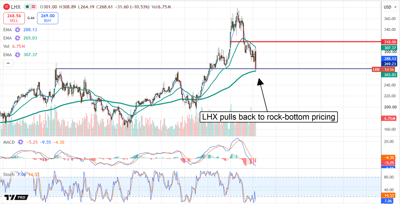
L3Harris Delivered the Quarter Investors Usually Reward
L3Harris had a solid second quarter, generating $5.9 billion in net revenue, up 8.4% year over year and ahead of consensus forecasts. The strength was broad-based, with Missile Solutions and Space & Mission leading the growth. More importantly, the company is producing profitable growth, expanding margins and generating robust cash flow. Operating margin improved by 60 basis points, driving a 28% increase in adjusted earnings, aided by share buybacks. Free cash flow, the all-important metric, was also strong, increasing 37% and expected to remain robust in the coming quarters.
Guidance is also good news, contrary to the market’s response. The company raised its targets for quarterly and full-year results, with the new forecast underpinned by healthy internal metrics. New orders increased by $7.3 billion, outpacing billings and producing a book-to-bill ratio of 1.2. The backlog, which sits at record levels, is worth approximately $42 billion, or more than seven quarters of revenue at the Q2 pace. Looking ahead, the company’s forecast may underestimate its growth potential, given the strength of Q2 results and plans to increase defense spending globally.
Cash Flow Supports the Story, But Risks Remain
L3Harris investors face capital return risk, as the Department of Defense and the Trump administration scrutinize defense contractors and lawmakers debate legislation that could limit capacity. However, other risks include the company’s ability to scale production profitably, generate sufficient free cash flow and benefit from direct government investment in its expansion capacity. The $1 billion investment is tied to the company’s Missile Solutions business and engine production capacity. The question now is whether the segment will be spun off, as suggested earlier in 2026, or remain part of the company, as now appears possible.
LHX’s 30% stock price correction as of late July has created an overhang for the market but has likely run its course. The 10% post-release decline following the Q2 earnings report pushed the stock to long-term lows, aligning with prior resistance and a critical breakout point that is unlikely to be broken. Additionally, MACD divergence suggests that bearish traders are losing control, setting the stage for a rebound and price recovery in the coming quarters. Institutional data is also favorable, with institutions owning nearly 85% of the stock and accumulating shares ahead of the release. The likely outcome is that they will continue taking advantage of price discounts, limiting downside risk as Q3 progresses.
L3Harris Still Has to Convert Backlog Into Value
This year’s catalysts include scaling its Missile Solutions business and news about the planned spinout. Scaling the business means converting the massive backlog into revenue, outperforming estimates and affirming long-term targets, all of which suggest the stock is trading at a deep value. The planned IPO is expected to unlock value by creating pure-play companies focused on Missiles and Space, but it may not occur until mid-2027 or later if market conditions fail to improve.
The company’s biggest risks, aside from macroeconomic pressures, are execution and debt. The acquisition of Aerojet Rocketdyne left L3Harris with excessive debt, increasing its exposure to execution risks amplified by its repositioning efforts. In addition to the planned IPO, the company is purging noncore assets from the Space segment. In this environment, any delays or missteps will be reflected in the stock’s price.
This email is a sponsored message for Darwin, a third-party advertiser of DividendStocks.com and MarketBeat.
If you need help with your account, feel free to email our U.S. based support team at [email protected].
If you no longer wish to receive email from DividendStocks.com, you can unsubscribe.
© 2006-2026 MarketBeat Media, LLC. All rights reserved.
345 North Reid Place #620, Sioux Falls, South Dakota 57103. USA..