
| From | Editors, Earth Island Journal <[email protected]> |
| Subject | Fuel for Fire Clouds |
| Date | July 31, 2026 11:45 PM |
Links have been removed from this email. Learn more in the FAQ.
Links have been removed from this email. Learn more in the FAQ.
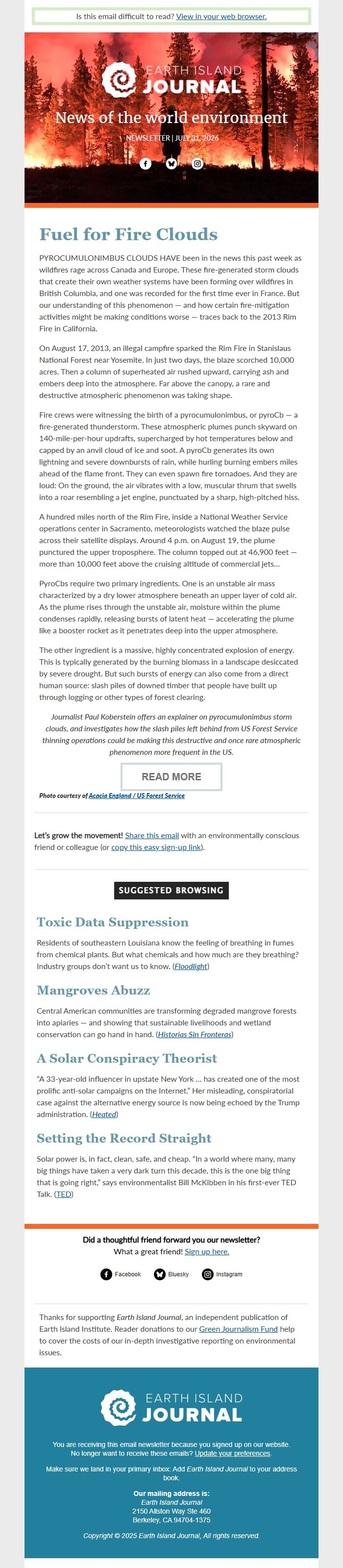
Slash piles from forest-thinning operations may be setting off fire storms.
Is this email difficult to read? View in your web browser. ([link removed])
News of the world environment
NEWSLETTER | JULY 31, 2026
([link removed])
([link removed])
([link removed])
Fuel for Fire Clouds
PYROCUMULONIMBUS CLOUDS HAVE been in the news this past week as wildfires rage across Canada and Europe. These fire-generated storm clouds that create their own weather systems have been forming over wildfires in British Columbia, and one was recorded for the first time ever in France. But our understanding of this phenomenon — and how certain fire-mitigation activities might be making conditions worse — traces back to the 2013 Rim Fire in California.
On August 17, 2013, an illegal campfire sparked the Rim Fire in Stanislaus National Forest near Yosemite. In just two days, the blaze scorched 10,000 acres. Then a column of superheated air rushed upward, carrying ash and embers deep into the atmosphere. Far above the canopy, a rare and destructive atmospheric phenomenon was taking shape.
Fire crews were witnessing the birth of a pyrocumulonimbus, or pyroCb — a fire-generated thunderstorm. These atmospheric plumes punch skyward on 140-mile-per-hour updrafts, supercharged by hot temperatures below and capped by an anvil cloud of ice and soot. A pyroCb generates its own lightning and severe downbursts of rain, while hurling burning embers miles ahead of the flame front. They can even spawn fire tornadoes. And they are loud: On the ground, the air vibrates with a low, muscular thrum that swells into a roar resembling a jet engine, punctuated by a sharp, high-pitched hiss.
A hundred miles north of the Rim Fire, inside a National Weather Service operations center in Sacramento, meteorologists watched the blaze pulse across their satellite displays. Around 4 p.m. on August 19, the plume punctured the upper troposphere. The column topped out at 46,900 feet — more than 10,000 feet above the cruising altitude of commercial jets…
PyroCbs require two primary ingredients. One is an unstable air mass characterized by a dry lower atmosphere beneath an upper layer of cold air. As the plume rises through the unstable air, moisture within the plume condenses rapidly, releasing bursts of latent heat — accelerating the plume like a booster rocket as it penetrates deep into the upper atmosphere.
The other ingredient is a massive, highly concentrated explosion of energy. This is typically generated by the burning biomass in a landscape desiccated by severe drought. But such bursts of energy can also come from a direct human source: slash piles of downed timber that people have built up through logging or other types of forest clearing.
Journalist Paul Koberstein offers an explainer on pyrocumulonimbus storm clouds, and investigates how the slash piles left behind from US Forest Service thinning operations could be making this destructive and once rare atmospheric phenomenon more frequent in the US.
READ MORE ([link removed])
Photo courtesy of Acacia England / US Forest Service ([link removed])
Let’s grow the movement! Share this email (mailto:?subject=This%20Earth%20Island%20Journal%20newsletter%20made%20me%20think%20of%20you&body=Check%20out%20this%20newsletter%20from%20Earth%20Island%20Journal!%20You%20can%20view%20the%20web%20version%20of%20the%20email%20through%20this%20link%3A%20https://us.engagingnetworks.app/page/email/message/view?templateId=458752) with an environmentally conscious friend or colleague (or copy this easy sign-up link ([link removed])).
SUGGESTED BROWSING ()
Toxic Data Suppression ([link removed])
Residents of southeastern Louisiana know the feeling of breathing in fumes from chemical plants. But what chemicals and how much are they breathing? Industry groups don’t want us to know. (Floodlight ([link removed]))
Mangroves Abuzz ([link removed])
Central American communities are transforming degraded mangrove forests into apiaries — and showing that sustainable livelihoods and wetland conservation can go hand in hand. (Historias Sin Fronteras ([link removed]))
A Solar Conspiracy Theorist ([link removed])
“A 33-year-old influencer in upstate New York … has created one of the most prolific anti-solar campaigns on the Internet.” Her misleading, conspiratorial case against the alternative energy source is now being echoed by the Trump administration. (Heated ([link removed]))
Setting the Record Straight ([link removed])
Solar power is, in fact, clean, safe, and cheap. “In a world where many, many big things have taken a very dark turn this decade, this is the one big thing that is going right,” says environmentalist Bill McKibben in his first-ever TED Talk. (TED ([link removed]))
Did a thoughtful friend forward you our newsletter?
What a great friend! Sign up here. ([link removed])
([link removed])
Facebook ([link removed])
([link removed])
Bluesky ([link removed])
([link removed])
Instagram ([link removed])
Thanks for supporting Earth Island Journal, an independent publication of Earth Island Institute. Reader donations to our Green Journalism Fund ([link removed]) help to cover the costs of our in-depth investigative reporting on environmental issues.
([link removed])
You are receiving this email newsletter because you signed up on our website.
No longer want to receive these emails? Update your preferences ([link removed]).
Make sure we land in your primary inbox: Add Earth Island Journal to your address book.
Our mailing address is:
Earth Island Journal
2150 Allston Way Ste 460
Berkeley, CA 94704-1375
Copyright © 2025 Earth Island Journal, All rights reserved.
Is this email difficult to read? View in your web browser. ([link removed])
News of the world environment
NEWSLETTER | JULY 31, 2026
([link removed])
([link removed])
([link removed])
Fuel for Fire Clouds
PYROCUMULONIMBUS CLOUDS HAVE been in the news this past week as wildfires rage across Canada and Europe. These fire-generated storm clouds that create their own weather systems have been forming over wildfires in British Columbia, and one was recorded for the first time ever in France. But our understanding of this phenomenon — and how certain fire-mitigation activities might be making conditions worse — traces back to the 2013 Rim Fire in California.
On August 17, 2013, an illegal campfire sparked the Rim Fire in Stanislaus National Forest near Yosemite. In just two days, the blaze scorched 10,000 acres. Then a column of superheated air rushed upward, carrying ash and embers deep into the atmosphere. Far above the canopy, a rare and destructive atmospheric phenomenon was taking shape.
Fire crews were witnessing the birth of a pyrocumulonimbus, or pyroCb — a fire-generated thunderstorm. These atmospheric plumes punch skyward on 140-mile-per-hour updrafts, supercharged by hot temperatures below and capped by an anvil cloud of ice and soot. A pyroCb generates its own lightning and severe downbursts of rain, while hurling burning embers miles ahead of the flame front. They can even spawn fire tornadoes. And they are loud: On the ground, the air vibrates with a low, muscular thrum that swells into a roar resembling a jet engine, punctuated by a sharp, high-pitched hiss.
A hundred miles north of the Rim Fire, inside a National Weather Service operations center in Sacramento, meteorologists watched the blaze pulse across their satellite displays. Around 4 p.m. on August 19, the plume punctured the upper troposphere. The column topped out at 46,900 feet — more than 10,000 feet above the cruising altitude of commercial jets…
PyroCbs require two primary ingredients. One is an unstable air mass characterized by a dry lower atmosphere beneath an upper layer of cold air. As the plume rises through the unstable air, moisture within the plume condenses rapidly, releasing bursts of latent heat — accelerating the plume like a booster rocket as it penetrates deep into the upper atmosphere.
The other ingredient is a massive, highly concentrated explosion of energy. This is typically generated by the burning biomass in a landscape desiccated by severe drought. But such bursts of energy can also come from a direct human source: slash piles of downed timber that people have built up through logging or other types of forest clearing.
Journalist Paul Koberstein offers an explainer on pyrocumulonimbus storm clouds, and investigates how the slash piles left behind from US Forest Service thinning operations could be making this destructive and once rare atmospheric phenomenon more frequent in the US.
READ MORE ([link removed])
Photo courtesy of Acacia England / US Forest Service ([link removed])
Let’s grow the movement! Share this email (mailto:?subject=This%20Earth%20Island%20Journal%20newsletter%20made%20me%20think%20of%20you&body=Check%20out%20this%20newsletter%20from%20Earth%20Island%20Journal!%20You%20can%20view%20the%20web%20version%20of%20the%20email%20through%20this%20link%3A%20https://us.engagingnetworks.app/page/email/message/view?templateId=458752) with an environmentally conscious friend or colleague (or copy this easy sign-up link ([link removed])).
SUGGESTED BROWSING ()
Toxic Data Suppression ([link removed])
Residents of southeastern Louisiana know the feeling of breathing in fumes from chemical plants. But what chemicals and how much are they breathing? Industry groups don’t want us to know. (Floodlight ([link removed]))
Mangroves Abuzz ([link removed])
Central American communities are transforming degraded mangrove forests into apiaries — and showing that sustainable livelihoods and wetland conservation can go hand in hand. (Historias Sin Fronteras ([link removed]))
A Solar Conspiracy Theorist ([link removed])
“A 33-year-old influencer in upstate New York … has created one of the most prolific anti-solar campaigns on the Internet.” Her misleading, conspiratorial case against the alternative energy source is now being echoed by the Trump administration. (Heated ([link removed]))
Setting the Record Straight ([link removed])
Solar power is, in fact, clean, safe, and cheap. “In a world where many, many big things have taken a very dark turn this decade, this is the one big thing that is going right,” says environmentalist Bill McKibben in his first-ever TED Talk. (TED ([link removed]))
Did a thoughtful friend forward you our newsletter?
What a great friend! Sign up here. ([link removed])
([link removed])
Facebook ([link removed])
([link removed])
Bluesky ([link removed])
([link removed])
Instagram ([link removed])
Thanks for supporting Earth Island Journal, an independent publication of Earth Island Institute. Reader donations to our Green Journalism Fund ([link removed]) help to cover the costs of our in-depth investigative reporting on environmental issues.
([link removed])
You are receiving this email newsletter because you signed up on our website.
No longer want to receive these emails? Update your preferences ([link removed]).
Make sure we land in your primary inbox: Add Earth Island Journal to your address book.
Our mailing address is:
Earth Island Journal
2150 Allston Way Ste 460
Berkeley, CA 94704-1375
Copyright © 2025 Earth Island Journal, All rights reserved.
Message Analysis
- Sender: Earth Island
- Political Party: n/a
- Country: United States
- State/Locality: n/a
- Office: n/a