
Email
The biggest scam in American history is at every gas station.
| From | The oil secret via Evan Brooks from TRC <[email protected]> |
| Subject | The biggest scam in American history is at every gas station. |
| Date | July 31, 2026 5:29 PM |
Links have been removed from this email. Learn more in the FAQ.
Links have been removed from this email. Learn more in the FAQ.
They call it "market pricing." It's not. OPEC decides in secret. Goldman moves
billions before the press release. You get the bill.
<[link removed]>
Сⅼіϲkhеrе and I'll reveal the shocking details. <[link removed]>
They call it "market pricing."
It's not.
OPEC decides in secret. Goldman moves billions before the press release. You
get the bill.
For 50 years, nobody talked.
One former insider just broke ranks.
See what he's exposing — before it gets taken down →
<[link removed]>
If you would like to stop receiving these offers, please click here
<[link removed]>
to unsubscribe.
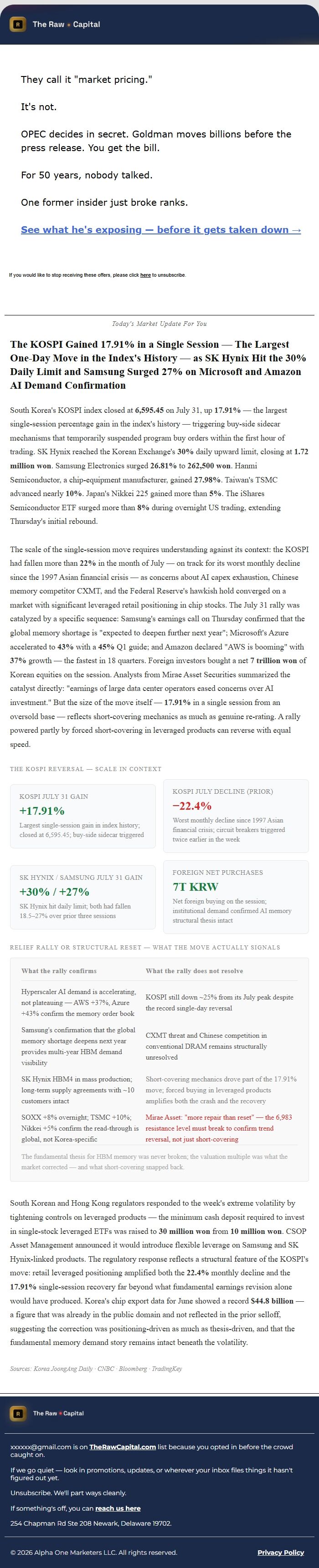
Today's Market Update For You
The KOSPI Gained 17.91% in a Single Session — The Largest One-Day Move in the
Index's History — as SK Hynix Hit the30% Daily Limit and Samsung Surged 27% on
Microsoft and Amazon AI Demand Confirmation
South Korea's KOSPI index closed at 6,595.45 on July 31, up 17.91% — the
largest single-session percentage gain in the index's history — triggering
buy-side sidecar mechanisms that temporarily suspended program buy orders
within the first hour of trading. SK Hynix reached the Korean Exchange's30%
daily upward limit, closing at1.72 million won. Samsung Electronics surged
26.81% to 262,500 won. Hanmi Semiconductor, a chip-equipment manufacturer,
gained27.98%. Taiwan's TSMC advanced nearly 10%. Japan's Nikkei 225 gained more
than5%. The iShares Semiconductor ETF surged more than 8% during overnight US
trading, extending Thursday's initial rebound.
The scale of the single-session move requires understanding against its
context: the KOSPI had fallen more than22% in the month of July — on track for
its worst monthly decline since the 1997 Asian financial crisis — as concerns
about AI capex exhaustion, Chinese memory competitor CXMT, and the Federal
Reserve's hawkish hold converged on a market with significant leveraged retail
positioning in chip stocks. The July 31 rally was catalyzed by a specific
sequence: Samsung's earnings call on Thursday confirmed that the global memory
shortage is "expected to deepen further next year"; Microsoft's Azure
accelerated to43% with a 45% Q1 guide; and Amazon declared "AWS is booming" with
37% growth — the fastest in 18 quarters. Foreign investors bought a net 7
trillion won of Korean equities on the session. Analysts from Mirae Asset
Securities summarized the catalyst directly: "earnings of large data center
operators eased concerns over AI investment." But the size of the move itself —
17.91% in a single session from an oversold base — reflects short-covering
mechanics as much as genuine re-rating. A rally powered partly by forced
short-covering in leveraged products can reverse with equal speed.
The KOSPI Reversal — Scale in Context
KOSPI July 31 Gain+17.91%Largest single-session gain in index history; closed
at 6,595.45; buy-side sidecar triggered
KOSPI July Decline (Prior)−22.4%Worst monthly decline since 1997 Asian
financial crisis; circuit breakers triggered twice earlier in the week
SK Hynix / Samsung July 31 Gain+30% / +27%SK Hynix hit daily limit; both had
fallen 18.5–27% over prior three sessions
Foreign Net Purchases7T KRWNet foreign buying on the session; institutional
demand confirmed AI memory structural thesis intact
Relief Rally or Structural Reset — What the Move Actually Signals
What the rally confirms What the rally does not resolve
Hyperscaler AI demand is accelerating, not plateauing — AWS +37%, Azure +43%
confirm the memory order bookKOSPI still down ~25% from its July peak despite
the record single-day reversal
Samsung's confirmation that the global memory shortage deepens next year
provides multi-year HBM demand visibilityCXMT threat and Chinese competition in
conventional DRAM remains structurally unresolved
SK Hynix HBM4 in mass production; long-term supply agreements with ~10
customers intactShort-covering mechanics drove part of the 17.91% move; forced
buying in leveraged products amplifies both the crash and the recovery
SOXX +8% overnight; TSMC +10%; Nikkei +5% confirm the read-through is global,
not Korea-specificMirae Asset: "more repair than reset" — the 6,983 resistance
level must break to confirm trend reversal, not just short-covering
The fundamental thesis for HBM memory was never broken; the valuation multiple
was what the market corrected — and what short-covering snapped back.
South Korean and Hong Kong regulators responded to the week's extreme
volatility by tightening controls on leveraged products — the minimum cash
deposit required to invest in single-stock leveraged ETFs was raised to30
million won from 10 million won. CSOP Asset Management announced it would
introduce flexible leverage on Samsung and SK Hynix-linked products. The
regulatory response reflects a structural feature of the KOSPI's move: retail
leveraged positioning amplified both the22.4% monthly decline and the 17.91%
single-session recovery far beyond what fundamental earnings revision alone
would have produced. Korea's chip export data for June showed a record$44.8
billion — a figure that was already in the public domain and not reflected in
the prior selloff, suggesting the correction was positioning-driven as much as
thesis-driven, and that the fundamental memory demand story remains intact
beneath the volatility.
Sources: Korea JoongAng Daily · CNBC · Bloomberg · TradingKey
<[link removed]>
[email protected] is on TheRawCapital.com <[link removed]>
list because you opted in before the crowd caught on.
If we go quiet — look in promotions, updates, or wherever your inbox files
things it hasn't figured out yet.
Unsubscribe
<[link removed]>
. We'll part ways cleanly.
If something's off, you can reach us here <mailto:[email protected]>
254 Chapman Rd Ste 208 Newark, Delaware 19702.
© 2026 Alpha One Marketers LLC. All rights reserved. Privacy Policy
<[link removed]>
billions before the press release. You get the bill.
<[link removed]>
Сⅼіϲkhеrе and I'll reveal the shocking details. <[link removed]>
They call it "market pricing."
It's not.
OPEC decides in secret. Goldman moves billions before the press release. You
get the bill.
For 50 years, nobody talked.
One former insider just broke ranks.
See what he's exposing — before it gets taken down →
<[link removed]>
If you would like to stop receiving these offers, please click here
<[link removed]>
to unsubscribe.
Today's Market Update For You
The KOSPI Gained 17.91% in a Single Session — The Largest One-Day Move in the
Index's History — as SK Hynix Hit the30% Daily Limit and Samsung Surged 27% on
Microsoft and Amazon AI Demand Confirmation
South Korea's KOSPI index closed at 6,595.45 on July 31, up 17.91% — the
largest single-session percentage gain in the index's history — triggering
buy-side sidecar mechanisms that temporarily suspended program buy orders
within the first hour of trading. SK Hynix reached the Korean Exchange's30%
daily upward limit, closing at1.72 million won. Samsung Electronics surged
26.81% to 262,500 won. Hanmi Semiconductor, a chip-equipment manufacturer,
gained27.98%. Taiwan's TSMC advanced nearly 10%. Japan's Nikkei 225 gained more
than5%. The iShares Semiconductor ETF surged more than 8% during overnight US
trading, extending Thursday's initial rebound.
The scale of the single-session move requires understanding against its
context: the KOSPI had fallen more than22% in the month of July — on track for
its worst monthly decline since the 1997 Asian financial crisis — as concerns
about AI capex exhaustion, Chinese memory competitor CXMT, and the Federal
Reserve's hawkish hold converged on a market with significant leveraged retail
positioning in chip stocks. The July 31 rally was catalyzed by a specific
sequence: Samsung's earnings call on Thursday confirmed that the global memory
shortage is "expected to deepen further next year"; Microsoft's Azure
accelerated to43% with a 45% Q1 guide; and Amazon declared "AWS is booming" with
37% growth — the fastest in 18 quarters. Foreign investors bought a net 7
trillion won of Korean equities on the session. Analysts from Mirae Asset
Securities summarized the catalyst directly: "earnings of large data center
operators eased concerns over AI investment." But the size of the move itself —
17.91% in a single session from an oversold base — reflects short-covering
mechanics as much as genuine re-rating. A rally powered partly by forced
short-covering in leveraged products can reverse with equal speed.
The KOSPI Reversal — Scale in Context
KOSPI July 31 Gain+17.91%Largest single-session gain in index history; closed
at 6,595.45; buy-side sidecar triggered
KOSPI July Decline (Prior)−22.4%Worst monthly decline since 1997 Asian
financial crisis; circuit breakers triggered twice earlier in the week
SK Hynix / Samsung July 31 Gain+30% / +27%SK Hynix hit daily limit; both had
fallen 18.5–27% over prior three sessions
Foreign Net Purchases7T KRWNet foreign buying on the session; institutional
demand confirmed AI memory structural thesis intact
Relief Rally or Structural Reset — What the Move Actually Signals
What the rally confirms What the rally does not resolve
Hyperscaler AI demand is accelerating, not plateauing — AWS +37%, Azure +43%
confirm the memory order bookKOSPI still down ~25% from its July peak despite
the record single-day reversal
Samsung's confirmation that the global memory shortage deepens next year
provides multi-year HBM demand visibilityCXMT threat and Chinese competition in
conventional DRAM remains structurally unresolved
SK Hynix HBM4 in mass production; long-term supply agreements with ~10
customers intactShort-covering mechanics drove part of the 17.91% move; forced
buying in leveraged products amplifies both the crash and the recovery
SOXX +8% overnight; TSMC +10%; Nikkei +5% confirm the read-through is global,
not Korea-specificMirae Asset: "more repair than reset" — the 6,983 resistance
level must break to confirm trend reversal, not just short-covering
The fundamental thesis for HBM memory was never broken; the valuation multiple
was what the market corrected — and what short-covering snapped back.
South Korean and Hong Kong regulators responded to the week's extreme
volatility by tightening controls on leveraged products — the minimum cash
deposit required to invest in single-stock leveraged ETFs was raised to30
million won from 10 million won. CSOP Asset Management announced it would
introduce flexible leverage on Samsung and SK Hynix-linked products. The
regulatory response reflects a structural feature of the KOSPI's move: retail
leveraged positioning amplified both the22.4% monthly decline and the 17.91%
single-session recovery far beyond what fundamental earnings revision alone
would have produced. Korea's chip export data for June showed a record$44.8
billion — a figure that was already in the public domain and not reflected in
the prior selloff, suggesting the correction was positioning-driven as much as
thesis-driven, and that the fundamental memory demand story remains intact
beneath the volatility.
Sources: Korea JoongAng Daily · CNBC · Bloomberg · TradingKey
<[link removed]>
[email protected] is on TheRawCapital.com <[link removed]>
list because you opted in before the crowd caught on.
If we go quiet — look in promotions, updates, or wherever your inbox files
things it hasn't figured out yet.
Unsubscribe
<[link removed]>
. We'll part ways cleanly.
If something's off, you can reach us here <mailto:[email protected]>
254 Chapman Rd Ste 208 Newark, Delaware 19702.
© 2026 Alpha One Marketers LLC. All rights reserved. Privacy Policy
<[link removed]>
Message Analysis
- Sender: n/a
- Political Party: n/a
- Country: n/a
- State/Locality: n/a
- Office: n/a
-
Email Providers:
- Iterable