
| From | The American Enterprise <[email protected]> |
| Subject | What Is a Gerrymander? |
| Date | July 31, 2026 3:53 PM |
Links have been removed from this email. Learn more in the FAQ.
Links have been removed from this email. Learn more in the FAQ.
Welcome to the July 2026 edition of The American Enterprise. This month, we are featuring essays by Sean Trende on the definition and political fairness of gerrymandering, Robert Pondicsio on the educational opportunity of artificial intelligence in schools, and Mark J. Warshawsky on the Trump administration's plan to make Medicare Advantage the default coverage option for Medicare enrollees.
TheAmericanEnterprise_test3 (1) ([link removed] )
July 2026
Welcome to the July 2026 edition of The American Enterprise. This month, we are featuring essays by Sean Trende ([link removed] ) on the definition and political fairness of gerrymandering, Robert Pondicsio ([link removed] ) on the educational opportunity of artificial intelligence in schools, and Mark J. Warshawsky ([link removed] ) on the Trump administration's plan to make Medicare Advantage the default coverage option for Medicare enrollees.
Make sure to subscribe ([link removed] ) and read the online version here ([link removed] ) !
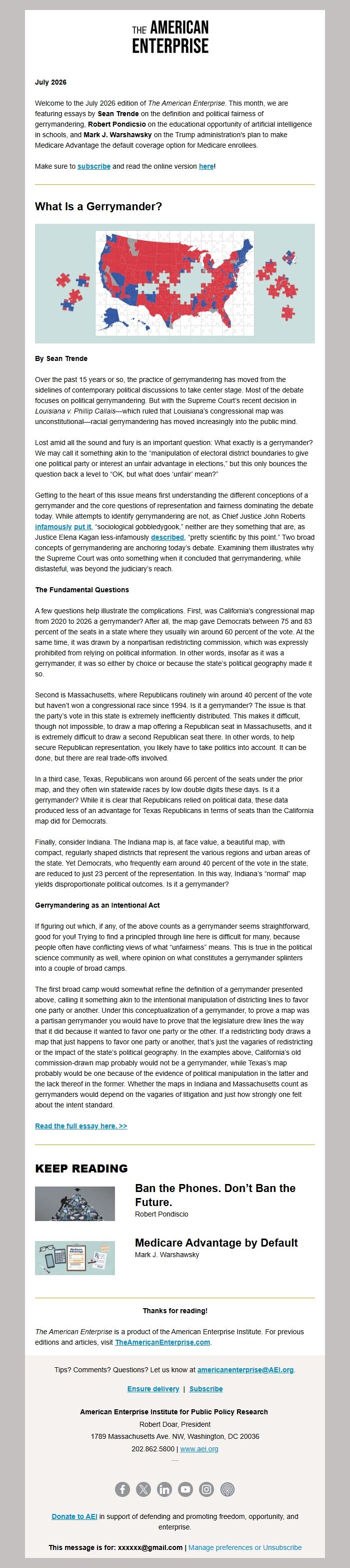
What Is a Gerrymander? ([link removed] )
July 2026_Article 1_FINAL ([link removed] )
By Sean Trende
Over the past 15 years or so, the practice of gerrymandering has moved from the sidelines of contemporary political discussions to take center stage. Most of the debate focuses on political gerrymandering. But with the Supreme Court’s recent decision in Louisiana v. Phillip Callais—which ruled that Louisiana’s congressional map was unconstitutional—racial gerrymandering has moved increasingly into the public mind.
Lost amid all the sound and fury is an important question: What exactly is a gerrymander? We may call it something akin to the “manipulation of electoral district boundaries to give one political party or interest an unfair advantage in elections,” but this only bounces the question back a level to “OK, but what does ‘unfair’ mean?”
Getting to the heart of this issue means first understanding the different conceptions of a gerrymander and the core questions of representation and fairness dominating the debate today. While attempts to identify gerrymandering are not, as Chief Justice John Roberts infamously ([link removed] ) put it ([link removed] ) , “sociological gobbledygook,” neither are they something that are, as Justice Elena Kagan less-infamously described ([link removed] ) , “pretty scientific by this point.” Two broad concepts of gerrymandering are anchoring today’s debate. Examining them illustrates why the Supreme Court was onto something when it concluded that gerrymandering, while distasteful, was beyond the judiciary’s reach.
The Fundamental Questions
A few questions help illustrate the complications. First, was California’s congressional map from 2020 to 2026 a gerrymander? After all, the map gave Democrats between 75 and 83 percent of the seats in a state where they usually win around 60 percent of the vote. At the same time, it was drawn by a nonpartisan redistricting commission, which was expressly prohibited from relying on political information. In other words, insofar as it was a gerrymander, it was so either by choice or because the state’s political geography made it so.
Second is Massachusetts, where Republicans routinely win around 40 percent of the vote but haven’t won a congressional race since 1994. Is it a gerrymander? The issue is that the party’s vote in this state is extremely inefficiently distributed. This makes it difficult, though not impossible, to draw a map offering a Republican seat in Massachusetts, and it is extremely difficult to draw a second Republican seat there. In other words, to help secure Republican representation, you likely have to take politics into account. It can be done, but there are real trade-offs involved.
In a third case, Texas, Republicans won around 66 percent of the seats under the prior map, and they often win statewide races by low double digits these days. Is it a gerrymander? While it is clear that Republicans relied on political data, these data produced less of an advantage for Texas Republicans in terms of seats than the California map did for Democrats.
Finally, consider Indiana. The Indiana map is, at face value, a beautiful map, with compact, regularly shaped districts that represent the various regions and urban areas of the state. Yet Democrats, who frequently earn around 40 percent of the vote in the state, are reduced to just 23 percent of the representation. In this way, Indiana’s “normal” map yields disproportionate political outcomes. Is it a gerrymander?
Gerrymandering as an Intentional Act
If figuring out which, if any, of the above counts as a gerrymander seems straightforward, good for you! Trying to find a principled through line here is difficult for many, because people often have conflicting views of what “unfairness” means. This is true in the political science community as well, where opinion on what constitutes a gerrymander splinters into a couple of broad camps.
The first broad camp would somewhat refine the definition of a gerrymander presented above, calling it something akin to the intentional manipulation of districting lines to favor one party or another. Under this conceptualization of a gerrymander, to prove a map was a partisan gerrymander you would have to prove that the legislature drew lines the way that it did because it wanted to favor one party or the other. If a redistricting body draws a map that just happens to favor one party or another, that’s just the vagaries of redistricting or the impact of the state’s political geography. In the examples above, California’s old commission-drawn map probably would not be a gerrymander, while Texas’s map probably would be one because of the evidence of political manipulation in the latter and the lack thereof in the former. Whether the maps in Indiana and Massachusetts count as gerrymanders would depend on the vagaries of litigation and just how strongly one felt about the intent standard.
Read the full essay here. >> ([link removed] )
KEEP READING
Pondiscio_06.26 ([link removed] )
Ban the Phones. Don’t Ban the Future. ([link removed] )
Robert Pondiscio
Warshawsky_06.26 ([link removed] )
Medicare Advantage by Default ([link removed] )
Mark J. Warshawsky
Thanks for reading!
The American Enterprise is a product of the American Enterprise Institute. For previous editions and articles, visit TheAmericanEnterprise.com ([link removed] ) .
Tips? Comments? Questions? Let us know at [email protected] (mailto:[email protected]) .
Ensure delivery ([link removed] ) | Subscribe ([link removed] )
American Enterprise Institute for Public Policy Research
Robert Doar, President
1789 Massachusetts Ave. NW, Washington, DC 20036
202.862.5800 | www.aei.org ([link removed] )
Unsubscribe from the link below. ([link removed] )
Facebook ([link removed] )
X ([link removed] )
LinkedIn ([link removed] )
YouTube ([link removed] )
Instagram ([link removed] )
Podcast Logo New_Gray ([link removed] )
Donate to AEI ([link removed] ) in support of defending and promoting freedom, opportunity, and enterprise.
This message is for: [email protected] | ([link removed] ) Manage preferences or Unsubscribe ([link removed] )
TheAmericanEnterprise_test3 (1) ([link removed] )
July 2026
Welcome to the July 2026 edition of The American Enterprise. This month, we are featuring essays by Sean Trende ([link removed] ) on the definition and political fairness of gerrymandering, Robert Pondicsio ([link removed] ) on the educational opportunity of artificial intelligence in schools, and Mark J. Warshawsky ([link removed] ) on the Trump administration's plan to make Medicare Advantage the default coverage option for Medicare enrollees.
Make sure to subscribe ([link removed] ) and read the online version here ([link removed] ) !
What Is a Gerrymander? ([link removed] )
July 2026_Article 1_FINAL ([link removed] )
By Sean Trende
Over the past 15 years or so, the practice of gerrymandering has moved from the sidelines of contemporary political discussions to take center stage. Most of the debate focuses on political gerrymandering. But with the Supreme Court’s recent decision in Louisiana v. Phillip Callais—which ruled that Louisiana’s congressional map was unconstitutional—racial gerrymandering has moved increasingly into the public mind.
Lost amid all the sound and fury is an important question: What exactly is a gerrymander? We may call it something akin to the “manipulation of electoral district boundaries to give one political party or interest an unfair advantage in elections,” but this only bounces the question back a level to “OK, but what does ‘unfair’ mean?”
Getting to the heart of this issue means first understanding the different conceptions of a gerrymander and the core questions of representation and fairness dominating the debate today. While attempts to identify gerrymandering are not, as Chief Justice John Roberts infamously ([link removed] ) put it ([link removed] ) , “sociological gobbledygook,” neither are they something that are, as Justice Elena Kagan less-infamously described ([link removed] ) , “pretty scientific by this point.” Two broad concepts of gerrymandering are anchoring today’s debate. Examining them illustrates why the Supreme Court was onto something when it concluded that gerrymandering, while distasteful, was beyond the judiciary’s reach.
The Fundamental Questions
A few questions help illustrate the complications. First, was California’s congressional map from 2020 to 2026 a gerrymander? After all, the map gave Democrats between 75 and 83 percent of the seats in a state where they usually win around 60 percent of the vote. At the same time, it was drawn by a nonpartisan redistricting commission, which was expressly prohibited from relying on political information. In other words, insofar as it was a gerrymander, it was so either by choice or because the state’s political geography made it so.
Second is Massachusetts, where Republicans routinely win around 40 percent of the vote but haven’t won a congressional race since 1994. Is it a gerrymander? The issue is that the party’s vote in this state is extremely inefficiently distributed. This makes it difficult, though not impossible, to draw a map offering a Republican seat in Massachusetts, and it is extremely difficult to draw a second Republican seat there. In other words, to help secure Republican representation, you likely have to take politics into account. It can be done, but there are real trade-offs involved.
In a third case, Texas, Republicans won around 66 percent of the seats under the prior map, and they often win statewide races by low double digits these days. Is it a gerrymander? While it is clear that Republicans relied on political data, these data produced less of an advantage for Texas Republicans in terms of seats than the California map did for Democrats.
Finally, consider Indiana. The Indiana map is, at face value, a beautiful map, with compact, regularly shaped districts that represent the various regions and urban areas of the state. Yet Democrats, who frequently earn around 40 percent of the vote in the state, are reduced to just 23 percent of the representation. In this way, Indiana’s “normal” map yields disproportionate political outcomes. Is it a gerrymander?
Gerrymandering as an Intentional Act
If figuring out which, if any, of the above counts as a gerrymander seems straightforward, good for you! Trying to find a principled through line here is difficult for many, because people often have conflicting views of what “unfairness” means. This is true in the political science community as well, where opinion on what constitutes a gerrymander splinters into a couple of broad camps.
The first broad camp would somewhat refine the definition of a gerrymander presented above, calling it something akin to the intentional manipulation of districting lines to favor one party or another. Under this conceptualization of a gerrymander, to prove a map was a partisan gerrymander you would have to prove that the legislature drew lines the way that it did because it wanted to favor one party or the other. If a redistricting body draws a map that just happens to favor one party or another, that’s just the vagaries of redistricting or the impact of the state’s political geography. In the examples above, California’s old commission-drawn map probably would not be a gerrymander, while Texas’s map probably would be one because of the evidence of political manipulation in the latter and the lack thereof in the former. Whether the maps in Indiana and Massachusetts count as gerrymanders would depend on the vagaries of litigation and just how strongly one felt about the intent standard.
Read the full essay here. >> ([link removed] )
KEEP READING
Pondiscio_06.26 ([link removed] )
Ban the Phones. Don’t Ban the Future. ([link removed] )
Robert Pondiscio
Warshawsky_06.26 ([link removed] )
Medicare Advantage by Default ([link removed] )
Mark J. Warshawsky
Thanks for reading!
The American Enterprise is a product of the American Enterprise Institute. For previous editions and articles, visit TheAmericanEnterprise.com ([link removed] ) .
Tips? Comments? Questions? Let us know at [email protected] (mailto:[email protected]) .
Ensure delivery ([link removed] ) | Subscribe ([link removed] )
American Enterprise Institute for Public Policy Research
Robert Doar, President
1789 Massachusetts Ave. NW, Washington, DC 20036
202.862.5800 | www.aei.org ([link removed] )
Unsubscribe from the link below. ([link removed] )
Facebook ([link removed] )
X ([link removed] )
LinkedIn ([link removed] )
YouTube ([link removed] )
Instagram ([link removed] )
Podcast Logo New_Gray ([link removed] )
Donate to AEI ([link removed] ) in support of defending and promoting freedom, opportunity, and enterprise.
This message is for: [email protected] | ([link removed] ) Manage preferences or Unsubscribe ([link removed] )
Message Analysis
- Sender: American Enterprise Institute
- Political Party: n/a
- Country: United States
- State/Locality: n/a
- Office: n/a
-
Email Providers:
- HubSpot