
| From | Avenir Suisse newsletter <[email protected]> |
| Subject | A 15-Hour Workweek Thanks to AI? |
| Date | July 31, 2026 8:04 AM |
Links have been removed from this email. Learn more in the FAQ.
Links have been removed from this email. Learn more in the FAQ.
Why Keynes May Have Been More Right Than We Think
header_newsletter_en_2024-1 ([link removed] )
24.07.2026
View in browser ([link removed] )
x ([link removed] )
linkedin ([link removed] )
instagram (2) ([link removed] )
email (mailto:%[email protected])
Swiss Insights 7/2026
header_newsletter_en_2024-1 ([link removed] )
24.07.2026
View in browser ([link removed] )
x ([link removed] )
linkedin ([link removed] )
instagram (2) ([link removed] )
email (mailto:%[email protected])
Swiss Insights 7/2026
Work & Productivity
Why Keynes May Have Been More Right Than We Think
John Maynard Keynes's prediction of a 15-hour workweek is often dismissed as a great forecasting failure. But judging him solely by the number of hours we spend working misses the bigger picture. The real revolution, Jürg Müller argues, has taken place elsewhere. The question now is whether artificial intelligence will finally deliver what Keynes once predicted. ([link removed] )
The Figure
20 Hours
People today spend far more years outside the workforce than previous generations did – first because education lasts longer, and second because life expectancy has risen. Over the course of a lifetime, a 20-year-old university student today will average roughly 20 hours of work per week. A peer born in 1930 worked more than 40 hours per week. (AGU)
Health Care
Premium Subsidies: A Remedy With Side Effects
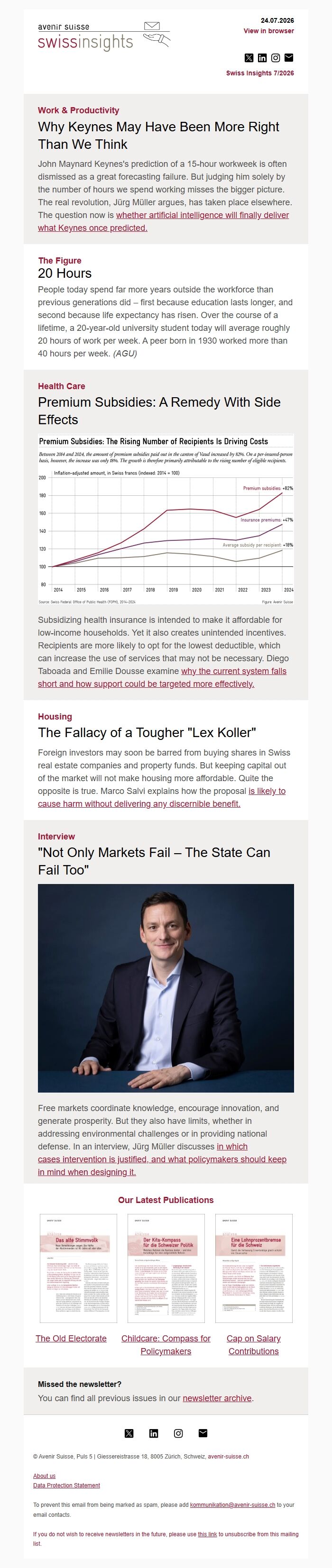
Subsidizing health insurance is intended to make it affordable for low-income households. Yet it also creates unintended incentives. Recipients are more likely to opt for the lowest deductible, which can increase the use of services that may not be necessary. Diego Taboada and Emilie Dousse examine why the current system falls short and how support could be targeted more effectively. ([link removed] )
Housing
The Fallacy of a Tougher "Lex Koller"
Foreign investors may soon be barred from buying shares in Swiss real estate companies and property funds. But keeping capital out of the market will not make housing more affordable. Quite the opposite is true. Marco Salvi explains how the proposal is likely to cause harm without delivering any discernible benefit. ([link removed] )
Interview
"Not Only Markets Fail – The State Can Fail Too"
Free markets coordinate knowledge, encourage innovation, and generate prosperity. But they also have limits, whether in addressing environmental challenges or in providing national defense. In an interview, Jürg Müller discusses in which cases intervention is justified, and what policymakers should keep in mind when designing it. ([link removed] )
Our Latest Publications
2026-06_analyse_das_alte_stimmvolk_de_rahmen ([link removed] )
The Old Electorate ([link removed] )
2026_03_kita_kompass_de_rahmen ([link removed] )
Childcare: Compass for Policymakers ([link removed] )
2026_03_Cover_Lohnprozentbremse_de_mit_Rahmen.png ([link removed] )
Cap on Salary Contributions ([link removed] )
Missed the newsletter?
You can find all previous issues in our newsletter archive ([link removed] ) .
x ([link removed] )
linkedin ([link removed] )
instagram (2) ([link removed] )
email (mailto:[email protected])
© Avenir Suisse, Puls 5 | Giessereistrasse 18, 8005 Zürich, Schweiz, avenir-suisse.ch ([link removed] )
About us ([link removed] )
Data Protection Statement ([link removed] )
To prevent this email from being marked as spam, please add [email protected] (mailto:[email protected]) to your email contacts.
If you do not wish to receive newsletters in the future, please use this link ([link removed] ) to unsubscribe from this mailing list.
header_newsletter_en_2024-1 ([link removed] )
24.07.2026
View in browser ([link removed] )
x ([link removed] )
linkedin ([link removed] )
instagram (2) ([link removed] )
email (mailto:%[email protected])
Swiss Insights 7/2026
header_newsletter_en_2024-1 ([link removed] )
24.07.2026
View in browser ([link removed] )
x ([link removed] )
linkedin ([link removed] )
instagram (2) ([link removed] )
email (mailto:%[email protected])
Swiss Insights 7/2026
Work & Productivity
Why Keynes May Have Been More Right Than We Think
John Maynard Keynes's prediction of a 15-hour workweek is often dismissed as a great forecasting failure. But judging him solely by the number of hours we spend working misses the bigger picture. The real revolution, Jürg Müller argues, has taken place elsewhere. The question now is whether artificial intelligence will finally deliver what Keynes once predicted. ([link removed] )
The Figure
20 Hours
People today spend far more years outside the workforce than previous generations did – first because education lasts longer, and second because life expectancy has risen. Over the course of a lifetime, a 20-year-old university student today will average roughly 20 hours of work per week. A peer born in 1930 worked more than 40 hours per week. (AGU)
Health Care
Premium Subsidies: A Remedy With Side Effects
Subsidizing health insurance is intended to make it affordable for low-income households. Yet it also creates unintended incentives. Recipients are more likely to opt for the lowest deductible, which can increase the use of services that may not be necessary. Diego Taboada and Emilie Dousse examine why the current system falls short and how support could be targeted more effectively. ([link removed] )
Housing
The Fallacy of a Tougher "Lex Koller"
Foreign investors may soon be barred from buying shares in Swiss real estate companies and property funds. But keeping capital out of the market will not make housing more affordable. Quite the opposite is true. Marco Salvi explains how the proposal is likely to cause harm without delivering any discernible benefit. ([link removed] )
Interview
"Not Only Markets Fail – The State Can Fail Too"
Free markets coordinate knowledge, encourage innovation, and generate prosperity. But they also have limits, whether in addressing environmental challenges or in providing national defense. In an interview, Jürg Müller discusses in which cases intervention is justified, and what policymakers should keep in mind when designing it. ([link removed] )
Our Latest Publications
2026-06_analyse_das_alte_stimmvolk_de_rahmen ([link removed] )
The Old Electorate ([link removed] )
2026_03_kita_kompass_de_rahmen ([link removed] )
Childcare: Compass for Policymakers ([link removed] )
2026_03_Cover_Lohnprozentbremse_de_mit_Rahmen.png ([link removed] )
Cap on Salary Contributions ([link removed] )
Missed the newsletter?
You can find all previous issues in our newsletter archive ([link removed] ) .
x ([link removed] )
linkedin ([link removed] )
instagram (2) ([link removed] )
email (mailto:[email protected])
© Avenir Suisse, Puls 5 | Giessereistrasse 18, 8005 Zürich, Schweiz, avenir-suisse.ch ([link removed] )
About us ([link removed] )
Data Protection Statement ([link removed] )
To prevent this email from being marked as spam, please add [email protected] (mailto:[email protected]) to your email contacts.
If you do not wish to receive newsletters in the future, please use this link ([link removed] ) to unsubscribe from this mailing list.
Message Analysis
- Sender: Avenir Suisse
- Political Party: n/a
- Country: Switzerland
- State/Locality: n/a
- Office: n/a