
| From | AEI DataPoints <[email protected]> |
| Subject | What America’s Report Card Doesn’t Count |
| Date | July 30, 2026 1:35 PM |
Links have been removed from this email. Learn more in the FAQ.
Links have been removed from this email. Learn more in the FAQ.
Also: Atlantic Hurricanes and Social Media Use
AEIDataPoints-Banner ([link removed] )
Expert analysis made easy. Breaking down the news with data, charts, and maps.
Edited by Carter Hutchinson and Lexi Baker
Happy Thursday! In today’s newsletter, we examine the impact of family structure on student success, what El Niño means for hurricane season, and the effect of social media on teen girls.
Don’t forget—subscribe ([link removed] ) and send DataPoints to a friend!
For inquiries, please email [email protected] (mailto:[email protected]) .
1. The Missing Stat: Family Structure and Student Success ([link removed] )
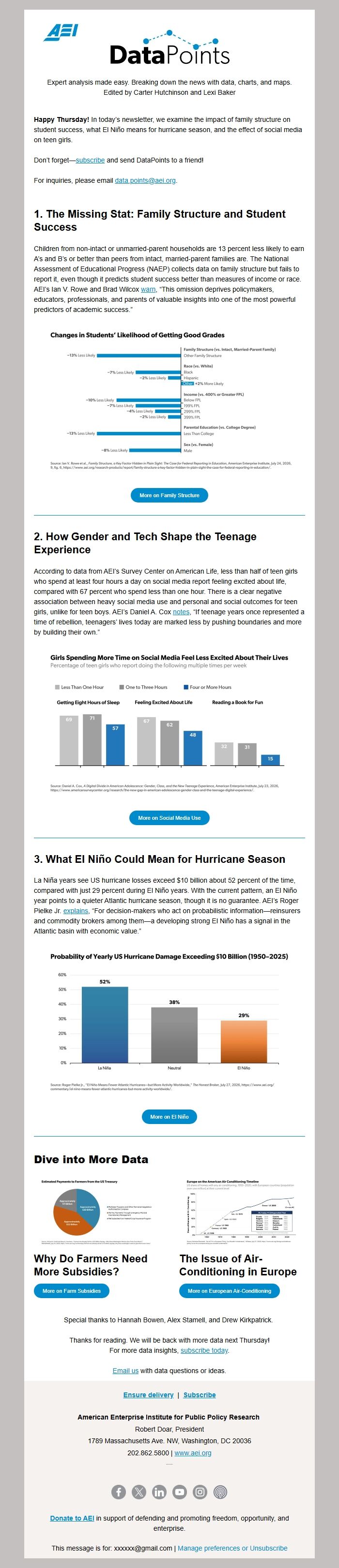
Children from non-intact or unmarried-parent households are 13 percent less likely to earn A’s and B’s or better than peers from intact, married-parent families are. The National Assessment of Educational Progress (NAEP) collects data on family structure but fails to report it, even though it predicts student success better than measures of income or race. AEI’s Ian V. Rowe and Brad Wilcox warn ([link removed] ) , “This omission deprives policymakers, educators, professionals, and parents of valuable insights into one of the most powerful predictors of academic success.”
07.30_WilcoxRowe ([link removed] )
More on Family Structure
([link removed] )
2. How Gender and Tech Shape the Teenage Experience ([link removed] )
According to data from AEI’s Survey Center on American Life, less than half of teen girls who spend at least four hours a day on social media report feeling excited about life, compared with 67 percent who spend less than one hour. There is a clear negative association between heavy social media use and personal and social outcomes for teen girls, unlike for teen boys. AEI’s Daniel A. Cox notes ([link removed] ) , “If teenage years once represented a time of rebellion, teenagers’ lives today are marked less by pushing boundaries and more by building their own.”
07.30_Cox ([link removed] )
More on Social Media Use
([link removed] )
3. What El Niño Could Mean for Hurricane Season ([link removed] )
La Niña years see US hurricane losses exceed $10 billion about 52 percent of the time, compared with just 29 percent during El Niño years. With the current pattern, an El Niño year points to a quieter Atlantic hurricane season, though it is no guarantee. AEI’s Roger Pielke Jr. explains ([link removed] ) , “For decision-makers who act on probabilistic information—reinsurers and commodity brokers among them—a developing strong El Niño has a signal in the Atlantic basin with economic value.”
07.30_Pielke ([link removed] )
More on El Niño
([link removed] )
Dive into More Data
07.30_SmithGodwin ([link removed] )
Why Do Farmers Need More Subsidies? ([link removed] )
More on Farm Subsidies
([link removed] )
07.30_Eberstadt ([link removed] )
The Issue of Air-Conditioning in Europe ([link removed] )
More on European Air-Conditioning
([link removed] )
Special thanks to Hannah Bowen, Alex Stamell, and Drew Kirkpatrick.
Thanks for reading. We will be back with more data next Thursday!
For more data insights, subscribe today ([link removed] ) .
Email us (mailto:[email protected]) with data questions or ideas.
Ensure delivery ([link removed] ) | Subscribe ([link removed] )
American Enterprise Institute for Public Policy Research
Robert Doar, President
1789 Massachusetts Ave. NW, Washington, DC 20036
202.862.5800 | www.aei.org ([link removed] )
Unsubscribe from the link below. ([link removed] )
Facebook ([link removed] )
X ([link removed] )
LinkedIn ([link removed] )
YouTube ([link removed] )
Instagram ([link removed] )
Podcast Logo New_Gray ([link removed] )
Donate to AEI ([link removed] ) in support of defending and promoting freedom, opportunity, and enterprise.
This message is for: [email protected] | Manage preferences or Unsubscribe ([link removed] )
AEIDataPoints-Banner ([link removed] )
Expert analysis made easy. Breaking down the news with data, charts, and maps.
Edited by Carter Hutchinson and Lexi Baker
Happy Thursday! In today’s newsletter, we examine the impact of family structure on student success, what El Niño means for hurricane season, and the effect of social media on teen girls.
Don’t forget—subscribe ([link removed] ) and send DataPoints to a friend!
For inquiries, please email [email protected] (mailto:[email protected]) .
1. The Missing Stat: Family Structure and Student Success ([link removed] )
Children from non-intact or unmarried-parent households are 13 percent less likely to earn A’s and B’s or better than peers from intact, married-parent families are. The National Assessment of Educational Progress (NAEP) collects data on family structure but fails to report it, even though it predicts student success better than measures of income or race. AEI’s Ian V. Rowe and Brad Wilcox warn ([link removed] ) , “This omission deprives policymakers, educators, professionals, and parents of valuable insights into one of the most powerful predictors of academic success.”
07.30_WilcoxRowe ([link removed] )
More on Family Structure
([link removed] )
2. How Gender and Tech Shape the Teenage Experience ([link removed] )
According to data from AEI’s Survey Center on American Life, less than half of teen girls who spend at least four hours a day on social media report feeling excited about life, compared with 67 percent who spend less than one hour. There is a clear negative association between heavy social media use and personal and social outcomes for teen girls, unlike for teen boys. AEI’s Daniel A. Cox notes ([link removed] ) , “If teenage years once represented a time of rebellion, teenagers’ lives today are marked less by pushing boundaries and more by building their own.”
07.30_Cox ([link removed] )
More on Social Media Use
([link removed] )
3. What El Niño Could Mean for Hurricane Season ([link removed] )
La Niña years see US hurricane losses exceed $10 billion about 52 percent of the time, compared with just 29 percent during El Niño years. With the current pattern, an El Niño year points to a quieter Atlantic hurricane season, though it is no guarantee. AEI’s Roger Pielke Jr. explains ([link removed] ) , “For decision-makers who act on probabilistic information—reinsurers and commodity brokers among them—a developing strong El Niño has a signal in the Atlantic basin with economic value.”
07.30_Pielke ([link removed] )
More on El Niño
([link removed] )
Dive into More Data
07.30_SmithGodwin ([link removed] )
Why Do Farmers Need More Subsidies? ([link removed] )
More on Farm Subsidies
([link removed] )
07.30_Eberstadt ([link removed] )
The Issue of Air-Conditioning in Europe ([link removed] )
More on European Air-Conditioning
([link removed] )
Special thanks to Hannah Bowen, Alex Stamell, and Drew Kirkpatrick.
Thanks for reading. We will be back with more data next Thursday!
For more data insights, subscribe today ([link removed] ) .
Email us (mailto:[email protected]) with data questions or ideas.
Ensure delivery ([link removed] ) | Subscribe ([link removed] )
American Enterprise Institute for Public Policy Research
Robert Doar, President
1789 Massachusetts Ave. NW, Washington, DC 20036
202.862.5800 | www.aei.org ([link removed] )
Unsubscribe from the link below. ([link removed] )
Facebook ([link removed] )
X ([link removed] )
LinkedIn ([link removed] )
YouTube ([link removed] )
Instagram ([link removed] )
Podcast Logo New_Gray ([link removed] )
Donate to AEI ([link removed] ) in support of defending and promoting freedom, opportunity, and enterprise.
This message is for: [email protected] | Manage preferences or Unsubscribe ([link removed] )
Message Analysis
- Sender: American Enterprise Institute
- Political Party: n/a
- Country: United States
- State/Locality: n/a
- Office: n/a
-
Email Providers:
- HubSpot