| Unsubscribe |
Dear Fellow Investor,
Wall Street is fixating on one number:
The staggering amount of electricity artificial intelligence is about to demand.
Some analysts believe AI could drive one of the largest jumps in power demand in decades...
With data center electricity use climbing as much as 160% by 2030.
The grid was simply not built for it.
And nobody seems to have an answer as to where this extra power will come from.
But tech expert George Gilder believes one already exists.
A new kind of computing chip that does the same work as today's AI systems... With up to 90% less power.
Not a little less.
A fraction.
While the rest of the market frets about where all that electricity will come from...
Gilder has been watching the one technology that barely needs it.
It is one of three companies that comprise what he calls the “Trillion Dollar Triangle.”
And Gilder believes the day all three techs converge...
Is the day computing gets rewritten from the ground up.
See the three companies behind the Trillion Dollar Triangle.
To the future,

Roger Michalski
Publisher, Eagle Financial Publications
P.S. One of these three companies went public just weeks ago. The profit window Gilder’s watching is opening right now.
Blueprint for a Billion: Nebius Group Secures the AI Floor
By Jeffrey Neal Johnson. Article Posted: 7/15/2026.

Key Points
- Nebius Group's stock dropped roughly 6% on 15 million shares traded as macroeconomic concerns triggered a broad sell-off across high-beta technology names.
- A $1 billion, NVIDIA-backed Reflection AI contract running through 2029 expanded Nebius Group's contracted backlog to an estimated $50 billion, bolstering revenue visibility.
- Insider share sales by Nebius Group's CEO and CTO appear to reflect routine liquidity events rather than diminished confidence, given the company's operational progress.
- Special Report: SpaceX is offering you shares. Don't take them.
The broader technology sector is currently navigating a sharp, liquidity-driven rotation. Recent macroeconomic shifts and tepid June payroll data have prompted institutional investors to lock in profits, triggering a broad sell-off across high-beta momentum equities.
Nebius Group (NASDAQ: NBIS) has found itself caught in this immediate crossfire, declining about 6% on heavy trading volume of 15 million shares.
Buy this stock tomorrow (Ad)
Marc Chaikin, founder of Chaikin Analytics, is flagging a little-known company that just secured a partnership with Nvidia - one he believes positions it ahead of Tesla in the autonomous vehicle race.
With a market-moving announcement expected on July 31st, Chaikin is urging investors to swap overpriced AI stocks for this under-the-radar name before markets open. He's also releasing a free Hotlist and Hitlist of buy and sell ideas for the second half of 2026.
Get the ticker symbol and full details at no charge todayWhen investors step back from the noise, Nebius' underlying business fundamentals reveal a structural advantage that the market may be mispricing.
The initial reaction to macroeconomic data often forces blanket selling across an entire sector, regardless of individual companies' execution.
For diligent investors, these sector-wide rotations create opportunities to evaluate infrastructure providers that are successfully expanding their operational moats while their share prices consolidate.
Reflection AI Deal Cements the Neocloud Foundation
Nebius Group recently executed a monumental $1 billion forward compute contract with Reflection AI. The agreement secures raw infrastructure supply for the startup through 2029, cementing Nebius Group's position as an indispensable provider in the generative AI ecosystem and de-risking its long-term revenue pipeline.
By locking in a billion-dollar forward contract, Nebius Group achieves something incredibly rare in the volatile technology sector: financial clarity. The market frequently worries about software churn and the risk that a trending AI application could lose its user base overnight to a faster competitor.
Nebius Group largely bypasses this software risk. It operates as a digital landlord, leasing the physical compute required to run complex models regardless of which software application ultimately wins the consumer race.
Beyond the deal's sheer size, the counterparty's strength helps protect the agreement. Reflection AI is directly backed by NVIDIA Corporation (NASDAQ: NVDA) and is currently finalizing a funding round at a $25 billion valuation. Reflection AI also recently executed a similar multibillion-dollar compute contract with SpaceX (NASDAQ: SPCX), illustrating inelastic enterprise demand. This substantial capitalization provides significant liquidity, turning Nebius Group's $1 billion contract into a revenue floor rather than a speculative projection.
Trading CPUs for Next-Generation GPUs
To understand the magnitude of this catalyst, it helps to break down the mechanics of the neocloud business model. Traditional cloud providers operate legacy data centers built heavily around CPUs. Neoclouds like Nebius Group are engineered from the ground up to host high-density GPU clusters, which are essential for training frontier artificial intelligence models.
Legacy data centers face severe thermal and structural limitations when retrofitting their facilities to meet the power-density requirements of modern AI training. Nebius Group purpose-builds its facilities to accommodate the extreme liquid-cooling and power loads required by the latest hardware. This architectural foresight gives the company a distinct technical advantage, allowing it to lease capacity at a premium to startups and enterprises that cannot afford deployment delays.
Unpacking a $50 Billion Backlog Buffer
The Reflection AI deal pushes Nebius Group's total reported contracted backlog to an estimated $50 billion. For investors modeling future cash flows, a backlog of this magnitude acts as a shock absorber against cyclical uncertainty. Recent quarterly filings highlight a staggering 684% year-over-year revenue surge.
When reviewing the headline financials, a reported net margin of more than 95% immediately stands out. Investors need to strip away accounting anomalies to evaluate the true operating reality. Recent filings indicate that a $781 million noncash gain heavily skewed quarterly net income. Adjusted operating metrics actually reveal a 20% widening of net losses.
Far from being a red flag, this widening loss is a direct result of the heavy infrastructure capital expenditures required for hardware procurement. Nebius Group is deploying significant capital to scale its data centers today, which directly translates into leasing capacity tomorrow. It is a classic and necessary “if you build it, they will come” infrastructure build-out phase that precedes deep free cash flow generation.
Securing the NVIDIA GB300 Hardware Pipeline
A prevailing bear thesis surrounding Nebius Group centers on the imminent threat of traditional hyperscalers entering the third-party hardware-leasing market. The fear is that if tech giants pivot to leasing out excess compute, the sudden surge in supply could compress margins across the specialized neocloud sector.
This perspective mischaracterizes Nebius Group's strategic positioning. Market data confirms that Nebius Group holds active partnership agreements with both Meta Platforms (NASDAQ: META) and Microsoft Corporation (NASDAQ: MSFT).
Rather than acting solely as competitors, these hyperscalers often use specialized neocloud infrastructure to handle excess compute demand and run distinct, segregated workloads. Nebius Group is effectively hedging against hyperscaler encroachment by embedding itself directly into their broader operational supply chains.
More importantly, Nebius Group maintains a highly privileged strategic alliance with NVIDIA. In an environment defined by global semiconductor bottlenecks, holding capital is not enough to build a data center; companies must also have guaranteed access to hardware. Nebius Group holds prioritized allocations for next-generation GB300 clusters. This hardware pipeline serves as an operational moat.
Finding Asymmetry in the Infrastructure Cycle
It is entirely natural for a stock with a $49.5 billion market capitalization and $529.80 million in trailing 12-month sales to experience sharp volatility. Trading at a trailing price-to-sales multiple of 93, Nebius is undeniably priced for flawless execution. When the market rotates away from technology, high-multiple stocks inevitably face the heaviest selling pressure. The recent pullback aligns logically with this sector consolidation.
Some market participants have pointed to recent insider distributions as a reason for caution. Regulatory filings show a 16,937-share sale by the chief technology officer and a block worth more than $10 million sold by the company's CEO. Contextualizing these sales against the total outstanding share count of more than 250 million reveals them as standard liquidity events, largely tied to compensation structuring.
Systematic selling can be a warning sign, but these specific distributions do not indicate a fundamental lack of executive conviction given the scale of the company's recent operational victories.
The artificial intelligence gold rush requires immense physical infrastructure, and the market is rapidly separating speculative software developers from foundational hardware providers.
Nebius has successfully secured its position as a premier pick-and-shovel operation, supported by a robust backlog and anchored by multiyear contracts with tier-one counterparties. Patient investors might view its sell-off as a compelling entry point into a business that has locked in its revenue pipeline for the rest of the decade.
Why Intuitive Surgical’s Strong Quarter Still Spooked Investors
By Chris Markoch. Article Posted: 7/18/2026.

Key Points
- Intuitive Surgical reported strong second-quarter results, with revenue up 19% and non-GAAP earnings per share up 28%.
- Investors focused on the company’s unchanged da Vinci procedure-growth guidance, which implies slower growth than in recent years.
- The stock’s premium valuation and technical breakdown could keep pressure on shares, even as analysts remain broadly bullish.
- Special Report: SpaceX is offering you shares. Don't take them.
Intuitive Surgical (NASDAQ: ISRG) was part of the artificial intelligence (AI) and robotics trade before those themes became mainstream.
The company manufactures the da Vinci robotic surgical system, which had an installed base of more than 11,700 systems as of June 30, 2026.
Buy this stock tomorrow (Ad)
Marc Chaikin, founder of Chaikin Analytics, is flagging a little-known company that just secured a partnership with Nvidia - one he believes positions it ahead of Tesla in the autonomous vehicle race.
With a market-moving announcement expected on July 31st, Chaikin is urging investors to swap overpriced AI stocks for this under-the-radar name before markets open. He's also releasing a free Hotlist and Hitlist of buy and sell ideas for the second half of 2026.
Get the ticker symbol and full details at no charge todayThat was one highlight from the company’s Q2 2026 earnings report.
In the report, released after the market closed on July 16, the company delivered impressive results.
Second-quarter 2026 revenue of $2.89 billion increased 19% from $2.44 billion in the second quarter of 2025.
Second-quarter 2026 non-GAAP net income attributable to Intuitive Surgical, Inc. was $1 billion, or $2.80 per diluted share, compared with $800 million, or $2.19 per diluted share, in the second quarter of 2025.
The company repurchased 0.9 million shares of its common stock for $380 million in the second quarter of 2026.
Despite the strong report, ISRG fell approximately 10% in after-hours trading. The headline reason was that the company didn’t raise its full-year guidance for da Vinci procedures. The company’s prior guidance was 13.5% to 15.5%, which would mark its slowest growth in several years.
A Kink in the Company’s Critical Flywheel
To be fair, Intuitive Surgical is still posting impressive growth for its da Vinci system. For the quarter just ended:
Worldwide da Vinci procedures grew approximately 15% year over year (YOY).
The company placed 468 da Vinci surgical systems, compared with 395 in the second quarter of 2025.
Second-quarter 2026 da Vinci surgical system placements included 246 da Vinci 5 systems, compared with 180 in the second quarter of 2025.
The company grew its da Vinci surgical system installed base to 11,710 systems as of June 30, 2026, an increase of 12% YOY.
But it’s hard to overstate how important the da Vinci system is to Intuitive Surgical’s growth. The system is a one-time purchase, but it generates demand for a host of services, instruments and accessories that drive revenue and earnings.
To be fair, ISRG had already been declining since July 14. That’s when HCA Healthcare (NYSE: HCA) trimmed its full-year outlook, implying fewer surgical procedures and sending medical device stocks lower.
That’s not necessarily what Intuitive Surgical is reporting. It’s reporting slower growth, but growth is still growth.
Why Intuitive Surgical Stock Still Commands a Premium Valuation
At the close of trading on July 16, Intuitive Surgical traded at around 46 times forward earnings. That’s a premium to the S&P 500, but for investors new to ISRG, it represents a discount to the company’s prior price-to-earnings (P/E) ratios, which reached around 60 times in recent years.
Nevertheless, ISRG is expensive at a time when investors are becoming more sensitive to the value they’re getting for the price. Some investors will point to companies such as Medtronic (NYSE: MDT) and Boston Scientific (NYSE: BSX), which are also in the medical device sector and trade at far lower multiples than Intuitive Surgical.
However, those companies have broader product portfolios, whereas Intuitive Surgical is laser-focused on the da Vinci system. The point is that it’s not an apples-to-apples comparison. Even as a standalone stock, ISRG has always commanded a premium price.
Intuitive Surgical Stock Breaks Below Long-Term Support
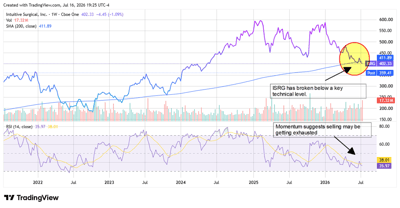
The weekly chart shows that ISRG is now trading below its 200-week simple moving average, at 411.89, for the first time in years. This level served as reliable support throughout the 2023-2025 uptrend. Before the earnings report, shares had fallen roughly 32% from last year’s peak near $590. The post-earnings drop to around $359 would represent a decisive break below that long-term trendline.
The weekly RSI sits at 35.97, its lowest reading since the 2022 bear market, though it has not yet entered oversold territory below 30. That leaves room for further downside before technical buyers would typically step in. The trend structure—lower highs since early 2025—suggests momentum remains firmly with sellers for now. A reclaim of the 200-week average would be the first signal that the technical picture is stabilizing.
Why the Intuitive Surgical Sell-Off May Be Overdone
At a time when high-speed algorithms are programmed to make buy and sell decisions based on raw data, this could be an overcorrection. It’s possible that the stock will reverse direction in the coming days. Analysts remain bullish on ISRG, with a consensus price target of $530.92, representing nearly 50% upside potential.
That means that if the stock continues to drop while analysts maintain their bullish targets, the opportunity for patient investors becomes even greater. The company may not have an impenetrable moat, but it’s still well fortified. For investors who have had ISRG on a watchlist, the time to buy may be approaching.
This email is a sponsored email provided by Eagle Publishing, a third-party advertiser of InsiderTrades.com and MarketBeat.
If you need help with your subscription, please feel free to contact MarketBeat's U.S. based support team at [email protected].
If you no longer wish to receive email from InsiderTrades.com, you can unsubscribe.
Copyright 2006-2026 MarketBeat Media, LLC. All rights reserved.
345 N Reid Place, Suite 620, Sioux Falls, S.D. 57103-7078. United States..