
| From | Gatestone Institute <[email protected]> |
| Subject | Trump's Saudi Nuclear Horror Show |
| Date | July 27, 2026 9:17 AM |
Links have been removed from this email. Learn more in the FAQ.
Links have been removed from this email. Learn more in the FAQ.
[link removed]
** Trump's Saudi Nuclear Horror Show ([link removed])
Why Trump and Congress Should Reject the US-Saudi Nuclear Deal
------------------------------------------------------------
by Khaled Abu Toameh • July 27, 2026 at 5:00 am
* The [US-Saudi civilian nuclear] agreement threatens to weaken decades of US non-proliferation policy, ignite a regional arms race, embolden America's adversaries, and create security risks that future generations may be powerless to reverse.
* The most controversial aspect of the proposed agreement is that it reportedly allows Saudi Arabia to develop domestic uranium enrichment capabilities under safeguards that fall short of the stringent standards previously demanded by Washington. While low-enriched uranium is used to fuel civilian nuclear reactors, the same technology can eventually produce highly enriched uranium suitable for nuclear weapons.
* "[W]ithout a doubt, if Iran developed a nuclear bomb, we will follow suit as soon as possible." — Saudi Crown Prince Mohammed bin Salman, CBS News, March 15, 2018.
* These words should have ended any discussion about permitting uranium enrichment on Saudi soil. They reveal that Riyadh views civilian nuclear capabilities not merely as an energy project but also as a potential strategic hedge against Iran.
* [G]overnments change, regimes fall, alliances split, and today's friend -- even as a member of the Abraham Accords -- may not be tomorrow's ally.
* [E]xtremist Islamist organizations continue to view the kingdom as both a battlefield and a prize. No one can predict Saudi Arabia's political landscape 20 or 30 years from now. A future period of instability, succession crisis, or regime collapse could deliver sensitive nuclear facilities, technology, or materials to actors whose goals are fundamentally hostile to the United States and its allies.
* The greatest danger, therefore, is not Crown Prince Mohammed bin Salman or the current Saudi leadership. The greatest danger is the uncertainty surrounding whoever may rule the kingdom decades from now. Nuclear technology lasts far longer than political regimes.
* The proposed agreement also abandons the "gold standard" that has guided US civilian nuclear cooperation for decades. Under the 2009 US-United Arab Emirates (UAE) nuclear agreement, Abu Dhabi accepted strict conditions that prohibited domestic uranium enrichment and spent-fuel reprocessing while granting comprehensive international oversight. These restrictions significantly reduced proliferation dangers.
* The Saudi agreement reportedly discards many of these safeguards. It also reportedly does not require Riyadh to adopt the International Atomic Energy Agency's Additional Protocol, which allows inspectors short-notice access to undeclared facilities to detect clandestine nuclear activities.
* The UAE would likely seek to renegotiate its own agreement. Turkey and Egypt would almost certainly demand similar privileges. Russia and China could use the American precedent to justify weaker safeguards in their own nuclear partnerships across the Middle East and beyond.
* Instead of strengthening the global non-proliferation regime, the United States would be weakening it with its own hands.
* Peace with Israel is not a prize awarded by Arab or Muslim countries. It is not something that should require American bribes in the form of nuclear technology or strategic incentives.
* Peace serves Saudi Arabia's own interests. It enhances regional stability, strengthens economic development, attracts foreign investment, and improves security for all parties. Arab and Muslim states should pursue peace with Israel because it benefits their own people -- not because Washington offers dangerous concessions.
* The United States should not become the architect of the next Middle East nuclear arms race.
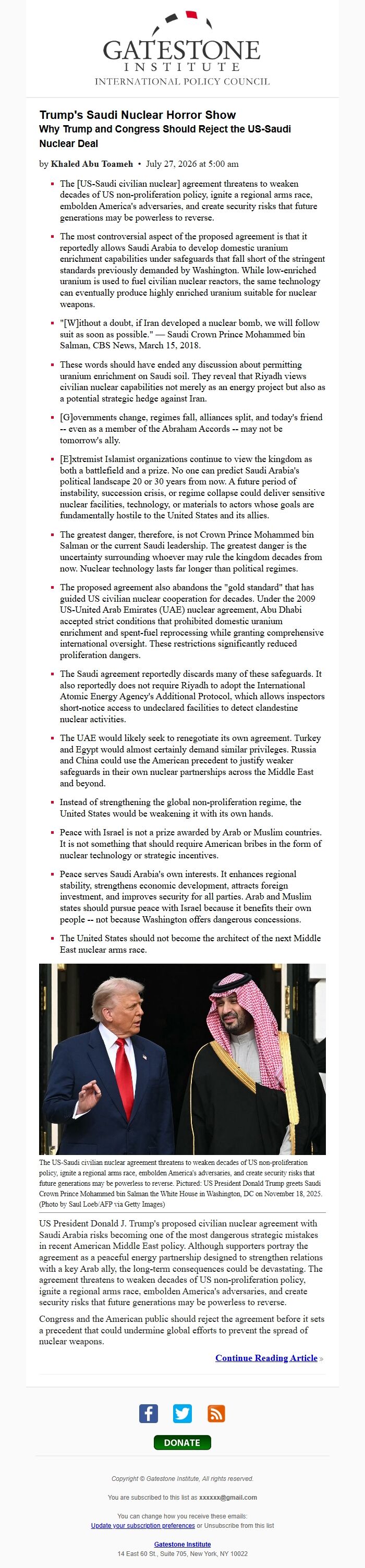
The US-Saudi civilian nuclear agreement threatens to weaken decades of US non-proliferation policy, ignite a regional arms race, embolden America's adversaries, and create security risks that future generations may be powerless to reverse. Pictured: US President Donald Trump greets Saudi Crown Prince Mohammed bin Salman the White House in Washington, DC on November 18, 2025. (Photo by Saul Loeb/AFP via Getty Images)
US President Donald J. Trump's proposed civilian nuclear agreement with Saudi Arabia risks becoming one of the most dangerous strategic mistakes in recent American Middle East policy. Although supporters portray the agreement as a peaceful energy partnership designed to strengthen relations with a key Arab ally, the long-term consequences could be devastating. The agreement threatens to weaken decades of US non-proliferation policy, ignite a regional arms race, embolden America's adversaries, and create security risks that future generations may be powerless to reverse.
Congress and the American public should reject the agreement before it sets a precedent that could undermine global efforts to prevent the spread of nuclear weapons.
Continue Reading Article ([link removed])
============================================================
** Facebook ([link removed])
** Twitter ([link removed])
** RSS ([link removed])
** Donate ([link removed])
Copyright © Gatestone Institute, All rights reserved.
You are subscribed to this list as [email protected]
You can change how you receive these emails:
** Update your subscription preferences ([link removed])
or ** Unsubscribe from this list ([link removed])
** Gatestone Institute ([link removed])
14 East 60 St., Suite 705, New York, NY 10022
** Trump's Saudi Nuclear Horror Show ([link removed])
Why Trump and Congress Should Reject the US-Saudi Nuclear Deal
------------------------------------------------------------
by Khaled Abu Toameh • July 27, 2026 at 5:00 am
* The [US-Saudi civilian nuclear] agreement threatens to weaken decades of US non-proliferation policy, ignite a regional arms race, embolden America's adversaries, and create security risks that future generations may be powerless to reverse.
* The most controversial aspect of the proposed agreement is that it reportedly allows Saudi Arabia to develop domestic uranium enrichment capabilities under safeguards that fall short of the stringent standards previously demanded by Washington. While low-enriched uranium is used to fuel civilian nuclear reactors, the same technology can eventually produce highly enriched uranium suitable for nuclear weapons.
* "[W]ithout a doubt, if Iran developed a nuclear bomb, we will follow suit as soon as possible." — Saudi Crown Prince Mohammed bin Salman, CBS News, March 15, 2018.
* These words should have ended any discussion about permitting uranium enrichment on Saudi soil. They reveal that Riyadh views civilian nuclear capabilities not merely as an energy project but also as a potential strategic hedge against Iran.
* [G]overnments change, regimes fall, alliances split, and today's friend -- even as a member of the Abraham Accords -- may not be tomorrow's ally.
* [E]xtremist Islamist organizations continue to view the kingdom as both a battlefield and a prize. No one can predict Saudi Arabia's political landscape 20 or 30 years from now. A future period of instability, succession crisis, or regime collapse could deliver sensitive nuclear facilities, technology, or materials to actors whose goals are fundamentally hostile to the United States and its allies.
* The greatest danger, therefore, is not Crown Prince Mohammed bin Salman or the current Saudi leadership. The greatest danger is the uncertainty surrounding whoever may rule the kingdom decades from now. Nuclear technology lasts far longer than political regimes.
* The proposed agreement also abandons the "gold standard" that has guided US civilian nuclear cooperation for decades. Under the 2009 US-United Arab Emirates (UAE) nuclear agreement, Abu Dhabi accepted strict conditions that prohibited domestic uranium enrichment and spent-fuel reprocessing while granting comprehensive international oversight. These restrictions significantly reduced proliferation dangers.
* The Saudi agreement reportedly discards many of these safeguards. It also reportedly does not require Riyadh to adopt the International Atomic Energy Agency's Additional Protocol, which allows inspectors short-notice access to undeclared facilities to detect clandestine nuclear activities.
* The UAE would likely seek to renegotiate its own agreement. Turkey and Egypt would almost certainly demand similar privileges. Russia and China could use the American precedent to justify weaker safeguards in their own nuclear partnerships across the Middle East and beyond.
* Instead of strengthening the global non-proliferation regime, the United States would be weakening it with its own hands.
* Peace with Israel is not a prize awarded by Arab or Muslim countries. It is not something that should require American bribes in the form of nuclear technology or strategic incentives.
* Peace serves Saudi Arabia's own interests. It enhances regional stability, strengthens economic development, attracts foreign investment, and improves security for all parties. Arab and Muslim states should pursue peace with Israel because it benefits their own people -- not because Washington offers dangerous concessions.
* The United States should not become the architect of the next Middle East nuclear arms race.
The US-Saudi civilian nuclear agreement threatens to weaken decades of US non-proliferation policy, ignite a regional arms race, embolden America's adversaries, and create security risks that future generations may be powerless to reverse. Pictured: US President Donald Trump greets Saudi Crown Prince Mohammed bin Salman the White House in Washington, DC on November 18, 2025. (Photo by Saul Loeb/AFP via Getty Images)
US President Donald J. Trump's proposed civilian nuclear agreement with Saudi Arabia risks becoming one of the most dangerous strategic mistakes in recent American Middle East policy. Although supporters portray the agreement as a peaceful energy partnership designed to strengthen relations with a key Arab ally, the long-term consequences could be devastating. The agreement threatens to weaken decades of US non-proliferation policy, ignite a regional arms race, embolden America's adversaries, and create security risks that future generations may be powerless to reverse.
Congress and the American public should reject the agreement before it sets a precedent that could undermine global efforts to prevent the spread of nuclear weapons.
Continue Reading Article ([link removed])
============================================================
** Facebook ([link removed])
** Twitter ([link removed])
** RSS ([link removed])
** Donate ([link removed])
Copyright © Gatestone Institute, All rights reserved.
You are subscribed to this list as [email protected]
You can change how you receive these emails:
** Update your subscription preferences ([link removed])
or ** Unsubscribe from this list ([link removed])
** Gatestone Institute ([link removed])
14 East 60 St., Suite 705, New York, NY 10022
Message Analysis
- Sender: Gatestone Institute
- Political Party: n/a
- Country: United States
- State/Locality: n/a
- Office: n/a
-
Email Providers:
- MailChimp