
|
 |
What Argentina can learn from the Falklands
The dispute over the islands is really about monetary policy
|

| |||||||||||||||


Daniel Raisbeck is an independent policy analyst on Latin America
In 2013, when 99.8 per cent of Falkland Islands voters chose to remain an Overseas Territory of the United Kingdom in a referendum (with only three votes against the motion) it was clear that, 31 years after the Argentine invasion, British patriotism ran deep among the Kelpers. Understandably so, given the heroics of Margaret Thatcher’s 1982 Expeditionary Force, which crossed an ocean to free the islands from General Galtieri’s conscript army.
But not even the 18 Argentines on the Falklands’ electoral register at the time voted against British territorial status (certainly not unanimously). The question is: why?
Let us assume that they lived and worked on the islands, but were not necessarily inclined to sing “Rule Britannia” at a moment’s notice. These were, after all, Argentine citizens and, most likely, not British patriots. So, what led them to favour British sovereignty?
I would argue that, beyond a penchant for the rule of law, they also opposed the mere possibility of Argentina’s political class having any say over their economic future and-especially - the currency they held in their pockets or bank accounts.
In 2013, the Falkland Islands’ nominal GDP per capita was over sevenfold Argentina’s (FKP / £60,000 or USD $93,600 at $1.56/£ vs. USD $12,964). This alone reveals a colossal gap in wealth and living standards.
Yet Argentine nationalists would claim that, with a population of some 3,000 islanders, the per capita metric skews things heavily in the Falklands’ favor. Besides, one of their incentives is to take over the Falklands’ natural resources, especially the large squid fishing revenues and potential oil and gas windfalls in territorial waters.
According to this mercantilist, zero-sum line of thought, an Argentine takeover of the Falklands would add considerably to Argentina’s national treasure ipso facto. Insofar as the islands are not a tech-or-services-oriented outpost in the South Atlantic, the argument has at least minimum merit at face value. In all likelihood, though, Argentina’s overbearing regulatory system and its tradition of disrespect for property rights would diminish the Falklands’ “extractive” industries.
Monetary policy, however, is another matter altogether. In this realm, the Falklands have one of the best systems available, Argentina one of the absolute worst.
The Falklands’ current monetary regime dates back to 1899, when the British government set up the Falkland Islands Currency Note Order. This allowed the islands’ monetary authorities to issue their own currency - the Falkland Islands pound - as long as it maintained 100 per cent reserves to back the circulating currency. A fixed exchange rate and full convertibility into sterling followed with the 1930 Notes Ordinance, which the Johns Hopkins Institute for Applied Economics classifies as a fully orthodox currency board.
According to Professor Steve Hanke’s terminology, in an orthodox currency board, the monetary authorities can solely carry out an exchange rate policy - based on maintaining 100 per cent reserves and full convertibility at a fixed rate with the “anchor” currency - but have no capacity to implement a discretionary monetary policy or act as a lender of last resort to commercial banks. Hence the Falklands have no central bank per se, but rather the aptly named Commissioners of Currency.
The Falklands’ Currency Ordinance of 1987 strengthened the system, above all by barring the Commissioners from granting advances or accepting deposits at their own discretion, thus closing off any route through which they could finance government deficits (surplus seigniorage is paid into general government revenue once a buffer is met, which is standard practice for an orthodox currency board). The ordinance also requires the Falklands government to make up any shortfall should the currency fund’s total assets ever fall below its liabilities. This statutory backstop guarantees full reserve backing.
Currency boards are a benevolent creation of the British Empire. They work because, as Hanke writes of the orthodox version, “the quantity of domestic currency in circulation is determined solely by market forces, namely the demand” for said currency. That is, there is no arbitrary creation of money via bureaucratic fiat. As economist George Selgin writes, a currency board is “an instance of a real monetary rule enforced by design,” in contrast with “pseudo” monetary rules such as a peg or “central bank based exchange rate commitment.”
In the Falklands, the results of this well-designed market system are plain to see. Since 1971, when the Falkland authorities began to track the Stanley Retail Price Index, a small basket of shipping-dependent goods, the annual inflation rate has matched that of the UK, albeit with slightly more volatility given the predominance of imports. Thus, as the Keynesian monetary consensus drove global stagflation, the Falklands’ inflation rate remained at or around the teens until 1981. The inflation rate reached a peak of 27.6 per cent amid the oil shock of 1973.
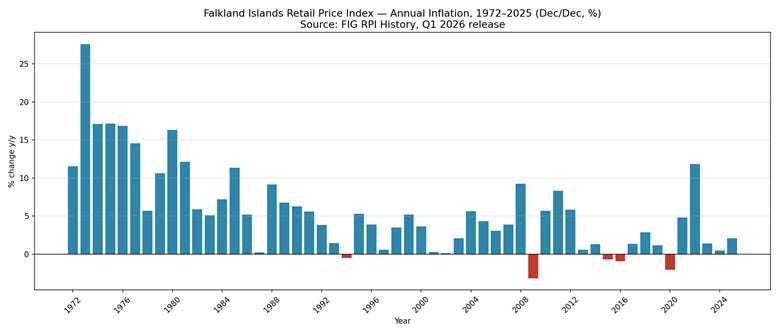 |
Between 1986 and 2025, however, the average inflation rate in the Falklands was 3.23 per cent, with a single year of double digit inflation (thanks to the 2022 lockdown and fiscal-monetary stimulus shock). There have even been several years - 2009, 2015-2016, 2020 - of deflation, thus aiding individual consumers with general price decreases.
The Falkland Islanders, in other words, have benefitted enormously, if quietly, from a strong currency (with zero devaluation against the pound), low inflation, and local politicians / bureaucrats’ inability to pay for any fiscal deficit by printing money. This has been the case especially for the past 40 years.
Since the 1970s, on the other hand, Argentina has been a chronic producer of junk currencies, unnecessarily high inflation in general terms, and frequent cases of hyperinflation. All of which is due to Argentine politicians’ inherent inability to live within their means, combined, of course, with their capacity to monetize their chronic deficits.
In the 1970s and 1980s, Argentina’s annual inflation remained above 100 per cent on average (133 and 750 per cent respectively), as the central bank managed to unleash three separate hyperinflationary episodes (1975, 1985, 1989). In the last quarter century, as much of Latin America left high inflation rates behind, Argentina has stood out—along with Venezuela—as the region’s inflationary basket case.
Since 2002, double-digit inflation has been the rule, with triple-digit levels reached in 2023 and 2024. Even now, after the Milei government avoided a new case of hyperinflation - the annual rate surpassed 200 per cent in 2023 - annual inflation remains above that of the Falklands’ 1973 record.
The curiosity is that, between 1992 and 2001, Argentina had low inflation rates thanks to a currency board-like system known as “convertibilidad.” Introduced by President Carlos Menem in 1991, the convertibility system pegged the peso to the dollar at a 1:1 ratio and, in theory, forced the central bank to back the entirety of the monetary base with foreign reserves.
The system lowered inflation from four figures in 1990 (1,343 per cent) to 17.5 per cent in 1992, a far faster pace of disinflation than that which Javier Milei has achieved thus far. By 1995, annual inflation was at a mere 1.6 per cent. In 1996 and 1997, Argentina “was among the ten countries with the lowest inflation rate in the world,” as economist Emilio Ocampo writes.
Yet the convertibility system’s staggering success was undone since the Argentine central bank remained in place, acted as a lender of last resort, and meddled in discretionary monetary policy. For instance, in June 2001, in the midst of a banking crisis, the central bank expanded the monetary base by 63 per cent on a single day. That same month, the government introduced a dual currency regime with a devalued peso rate for exports and a stronger rate for imports. Naturally, this and other monetary interventions spooked currency markets, where the peso lost parity with the dollar.
In January 2002, the Argentine government ended convertibility and, after a brief, failed attempt to devalue the peso, allowed it to float freely. By the end of the year, the peso had lost around 70 per cent of its value against the dollar while inflation climbed above 30 per cent, thus kicking off Argentina’s latest, multi-decade period of chronically high inflation.
 |
Argentina’s inability to rule itself—as its recent monetary history attests—should seriously undermine any of its claims to rule over others. This is one crucial reason why the country’s best bet is to shut down its central bank and dollarise the economy, as Javier Milei promised during the 2023 campaign but has not delivered. Instead, his government has controlled the exchange rate and intervened aggressively in currency markets (with a timely dose of fiscal discipline). It also received a de facto bailout from the U.S. Treasury via a currency swap mechanism when push came to shove in late 2025.
Whereas an orthodox currency board allows the local monetary authorities to carry out an exchange rate policy, dollarisation either removes the monetary powers that be altogether - i.e. with no central bank - or makes them obsolete. This is the ideal scenario in a country where the central bank acts as a historical source of impoverishment.
While Argentina is an example of what not to follow, the Falkland Islands’ sound monetary system - along with that of dollarised Panama, Ecuador, and El Salvador - should be a model for the rest of the Americas.
The distinction is relevant to the foreign policy debate in the United States, where some conservatives want to back Argentina’s claim over the Falklands since they see Milei as the ideologically aligned leader of a relatively large country. But they should reflect on why even the Argentines on the sparsely populated Falkland Islands have preferred to remain under British territorial status. The monetary angle is revealing of profound differences.
Milei is a transient leader, whose vociferous libertarian rhetoric does not always match his actions. Despite the previous years’ disinflation - far slower than under dollarisation or a currency board - both the peso and the central bank remain in place. The same institution that ruined the convertibility system of the 1990s maintains intact its capacity to unleash damage on a vast scale, for instance under a future Peronist government.
By contrast, the Falklands’ system of sound money has shown its mettle for well over a century. It is effective regardless of who holds power either in the islands or Westminster, precisely because it insulates monetary policy from the power of politicians.
U.S. policymakers should consider that, if Argentina itself and the rest of Latin America are to prosper, the people’s liberties must be protected from their own governments. This can be achieved under systems that resemble the Falklands’ market-based currency board far more than Argentina’s explosive central bank.
In the words of 16th century Spanish scholar Juan de Mariana, whom both John Locke and Thomas Jefferson read, debasing the people’s currency is an unequivocal act of tyranny.
What we’re reading
Puff piece. For The Critic, our own Christopher Snowdon has argued that Britain’s indoor smoking ban should be repealed or at least relaxed. The measure has become an unquestioned symbol of state paternalism rather than a proportionate public health measure. The original ban was driven as much by social intolerance towards smokers as by health concerns. It legislated an illiberal mindset in which governments increasingly regulate private behaviour.
American dream. Over at CityAM, Daniel Freeman has built upon the research of Tyler Goodspeed to make the case that Britain’s weak economic performance relative to the United States is better explained by overly restrictive banking regulation than by post-2010 fiscal austerity. Tougher capital requirements and other post-financial crisis regulations sharply curtailed bank lending, particularly to smaller businesses, depressing investment. Deregulation is essential.
Third world problems. For the Telegraph, Daniel Hannan, our Director-General, has suggested that Britain’s deepest problems stem from the importation of a “third-world mindset” rather than simply poor policy. While Britain remains a wealthy country with strong institutions, too many people now display attitudes characterised by low trust and weak respect for the rule of law. A renewed confidence in our civic norms is required for us to restore Britain’s prosperity.
Intelligence boost. For his Substack, Noah Smith has argued that although AI has already reached or surpassed human performance in many cognitive tasks, the long-predicted intelligence explosion has not yet transformed society in the dramatic way many hoped or feared. He suggests that this may be because intelligence itself has diminishing returns. Beyond a certain point, greater reasoning ability may only produce marginal gains.
Goodnight, sweet prince. According to Michael Hill at Notes on Growth, one of the less discussed reasons for Keir Starmer’s failure was not simply poor policy choices, but his government’s inability to implement worthwhile reforms quickly enough. He uses the proposed Brownfield Passport as his main example, contending that Labour had the right idea of making it easier to build homes on previously developed land but consultation meant the reforms took far too long.
You’re currently a free subscriber to Economic Affairs. For the full experience, upgrade your subscription.
Paid subscribers support the work of Economic Affairs and the IEA's charitable mission and receive special invites to exclusive events.
| ||||||||||


