Editor’s Note: Jeff Brown and Marc Chaikin, two investment legends who picked Nvidia 10 years ago, are predicting that by the end of this month, Elon Musk’s new AI breakthrough will collide with a strange market pattern with a flawless 100% track record of massive market gains. Click here to see the details or read more below because the last time this happened everyday folks had a chance to turn $10,000 into as much as $350,000 in just about 12 months.
Dear Reader,
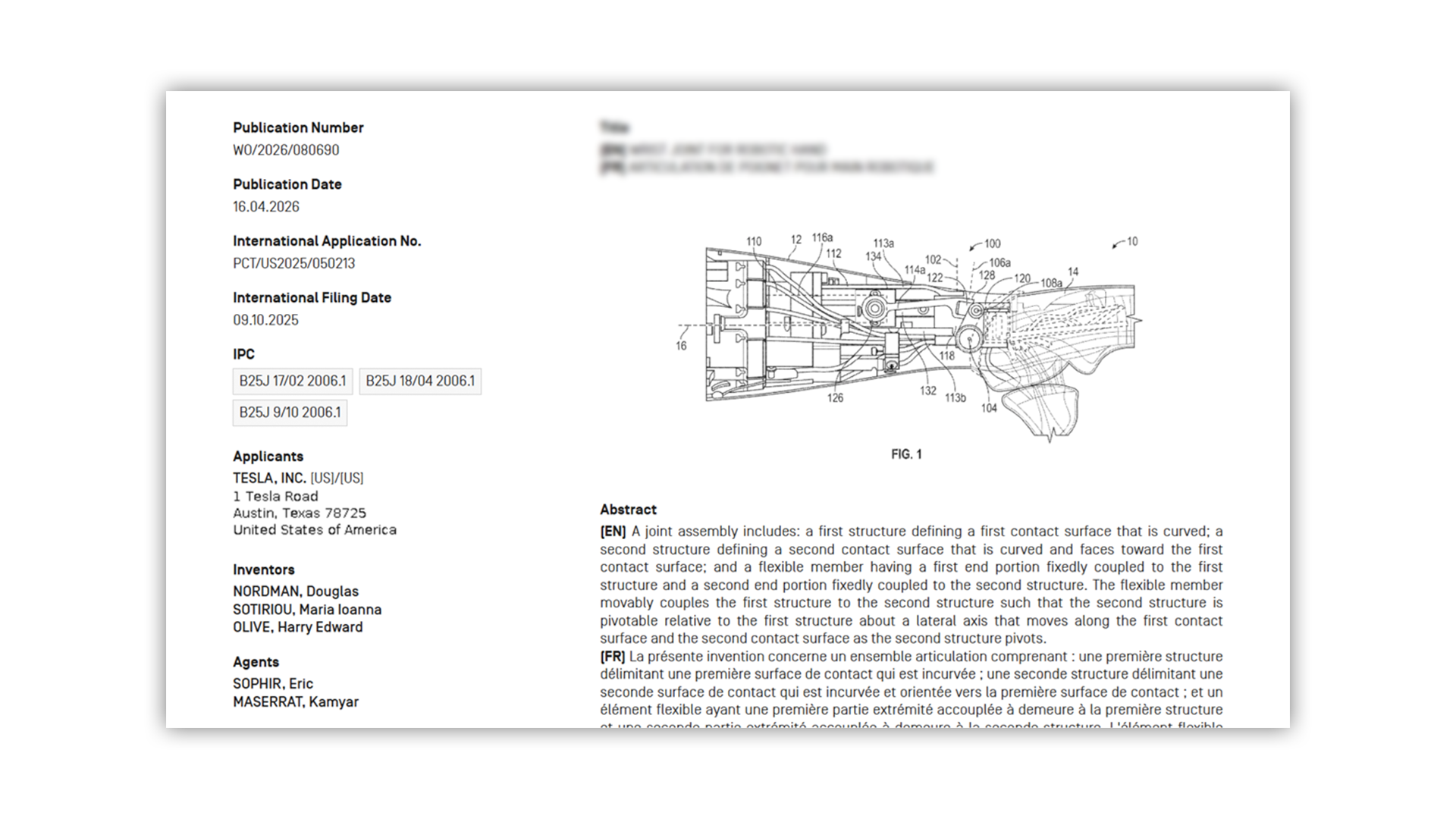
Take a look at Elon Musk’s new patent below…
Because it protects a new invention that could rewrite the future of wealth forever.
I’m talking about a radical new form of AI I call “M.A.G.I.”
One so revolutionary that Elon called it an “infinite money glitch.”
Click here to see the details because he believes this is a once-in-a-generation opportunity to create wealth on a scale most people can’t even comprehend.
What’s the upside potential here?
I know this is going to sound crazy…
But Elon is projecting growth of over 7,000,000%.
Let that sink in.
That’s enough to turn $100 into more than $7 million.
This sounds absolutely insane.
But then again… everything Elon has ever done sounded insane at first.
Self-driving cars.
Reusable rockets that land themselves.
Brain chips that let paralyzed people control computers with their minds.
Crazy ideas.
But he turned them into trillion-dollar realities.
So here’s the real question…
Will you watch Elon build another empire from the sidelines…
Or will you finally position yourself to potentially become one of the winners in his next trillion-dollar revolution?
Click here to get the details because I believe Elon will flip the switch on this new invention by the end of this month.
We have so much to look forward to,
Jeff Brown
Founder & CEO, Brownstone Research
Additional Reading from MarketBeat.com Confidence Is Back, But Earnings Show the Consumer Is Being PickyAuthored by Jessica Mitacek. Posted: 7/21/2026. 
Key Points- Consumer discretionary stocks remain among the weakest S&P 500 sectors in 2026 despite improving consumer sentiment.
- Domino's Pizza posted revenue growth, but flat same-store sales and a fifth earnings miss in seven quarters, showing value-focused deals aren't translating into meaningful growth.
- Higher-end brands like Darden Restaurants, Williams-Sonoma, and Ralph Lauren beat earnings expectations, while Best Buy and Home Depot showed weaker results reflecting cautious middle-income spending.
- Special Report: Hidden on Tesla's filing: A $12 billion "super startup"

This year, while the market has been preoccupied with how the Iran war is propping up the energy sector and how the memory chip shortage has been driving the AI rally, there has been little attention paid to the underperformance of consumer discretionary stocks.
In 2026, consumer discretionary remains among the weakest S&P 500 sectors. The Consumer Discretionary Select Sector SPDR Fund, a commonly used proxy for the sector, is down nearly 4% year-to-date.
Marc Chaikin, founder of Chaikin Analytics, is flagging a little-known company that just secured a partnership with Nvidia - one he believes positions it ahead of Tesla in the autonomous vehicle race.
With a market-moving announcement expected on July 31st, Chaikin is urging investors to swap overpriced AI stocks for this under-the-radar name before markets open. He's also releasing a free Hotlist and Hitlist of buy and sell ideas for the second half of 2026. Get the ticker symbol and full details at no charge today But as Q2 earnings season continues, signs are pointing to a rebound in consumer confidence. While that may bode well for the sector broadly, a sampling of consumer discretionary companies suggests that, if the recovery is sustainable, the results are anything but uniform.
After hitting all-time lows earlier this year, the University of Michigan’s Surveys of Consumers showed a modest uptick in July, with the index rising from 49.5 in June to 54.4. Despite remaining below the critical threshold of 60—the historical level that serves as a recession risk warning—the sentiment reading marked the second straight month of a 10% increase and the highest reading since February.
However, economists attribute that improvement to lower gasoline prices over the past few weeks, a trend that has already begun to reverse as the United States and Iran have resumed fighting. That was reinforced by a softer June Consumer Price Index reading, with the moderated 3.5% year-over-year (YOY) increase attributed to a drop in gas prices.
Still, even a brief reprieve from higher prices can have a psychological impact on consumers. So far, however, consumer discretionary earnings have been a mixed bag, telling a more complicated story.
Domino’s Value Deals Drive Orders, But Not Meaningful Growth
As Domino’s Pizza (NASDAQ: DPZ) recently demonstrated, everyday consumers may still be ordering, but they are barely growing their tabs. Instead, they are behaving in a highly selective manner.
The company reported Q2 earnings on Monday, July 20, announcing a revenue beat alongside YOY revenue growth of 4.3%.
But the real takeaway wasn’t revenue growth or even the earnings per share (EPS) miss. Rather, it was same-store sales, which rose just 0.1%.
As a result, Domino’s revised its 2026 guidance. While it maintained full-year sales and profit forecasts and still expects U.S. and international comps to rise in the low-single digits, the company trimmed its outlook for U.S. net unit growth to about 175 stores as franchisee profitability and the company’s development pipeline face elevated near-term pressure.
The EPS miss was symptomatic of a developing long-term trend. Dating back to Q4 2024, Domino’s has now missed earnings estimates in five of its last seven quarters, including three of the last four. Importantly, income from operations grew only 2.6% in Q2, which the company admitted during its earnings call was below expectations.
Domino’s has a broad target market, but it ramped up its value-focused campaigns and lower price points—including lengthy Mix & Match and Best Pizza Deal Ever promotions—in 2026. That strategy has successfully attracted a growing share of lower-income consumers. Much of that decision was driven by cautious consumer spending in the latter half of 2025 and into this year, but it has yet to translate into Domino’s income statement.
Full-Service Restaurants and High-End Brands Capture the Stronger Consumer
Meanwhile, multi-brand, full-service restaurant conglomerate Darden Restaurants (NYSE: DRI) tells a very different story.
The company, which owns and operates a portfolio that includes Olive Garden, LongHorn Steakhouse, Yard House, Ruth’s Chris Steak House, Cheddar’s, The Capital Grille, and Seasons 52, among others, reported its fiscal Q4 2026 earnings in late June.
EPS of $3.66 beat analyst expectations of $3.63, and while revenue of $3.72 billion just missed the forecasted $3.73 billion, it marked a 13.7% YOY increase.
With a trailing price-to-earnings (P/E) ratio of 18.76, the company’s earnings are expected to increase 9.84% over the next year.
Notably, Darden’s Q4 same-restaurant sales rose 4.6% YOY and 4.5% for the full fiscal year as diners continue to prioritize experiences over convenience. Olive Garden, LongHorn, and Yard House all posted their fifth consecutive year of positive comp sales, with LongHorn delivering 7.2% same-restaurant sales growth for the full fiscal year and 9.5% growth in Q4.
Cardenas specifically highlighted how Darden offers full-service dining for a variety-seeking demographic, offering “a collection of brands that gives us reach across multiple dining occasions, guest demographics, price points, geographies, and cuisine types.” In turn, the company doesn’t rely on a single brand or consumer segment.
High-end specialty retailer Williams-Sonoma (NYSE: WSM) also showed that higher-income consumers are spending more freely. When it reported fiscal Q1 earnings on May 21, it beat on earnings and revenue while announcing a 4.8% increase in comps and an operating margin of 16.2%.
Premium apparel maker Ralph Lauren (NYSE: RL) also beat on earnings and revenue when it reported fiscal Q4 2026 results on May 21, with revenue climbing 16.6% YOY.
Big-Ticket Purchases Are Still Lagging
Takeout pizza may be lagging the performance of high-end consumer goods and full-service restaurants aimed at affluent shoppers, but there are indications that middle-income consumers are also delaying gratification, especially on big-ticket items and home renovations.
Best Buy (NYSE: BBY) reported fiscal Q1 2027 revenue growth of just 1.9% YOY while comparable sales increased 2.0% YOY.
Another sign that middle- and lower-income consumers aren’t spending more: tepid financials from Home Depot (NYSE: HD). Often regarded as a bellwether for the economy, the home improvement giant reported negative 4.35% YOY EPS growth for fiscal Q1 2016, while sales rose 4.8% and comparable sales increased 0.6%.
Taken together, despite modest improvements in consumer sentiment, the inconsistencies in consumer discretionary stocks continue to show that shoppers are still navigating uncertainty, and any increase in spending is varying widely across income groups. |