Hi Friend,
Another big policy victory, another boondoggle out of Shane Jones'
slush fund
"Regional Infrastructure Fund", and a new myth-busting paper targeting
Chlöe Swarbrick's fake
news oft-repeated claims that the wealthy in New Zealand do not
pay their “fair share” of tax.
Let's dive in, .
A win for democratic accountability: Mana Whakahono ā Rohe
agreements to be scrapped...

Last week, we were across the media and in inboxes blowing the
whistle on councils rushing to sneak in undemocratic Mana Whakahono ā
Rohe agreements before the RMA is replaced.
The Government’s proposed laws would have prevented new agreements
being initiated, but as drafted entrenched existing agreements –
including those hurriedly negotiated before the new laws take effect –
into the replacement planning system.
When the replacement bills were introduced late last year, just
eight Mana Whakahono ā Rohe agreements existed.
Since then, several dozen more have been agreed or initiated.
Funny timing,
that... 🤔
The agreements are being used to embed iwi groups within council
planning and consenting decision-making processes, bind future elected
councils, and often cannot be terminated without all parties
agreeing.
Some
councillors have not even been allowed to see what their own officials
were negotiating.
That is why we asked supporters to contact Government MPs and
demand that the loophole be closed.
And contact them you did. 😘
Over the weekend, so many supporters contacted MPs that the
Beehive was clearly feeling the heat. 🔥
Senior figures from National, ACT, and New Zealand First
started contacting your humble Taxpayers’ Union.
By Monday morning, Mike Hosking was putting the issue directly to
Christopher Luxon.
The Prime Minister called councils rushing through the agreements
“disingenuous” and promised that RMA Reform Minister Chris Bishop
would have more to say "very soon".
While the Select Committee recommended allowing the agreements
initiated before Royal Assent to continue being negotiated during the
transition period and, if completed in time, transfer into the new
system, it seems our campaign forced action.
On Monday Cabinet decided to amend the Bills so that all
Mana Whakahono ā Rohe agreements will be scrapped.
That is a major victory for those of us who believe local
government and resource management/planning decision-makers should
always be democratically accountability.
Even
the NZ
Herald’s
Thomas Coughlan credited the decision to a “fierce campaign” by your
humble Taxpayers' Union and our friends at Federated Farmers.
We will take that!
💪
...but new "Iwi Participation Agreements" to be introduced 👀
While the past week shows that political pressure works, it's not
the end of the story. The Government intends to replace Mana Whakahono
ā Rohe with new, supposedly “narrowly scoped” iwi participation
agreements covering statutory planning processes and matters required
to give effect to Treaty settlements.
And the Select Committee has recommended requiring every spatial
planning committee to include at least one member with “knowledge,
skill, and experience relating to te ao Māori and Māori
development”.
The report does not say that this member must be elected, nor does
it suggest they would be denied voting rights.
By all appearances, that means an unelected appointee may
sit and vote alongside elected representatives on committees making
major regional planning decisions.
That is still undemocratic "co-governance".
Chris Bishop says the legislation will include clear guardrails to
prevent scope creep.
But we have heard something similar before from Bishop's Cabinet
colleague, Simon Watts.
National promised to repeal Labour’s co-governance model under
Three Waters. It repealed the law – but then allowed councils to
establish exactly the same 'co-governance' governance arrangements
under Watts' "Local Water Done Well" policy.
We
cannot allow the Government to scrap Mana Whakahono ā Rohe agreements
only to recreate privileged decision-making rights through new
agreements and unelected race-based committee
appointments.
Our position remains principled: councils should engage
constructively with iwi, just as they should engage with farmers,
businesses, ratepayers, community organisations, and everyone else
affected by planning decisions.
That means decisions affecting property rights, planning rules, and
resource consents should ultimately remain with representatives whom
the public can vote in — and vote out.
Expert advice and consultation do not require unelected
representatives to be given votes around the decision-making
table.
So yes, this is a significant win. But after Three Waters,
be assured that we will be reading the fine print *very*
carefully.
Shane Jones’ Regional Infrastructure Fund: mussel farms
and mystery money 🦪💸

And it’s not just Chris Bishop we’re waiting to see the fine print
from...
Another week, another "regional infrastructure" announcement from
Shane Jones about taxpayer backing for regional road rail line bridge mussel farm.
Eh?!
😳
Yes,
seriously, Jones is pumping $4.5 million of taxpayer cash into a
"joint iwi mussel spat project" in the Far North. The four local
iwi partners will run the project and contribute $1.3 million in
what the Government calls "co-funding".
Now, regular readers will not be shocked to learn that the
Taxpayers’ Union is not exactly wild about politicians playing venture
capitalist with our money.
If a project is commercially viable, private investors
should be lining up to fund it. If they are not, taxpayers deserve to
know why the Government thinks it knows better.
But here is the real kicker: Even when taxpayer money is being
handed out through the Regional Infrastructure Fund, the Government is
refusing to release the key terms.
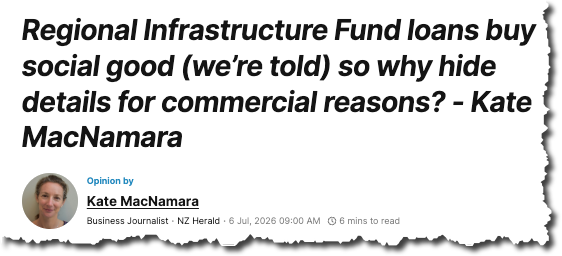
As
Kate MacNamara pointed out in the Herald (unfortunately
paywalled) the excuse is “commercial sensitivity”, with officials
effectively arguing that releasing the details “could prejudice the
commercial position of the parties involved”.
Sorry, but no.
These are taxpayer-backed "loans" but made on very favourable
terms. That is the whole point of the scheme. If the terms were the
same as the market would offer, the Government would not need to be
involved.

And we have seen how badly this can all go.
The Whakatōhea Mussels project in Ōpōtiki – another
example of what Mr Jones considers deserving "regional
infrastructure" – has
already soaked up tens of millions in public money while struggling to
deliver on big promises.
That's a warning red neon
sign flashing so bright even the Matua should see it.
🚨
Taxpayers do not need warm words about “regional development”,
“social good”, and BS about handouts being a "loan".
We say taxpayers have the right to know who is getting the
taxpayer money, what terms apply, what security (if any) has been
negotiated, and who carries the can if it all goes belly
up.
While reasonable minds could differ on the merits of slush
funds like the Provincial Growth Fund or Regional Infrastructure Fund,
at the very least, they should be transparent.
If Ministers are gambling with taxpayers’ money, taxpayers deserve
to at least see the betting slip.
DIA’s $11.7m pokie project: changing stories, no jackpot 🎰
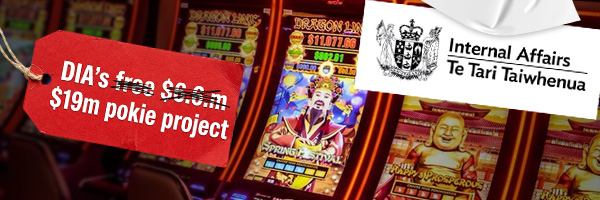
And speaking of taxpayer-funded gambles, there is something grimly
appropriate about a pokie machine IT project turning into one.
According
to the Sunday Star-Times, the Integrated Gambling Project
began in 2008 as a supposedly “free” Department of Internal Affairs
upgrade to modernise the paper-based system used to regulate
pokies.
Fair enough. Modernisation is necessary, and even we cannot
complain about a "free" project.
But unfortunately, someone got Wellington involved.
The project was initially pitched as a $2.75 million software
upgrade.
But officials moved from an off-the-shelf service to bespoke
software, costs escalated, and internal documents showed $9.2 million
had already been spent by 2015, with approved funding rising above $19
million.
That’s the entirety of 815 average Kiwi workers’
entire yearly tax take, blown on a useless
project.
When first questioned, DIA insisted the project had cost just $6.6
million.
Yet that figure did not square with its own documents. After more
questions, the department has now changed its story again.
DIA now admits total expenditure reached $11.7 million.
That's nearly 80 percent
more than it first conceded.
The department says the project comprised $8.6 million in capital
expenditure and $3.1 million in operating expenditure when it closed
in May 2016.
It had previously pointed to around $5 million in savings
negotiated with contractor Intralot. But those savings reduced the net
impact on the gambling memorandum account — they did not reduce the
project’s total expenditure.
In other words, the $6.6 million figure was not the actual cost of
the project.
Even better, the bespoke system took years to build and was
replaced just four years later by Kōtare, an off-the-shelf (read: less
expensive) platform.
DIA itself now says the bespoke system had limited functionality,
required manual processing, and was labour-intensive to change.
So the department went from a “free” project, to a $2.75 million
business case, to $11.7 million in actual spending, before replacing
the system four years later.
Not exactly
confidence-inspiring.
The costs were ultimately loaded through fees on the pokie sector -
money that could otherwise have gone back into community grants.
Worse, after those fees increased, DIA’s gambling memorandum
account swung from a deficit of almost $13 million to a surplus of
almost $20 million and still holds more than $15 million.
Internal Affairs Minister Brooke van Velden has now demanded an
immediate briefing and assurances that DIA has met its
obligations.
The Auditor-General will also examine the account as part of this
year’s audit.
Good.
But taxpayers and community groups should not have to rely
on repeated media questioning to drag the real numbers out of a
government department.
When even the pokie regulator cannot make the numbers add up,
someone needs to be held to account.
New paper busts the "rich not paying fair share of tax"
porky 💰

As the election gets closer, Labour, the Greens, TOP, and
Te Pāti Māori are circling the same target: more tax.
The Greens want a wealth tax, a higher top income tax rate, a
higher company tax rate, and an inheritance tax.
Labour wants a capital gains tax.
TOP wants a wealth land tax.
Te Pāti Māori has also been pushing significant tax hikes,
including wealth taxes.
And all of them rely on the same familiar line: “the rich
aren’t paying their fair share”.
But the numbers tell a very different story.
We've
just released Tax Inequality: Who really pays their fair
share?, our new handbook looking at who *actually* carries New
Zealand’s tax burden.
And the numbers are
pretty clear: under current tax settings, higher earners don't just
pay the lion’s share, they're covering the lion, the pride, and the
entire bloody savannah!
Based on official data from IRD, Stats NZ and the Treasury, the
report exposes that:
- The top 20 percent of income earners pay nearly two-thirds of all
personal income tax.
- The top 10 percent pay more than the bottom 80 percent
combined.
- And the top 1 percent - just 46,939 taxpayers - pay more
income tax than the entire bottom half of taxpayers combined.
Higher-income households pay disproportionately more GST as
well, with the top 20 percent accounting for more than a third of the
total GST take.
People can debate whether higher earners should pay even more. That
is the nature of politics.
But what politicians cannot honestly claim is that successful New
Zealanders are not already carrying a huge share of the tax
burden.
New Zealand’s relatively simple, broad-base, low-rate tax system is
one of our great economic strengths.
We should be very careful before piling more taxes on the people
already doing the most to fund the system.
Tax
Inequality sets out who really pays New Zealand’s tax burden -
and why the “fair share” argument does not stack up.
MPs’ gold-plated super scheme: rules for thee...
💰🏠
While politicians argue that everyone else should pay more, they
remain remarkably attached to their own taxpayer-funded perks. 🧐
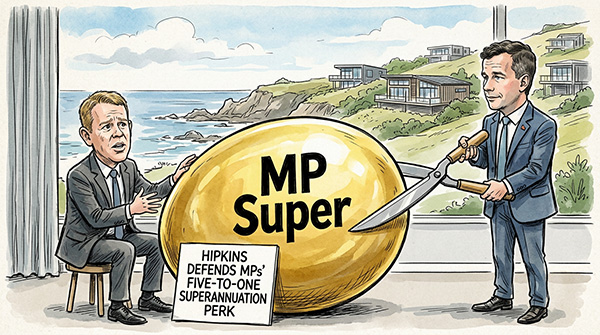
You
may remember the recent fuss over Chris Hipkins using his
parliamentary superannuation scheme to help pay the mortgage on his
family holiday home.
Hipkins insisted it was ultimately his own money.
Well, yes - apart from the bit where taxpayers put in $2.50
for every $1 an MP contributes, up to more than $36,000 a
year.
That is a retirement deal most New Zealanders could only dream
of.
And it turns out MPs came remarkably close to losing it.
The
NZ Herald revealed that the Remuneration Authority reviewed
the scheme in 2020 and concluded it was not fair to taxpayers.
It recommended phasing out the special arrangement for new MPs and
putting them onto ordinary KiwiSaver-style terms.
Then Covid happened, the proposal was shelved, and — funny old
thing — no one in Parliament rushed to revive it.
After all, politicians can say they are simply following the
rules...
But they are also the only people with the power to change
them.
According to Chris Hipkins, paying the mortgage on his
holiday home stops MPs from becoming corrupt... 🤨

Chris
Hipkins has now offered an extraordinary defence of the perk: generous
pay (and *very* generous retirement benefits) apparently stop
politicians from becoming corrupt.
Sorry,
what?
According to Hipkins, looking after MPs financially reduces the
temptation to take outside work or make decisions with their next job
in mind.
Maybe there is a grain of truth in that (if we pay MPs
minimum wage, the risks of corruption are obvious), but that cannot
extend to justifying taxpayers having to contribute five times the standard employer
KiwiSaver rate to stop MPs going rogue.
If Hipkins genuinely believes politicians are underpaid, he should
argue openly for higher salaries.
Hiding extra remuneration inside gold-plated superannuation
schemes, tax-free allowances, and accommodation perks is neither
transparent nor fair.
David Seymour, to his credit, has said he is open to reforming the
scheme.
Now every party leader needs to say where they stand.
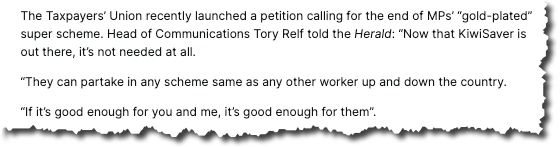
As
I told the NZ Herald last week, if KiwiSaver is good enough
for you and me, it’s good enough for MPs too.
We are calling for MPs’ special superannuation scheme to be
scrapped, tax-free cash entitlements to be replaced with reimbursement
for genuine expenses, and MPs to be stopped from using taxpayer-funded
accommodation payments to rent properties from themselves.
Politicians
designed these perks for politicians — send the party leaders a
message telling them it is time to end the gravy
train.
MPs may have their retirement sorted, but younger New Zealanders
are being told to pay more for theirs — while continuing to fund
everybody else’s...
That’s all for this week, Friend — thanks, as always, for standing
with us.


