
|
 |


Mohammed Amin MBE describes himself as a Briton of Punjabi ethnicity whose religion is Islam and whose politics are Liberal Democrat. For more background visit his personal website www.mohammedamin.com
I have always been inspired by Thomas Jefferson’s immortal words in the USA’s Declaration of Independence: “We hold these truths to be self-evident, that all men are created equal, that they are endowed by their Creator with certain unalienable Rights, that among these are Life, Liberty and the pursuit of Happiness.”
I am a Muslim. So why do I want to deny rights to Muslims?
That leads to the question of who can have rights.
I have no doubt that Jefferson believed that women were also endowed with unalienable rights to life, liberty and the pursuit of happiness. He was writing when the word ‘men’ encompassed ‘women’ except when that would be clearly incorrect.
Men and women, human beings, are what legal terminology calls ‘natural persons’. I agree with Jefferson that natural persons are born with unalienable rights. The law also recognises other persons: ‘legal persons’.
The most common example of a legal person is a company. For example, British Muslim Heritage Centre is a company limited by guarantee, incorporated under the Companies Acts, which is led by Muslims. It operates prayer facilities and many other community services in Manchester.
Legal persons like this company don’t have identical rights to natural persons, but the law does give them a wide panoply of rights. These include the right to own property. More interestingly, legal persons also have the right to sue for defamation as in the famous 1997 case McDonald’s Corporation v Steel & Morris, where Keir Starmer provided legal help to Helen Steel and Dave Morris.
What about Muslims as a group?
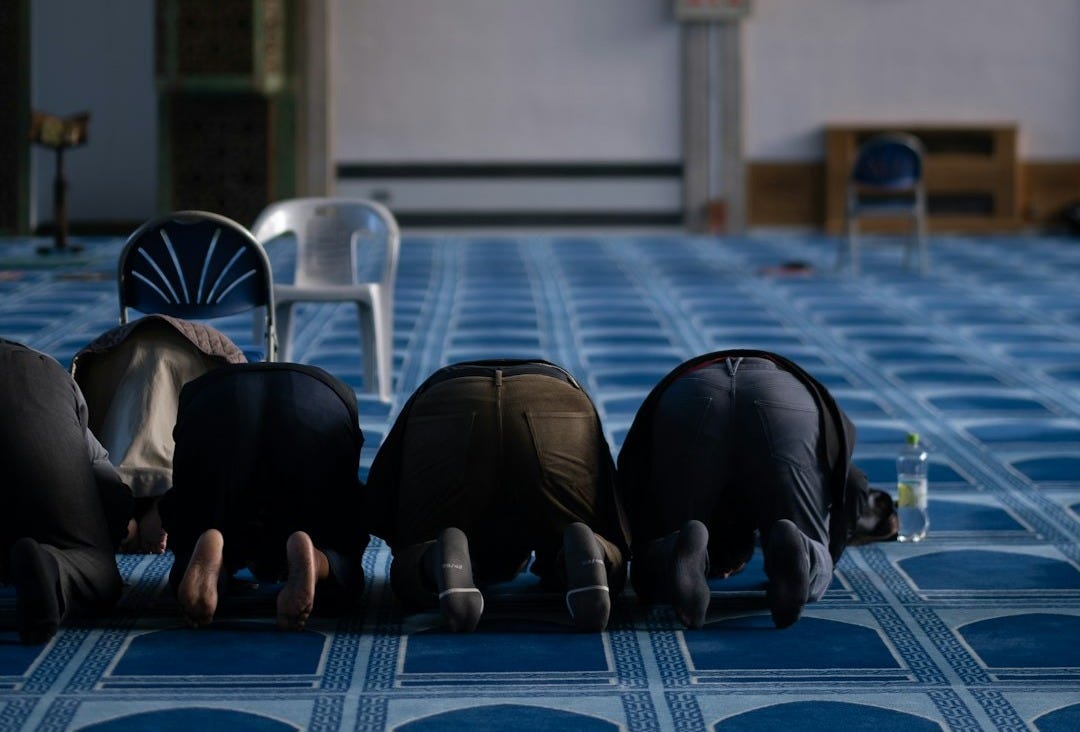 |
My understanding is that groups, as groups, have no legal standing since they are not legal (or natural) persons. More fundamentally, I believe that trying to give rights to groups would lead to many problems.
To start with, what is the group? One could say it is all Muslims in Britain. However, Muslims cannot agree amongst themselves who is a Muslim, just as Christians are not unanimous about who is a Christian. The much more serious problem is deciding what kinds of rights one would give to groups.
There are lots of rights that I care about for myself as a human being, or natural person. However, I have great difficulty identifying any rights that are needed by the whole group of Britain’s Muslims. (That is before having to resolve my problem of persuading all other Muslims in Britain to adopt my definition of who is a Muslim.)
Furthermore, just because I am a Muslim, that does not mean I agree with all other Muslims in Britain about matters of policy. For example, many Muslims would like to ban books such as Salman Rushdie’s Satanic Verses. Many would want to ban the burning of the Quran. I don’t share either objective.
Aggregating my individual rights with the individual rights of other Muslims to produce some kind of ‘group right’ is to deny each individual Muslim the freedom to decide how they want their individual rights to be exercised.
 |
Most seriously of all, once you give rights to groups rather than individuals, you inevitably create conflict, since every increase in rights for one group entails a diminution in rights for another group. We see that in India, where there are laws reserving certain proportions of government jobs for various ‘scheduled castes’. Any proposals to change to these reservations leads to inter-group contestation.
The starkest example is Lebanon, whose society is fractured between groups that fought a long civil war. This war was settled by a ‘National Pact’ under which the President of Lebanon must be a Maronite Christian, the Prime Minister must be a Sunni Muslim, and the Speaker of Parliament must be a Shia Muslim, and so on.
This settlement denies agency to Lebanese citizens as individuals. The entire system presumes that you are wholly defined by the group that you belong to, regardless of your individual views. Furthermore, Lebanon has not held a census since 1932, since the results of any census risk upsetting the delicate balance of power between groups.
Organising society in this way fundamentally contradicts the recognition of individual rights.
Every British citizen should have, and indeed does have, identical rights. These of course include the right to have, or not have, a religious belief and to practise, or not practise, that belief or non-belief. (I leave to one side King Charles who is denied religious freedom due to the establishment of the Church of England.)
Because these rights are identical, and individual, my exercise of my rights does not reduce the rights of any other person.
Society is not a zero-sum game between individuals. However, granting rights to groups would make society a zero-sum game between groups.
You’re currently a free subscriber to Economic Affairs. For the full experience, upgrade your subscription.
Paid subscribers support the work of Economic Affairs and the IEA's charitable mission and receive special invites to exclusive events.
| ||||||||||


