
| From | Scott Bullock, Institute for Justice <[email protected]> |
| Subject | IJ SCOTUS Hat Trick—Court takes forfeiture case! |
| Date | July 20, 2026 4:37 PM |
Links have been removed from this email. Learn more in the FAQ.
Links have been removed from this email. Learn more in the FAQ.
Alaska took pilot's plane over passenger's beer.
IJ logo ([link removed] )
Dear John,
The U.S. Supreme Court just announced they will hear our case on behalf of Ken Jouppi, a longtime Alaska air-taxi pilot who has spent more than a decade fighting to stop the government from forfeiting his airplane!
This will be the first time IJ takes three cases to the high court in one term.
Ken made his living as a bush pilot—a one-man air-taxi service—flying tourists and residents across the Alaskan wilderness. His legal odyssey began when he was scheduled to fly a recurring passenger and her groceries from Fairbanks to the remote, “dry” village of Beaver.
Unbeknownst to Ken, the passenger had three cases of beer in her luggage to give to her husband. Before Ken took off, state troopers searched the plane and discovered the beer.
As a pilot, Ken knew that some Alaska villages are dry, and he would never knowingly fly alcohol. But he also respected his passengers’ privacy. He didn’t believe he should rifle through their luggage without cause—he’s not the liquor police after all—and the law did not require him to do so.
Because he transported the forbidden Budweiser, though, prosecutors have tried for over a decade to forfeit his airplane—worth about $95,000.
Last year, the Alaska Supreme Court held that this grossly excessive forfeiture did not violate the Constitution. So IJ agreed to take his case to the U.S. Supreme Court, which just granted our petition.
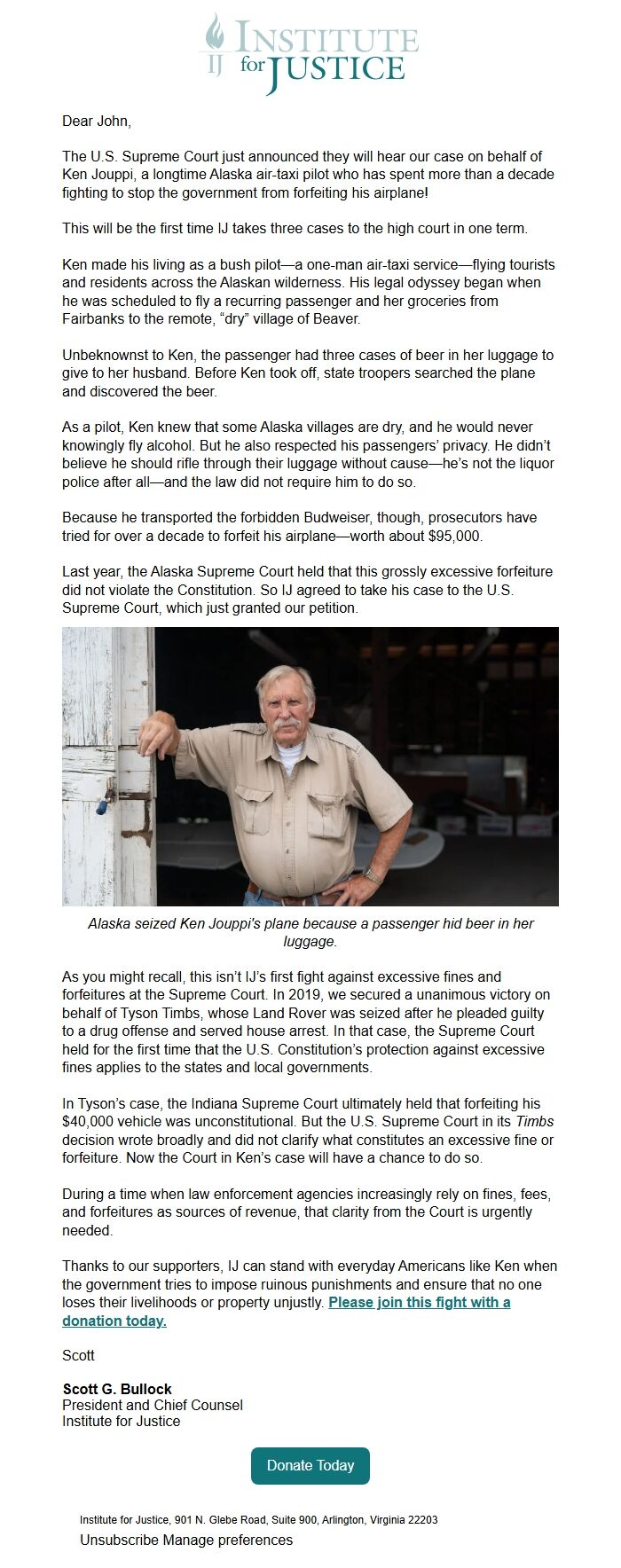
Ken Jouppi ([link removed] )
Alaska seized Ken Jouppi's plane because a passenger hid beer in her luggage.
As you might recall, this isn’t IJ’s first fight against excessive fines and forfeitures at the Supreme Court. In 2019, we secured a unanimous victory on behalf of Tyson Timbs, whose Land Rover was seized after he pleaded guilty to a drug offense and served house arrest. In that case, the Supreme Court held for the first time that the U.S. Constitution’s protection against excessive fines applies to the states and local governments.
In Tyson’s case, the Indiana Supreme Court ultimately held that forfeiting his $40,000 vehicle was unconstitutional. But the U.S. Supreme Court in its Timbs decision wrote broadly and did not clarify what constitutes an excessive fine or forfeiture. Now the Court in Ken’s case will have a chance to do so.
During a time when law enforcement agencies increasingly rely on fines, fees, and forfeitures as sources of revenue, that clarity from the Court is urgently needed.
Thanks to our supporters, IJ can stand with everyday Americans like Ken when the government tries to impose ruinous punishments and ensure that no one loses their livelihoods or property unjustly. Please join this fight with a donation today. ([link removed] )
Scott
Scott G. Bullock
President and Chief Counsel
Institute for Justice
Donate Today
([link removed] )
Institute for Justice, 901 N. Glebe Road, Suite 900, Arlington, Virginia 22203
Unsubscribe ([link removed] )
Manage preferences ([link removed] )
IJ logo ([link removed] )
Dear John,
The U.S. Supreme Court just announced they will hear our case on behalf of Ken Jouppi, a longtime Alaska air-taxi pilot who has spent more than a decade fighting to stop the government from forfeiting his airplane!
This will be the first time IJ takes three cases to the high court in one term.
Ken made his living as a bush pilot—a one-man air-taxi service—flying tourists and residents across the Alaskan wilderness. His legal odyssey began when he was scheduled to fly a recurring passenger and her groceries from Fairbanks to the remote, “dry” village of Beaver.
Unbeknownst to Ken, the passenger had three cases of beer in her luggage to give to her husband. Before Ken took off, state troopers searched the plane and discovered the beer.
As a pilot, Ken knew that some Alaska villages are dry, and he would never knowingly fly alcohol. But he also respected his passengers’ privacy. He didn’t believe he should rifle through their luggage without cause—he’s not the liquor police after all—and the law did not require him to do so.
Because he transported the forbidden Budweiser, though, prosecutors have tried for over a decade to forfeit his airplane—worth about $95,000.
Last year, the Alaska Supreme Court held that this grossly excessive forfeiture did not violate the Constitution. So IJ agreed to take his case to the U.S. Supreme Court, which just granted our petition.
Ken Jouppi ([link removed] )
Alaska seized Ken Jouppi's plane because a passenger hid beer in her luggage.
As you might recall, this isn’t IJ’s first fight against excessive fines and forfeitures at the Supreme Court. In 2019, we secured a unanimous victory on behalf of Tyson Timbs, whose Land Rover was seized after he pleaded guilty to a drug offense and served house arrest. In that case, the Supreme Court held for the first time that the U.S. Constitution’s protection against excessive fines applies to the states and local governments.
In Tyson’s case, the Indiana Supreme Court ultimately held that forfeiting his $40,000 vehicle was unconstitutional. But the U.S. Supreme Court in its Timbs decision wrote broadly and did not clarify what constitutes an excessive fine or forfeiture. Now the Court in Ken’s case will have a chance to do so.
During a time when law enforcement agencies increasingly rely on fines, fees, and forfeitures as sources of revenue, that clarity from the Court is urgently needed.
Thanks to our supporters, IJ can stand with everyday Americans like Ken when the government tries to impose ruinous punishments and ensure that no one loses their livelihoods or property unjustly. Please join this fight with a donation today. ([link removed] )
Scott
Scott G. Bullock
President and Chief Counsel
Institute for Justice
Donate Today
([link removed] )
Institute for Justice, 901 N. Glebe Road, Suite 900, Arlington, Virginia 22203
Unsubscribe ([link removed] )
Manage preferences ([link removed] )
Message Analysis
- Sender profile: Institute for Justice
- Political Party: n/a
- Country: United States
- State/Locality: n/a
- Office: n/a