Editor's Note: If you don't know Marc Chaikin, he's a living Wall Street legend that famous investors like Steve Cohen owe a huge debt of gratitude to for helping them build billion-dollar businesses. He's even been nicknamed "The Billionaire Maker." So, when he comes out with a new stock recommendation, I pay attention. The one below is so promising, I had to share it with you today. And if you click any of the links in Marc's e-mail below, you'll get the name and ticker of the company he's pounding the table on absolutely free.
Dear Reader,
In 2023, my system flashed bearish on an automotive company virtually no one had yet heard of.
Soon after, the stock crashed 35%.
But today, that stock's outlook has made a full 180-degree turnaround.
Check it out:

My system now rates this company "Very Bullish," with extremely high marks across the most critical factors in my stock analysis.
Because the very same company my system warned about in 2023 just formed a groundbreaking partnership with the king of AI, Nvidia.
See, Nvidia has built what is essentially the brains of the AI-powered cars of the future.
But getting that brain inside vehicles and operating safely is an enormously complex job.
That's precisely the job that went to this company. (Get the name and ticker FREE right here.)
That partnership basically hands this barely-known company the keys to the self-driving kingdom on a silver platter.
So, if you want to benefit from a company quickly becoming the center of the massive autonomous-vehicle trend, forget Tesla and get this stock's ticker before it becomes a household name...
Sincerely,
Marc Chaikin
Founder, Chaikin Analytics
P.S. Autonomous cars are the future, and too many people make the mistake of thinking Tesla stock is the best way to profit. Not even close! Watch right here where I compare Tesla side by side with the company I'm talking about above and you'll see why it’s time to dump Tesla and buy this stock instead.
Meta Platforms’ Cloud Push: Growth Opportunity Versus AI Concerns
Author: Leo Miller. Originally Published: 7/8/2026.

Key Points
- Meta Platforms stock rose 8.8% on July 1 following reports that the company may begin selling excess compute capacity to outside firms.
- Comparisons to CoreWeave and a SpaceX-Alphabet leasing deal suggest Meta's potential cloud business could scale quickly and ease concerns over rising capital spending.
- CFO Susan Li recently said Meta has consistently underestimated its compute needs, casting doubt on how much excess capacity actually exists for the cloud push.
- Special Report: SpaceX is offering you shares. Don't take them.
Shares of Magnificent Seven giant Meta Platforms (NASDAQ: META) recently got a meaningful boost after the company’s potential cloud push moved closer to reality. Shares jumped 8.8% on July 1 after reports surfaced that Meta plans to sell excess compute capacity to third parties.
While the market’s reaction was clearly positive, if Meta follows through, the move carries both upside and downside for investors to consider. Although a cloud push could become a meaningful source of revenue and profit, it also raises questions about the long-term competitiveness of Meta’s AI products.
Positives on Selling Compute: AI Monetization and Spending Signals
Elon’s big $266,000 per second purchase (Ad)
Elon Musk bought Super Bowl ad time at $266,000 per second - something he has never done before. 125 million Americans watched, but Whitney Tilson, former manager of a $200 million hedge fund, says most investors missed what it actually means.
With 1 in 3 Super Bowl viewers using buy-now-pay-later services and 40% of Americans carrying more credit card debt than savings, Tilson believes Elon's message reveals a major economic current - and a clear signal for where smart money should be positioned.
Watch Tilson's free presentation to see what he thinks you should do nowOne of the main reasons markets reacted positively to Meta’s cloud computing push is what it could mean for the company’s ability to generate new AI revenue. By renting computing capacity to other firms, Meta may be able to earn strong margins on its capital expenditures (CapEx).
When thinking about Meta’s positioning in the cloud computing space, neoclouds like CoreWeave (NASDAQ: CRWV) offer a useful comparison point. CoreWeave focuses exclusively on AI infrastructure demand, while longer-established companies like Microsoft (NASDAQ: MSFT) serve both AI and non-AI demand.
Because Meta’s AI infrastructure is heavily concentrated on graphics processing units, the company would operate in a similar space to CoreWeave. Looking at CoreWeave can therefore help illustrate the scale of the opportunity Meta may have if it enters the cloud computing market.
Last quarter, CoreWeave generated revenue of $2.08 billion. From that, the company produced approximately $1.2 billion in adjusted earnings before interest, taxes, depreciation, and amortization (EBITDA). Achieving something similar could provide a meaningful lift for Meta, whose calculated Q1 2026 EBITDA was approximately $28.87 billion. Still, as Meta enters the market, added competition could ضغط margins in this space.
However, with overall demand for compute still rising, Meta could have a significant growth opportunity ahead. In addition, the recent deal SpaceX (NASDAQ: SPCX) signed with Alphabet (NASDAQ: GOOGL) suggests that Meta could scale cloud revenue much faster than CoreWeave. Alphabet will pay SpaceX $920 million per month to lease computing assets, implying $2.76 billion in quarterly revenue.
Another important implication is what the move signals about Meta’s CapEx spending going forward. If Meta already believes it has excess compute, that suggests the company may not need to spend as heavily on CapEx in the future. Meta’s elevated and rising CapEx spending has arguably been the biggest overhang on its stock price. In turn, a sign that this trend could reverse is a positive for many investors.
The Negatives: Selling Compute Indicates AI Product Weakness
On the downside, Meta’s willingness to sell compute suggests it does not have enough strong internal use cases for that capacity, raising questions about its broader competitiveness in delivering AI products.
The timing of this pivot is notable given the release of Meta’s Muse Spark model several months ago, which is far more intelligent than its predecessors. The move to sell excess compute suggests development of Muse Spark-related products may not be progressing as quickly as hoped. Such products would likely require more compute to support usage. In fact, recent reports state that CEO Mark Zuckerberg told employees the pace of the company’s AI agent development has been slower than expected.
Furthermore, it is important to note that details of Meta’s cloud push are still very limited. At this point, it is unclear how much of Meta’s compute the company considers excess to internal needs. That distinction matters, since the amount of excess capacity would directly determine how much revenue Meta could generate from its cloud push.
Notably, statements made on Meta’s most recent earnings call push back against the idea that the company has significant excess compute. Chief Financial Officer Susan Li said, “Our experience so far has been that we have continued to underestimate our compute needs.” She added, “Our expectation is that compute will become even more central to the business going forward.”
Meta’s Next Earnings Call Could Provide Significant Clarity on Cloud Ambitions
Overall, Meta has yet to make any concrete comments on its cloud push. Given the significant implications for the company’s outlook, it will likely be a key topic of discussion during the next earnings call.
When Meta addresses cloud computing directly, investors should watch for how much compute the company plans to provide to third parties. That should offer better insight into both the size of the revenue opportunity and Meta’s confidence in marketing its own AI solutions.
As Employers Drop Obesity Drug Coverage, Hims & Hers Could Be the Winner
Author: Jessica Mitacek. Originally Published: 7/6/2026.

Key Points
- Employers are expected to drop coverage for GLP-1 weight-loss drugs in 2027, potentially driving patients toward Hims & Hers Health's telehealth subscription platform.
- Hims & Hers shares have surged more than 45% in 30 days and about 160% since their February low, leaving the stock technically overbought.
- Wall Street remains largely cautious on HIMS, with a consensus Hold rating, rising short interest, and increased insider selling despite the stock's rally.
- Special Report: SpaceX is offering you shares. Don't take them.
The healthcare sector has been one of the best-performing sectors in the S&P 500 over the past month, gaining roughly 6%. While that rebound has been led by a handful of mega-cap Big Pharma companies, it has also shown up in the performance of smaller firms.
One of those companies is mid-cap Hims & Hers Health (NYSE: HIMS), the telehealth platform that provides direct-to-consumer (D2C) personal care products and virtual medical services.
Elon’s big $266,000 per second purchase (Ad)
Elon Musk bought Super Bowl ad time at $266,000 per second - something he has never done before. 125 million Americans watched, but Whitney Tilson, former manager of a $200 million hedge fund, says most investors missed what it actually means.
With 1 in 3 Super Bowl viewers using buy-now-pay-later services and 40% of Americans carrying more credit card debt than savings, Tilson believes Elon's message reveals a major economic current - and a clear signal for where smart money should be positioned.
Watch Tilson's free presentation to see what he thinks you should do nowOver the past 30 days, HIMS has climbed more than 45%, pushing the stock’s year-to-date (YTD) gain to nearly 20%. After a move like that, the stock may be due for a short-term breather. But according to healthcare industry experts, a looming catalyst could have an outsized benefit for Hims & Hers in 2027 and beyond, setting the stock up as a buying opportunity on its next pullback.
The GLP-1 Craze Is Pushing Up Employers’ Healthcare Plan Costs
As the cost of weight-loss drugs continues to rise, Reuters recently reported that some employers are planning to drop coverage for GLP-1 treatments, including Wegovy, Ozempic, Zepbound, Mounjaro, and Foundayo—products manufactured by Novo Nordisk (NYSE: NVO) and Eli Lilly (NYSE: LLY).
Last year, more than 40% of employers covered weight-loss drugs, and estimates for this year are roughly the same. But analyses from two industry groups cited by Reuters suggest that may change in 2027.
According to policy research group Business Group on Health, about 10% of employers that currently offer coverage for GLP-1 drugs for weight loss said they plan to drop it in 2027. A second survey by Mercer, a benefits consultancy, found that 5% of large employers plan to drop coverage in 2027 or are actively considering it.
While that is unfortunate news for those undergoing treatment, it is welcome news for HIMS shareholders. Patients losing healthcare coverage for GLP-1 drugs could be a boon for Hims & Hers Health, which currently generates around one-third of its revenue from its weight-loss business.
Analysts expect the company’s revenue to grow from an estimated $2.89 billion in 2026 to $3.45 billion in 2027, and increased subscription demand for weight-loss drugs amid shrinking insurance coverage should play a significant role in that top-line growth.
Lost coverage for GLP-1 treatments should also spur a migration to D2C telehealth providers, with Hims & Hers serving as a natural destination thanks to its platform, which bundles medical provider access, unlimited clinical consultations, and pharmacy fulfillment services into one streamlined subscription.
Technical Analysis and Wall Street Suggest a Correction Is Ahead
With its recurring revenue model, Hims & Hers should be a long-term beneficiary of dropped coverage. The platform charges a $39 fee for the first month of its weight-loss membership. After that, the charge rises to $149 for clinical subscriptions, not including the cost of the medication itself. Medication is billed separately, and Hims says the membership does not include or guarantee a prescription. Compounded oral options, for instance, can run from $145 to more than $199 per month, while branded GLP-1 pens—like Wegovy—can cost even more.
However, following its roughly 160% gain from its YTD low on Feb. 27, HIMS appears overdue for a price correction. According to the Relative Strength Index (RSI)—a technical momentum indicator that shows whether a stock is overbought (above 70), oversold (below 30), or fairly valued (somewhere in between)—HIMS has moved into overbought territory.
As shown by the green arrow below, the RSI on HIMS' one-year chart currently reads 70.86, suggesting that the stock is overbought and due for a price reversal:
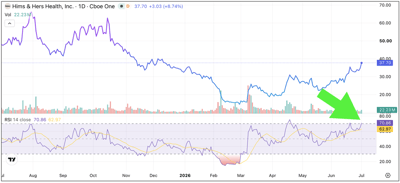
Technical analysis is hardly a perfect science. But the last two times the stock’s RSI breached 70—first in mid-April and then again in mid-June—HIMS pulled back more than 28% and nearly 8%, respectively, before continuing its rally.
Meanwhile, Wall Street remains bearish on the stock after its outperformance this year. Of the 16 analysts currently covering HIMS, only four assign it a Buy rating.
Overall, the stock receives a consensus Hold rating alongside a 12-month price target that implies more than 19% potential downside from current prices.
Concerningly, with a high-volatility beta of 2.35, current short interest in HIMS now stands at more than 32% of the float, or about 65.4 million shares valued at $1.97 billion.
That is the highest the stock has been shorted since March and marks a nearly 5% month-over-month increase.
At the same time, insider activity has seen an uptick in selling this year. In Q1 2026, $3.46 million worth of HIMS shares were sold with no buys. In Q2, that figure rose to $4.86 million sold against $1.17 million bought.
This email communication is a sponsored message from Chaikin Analytics, a third-party advertiser of DividendStocks.com and MarketBeat.
This ad is sent on behalf of Chaikin Analytics, 201 King Of Prussia Rd., Suite 650, Radnor, PA 19087. If you would like to optout from receiving offers from Chaikin Analytics please click here.
If you need assistance with your account, please contact our U.S. based support team at [email protected].
If you no longer wish to receive email from DividendStocks.com, you can unsubscribe.
© 2006-2026 MarketBeat Media, LLC. All rights reserved.
345 North Reid Place, Suite 620, Sioux Falls, S.D. 57103-7078. United States of America..