|
Hi
Friend,
I know
you're busy, but this can't wait.
Right now, councils across New Zealand are
quietly working to lock in "Mana Whakahono ā Rohe" (iwi participation
agreements) before Parliament passes the new Resource Management
laws.
The
Government’s proposed replacement legislation would prevent councils
from entering into new agreements — but, as currently drafted,
agreements signed before the new laws take effect will be
embedded.
Of
course our focus is the election – but we need your support to force
National to correct the wording of the proposed law before it is too
late.
What are Mana Whakahono ā Rohe (iwi participation
agreements)?
Mana Whakahono ā Rohe (MWRs) are statutory agreements
under the Resource Management Act 1991 (RMA) that record ways in which
mana whenua may participate in resource management and council
decision-making on planning and resource consents.
Under the current law, iwi authorities representing local
tangata whenua can "invite" a council to enter into a MWR
participation agreement.
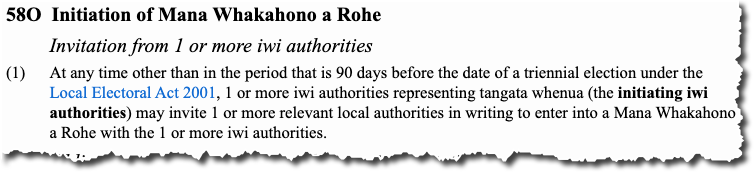
But the "invite" wording is
highly misleading.
The councils don't have a choice but to agree to one once
an iwi 'invites’ them to!
The above section goes on to explain the process the
council must follow in order to achieve an agreement. And there's even
a default timeframe:

So what do Mana Whakahono ā Rohe agreements
contain?
The
agreements set out how different iwi groups must be embedded within
the council's planning and consenting processes. Often the minute
detail is left for later, with the agreements setting out legally
binding principles.
For
example, the first three (legally enforceable) "Principles" to "guide
the relationship" (i.e. shared resource management decision making)
contained in the proposed Canterbury agreement are:
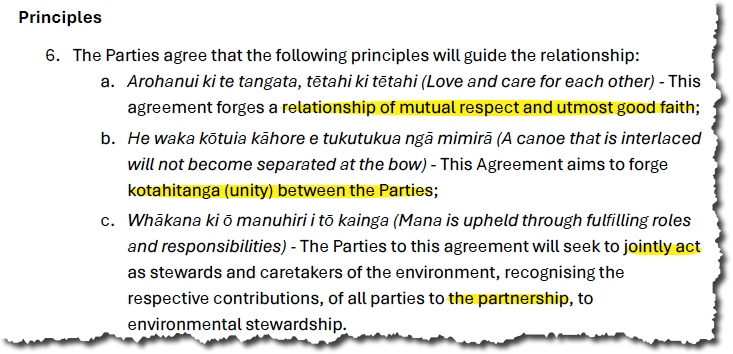
"Unity" is the operative word here.
Unity means 50/50 'partnership' or 'joint’
decision-making for things like water regulation, spatial plans, and
consenting.
Don't
believe me? Well, you soon will...
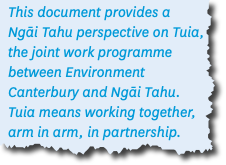
Ngāi Tahu has previously described the identical "Tuia" provisions
which the Council is adopting as a legally binding MWR as "meaning
working together arm in
arm".
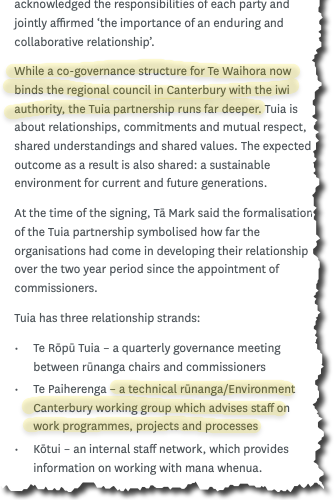
This is an
official Council/Ngāi Tahu briefing (uncovered by the Taxpayers'
Union):
It
states:
Can Mana Whakahono ā Rohe (iwi participation
agreements) be terminated?
Unlike previous local government co-governance agreements
iwi relationship agreements, Mana Whakahono ā Rohe can only be
terminated by mutual agreement!
That means
they bind future councillors/elected officials.
Why is this issue suddenly important?
The
reason for the sudden rush is that iwi groups and councils can see the
window is about to close and that replacement laws for the RMA are set
to grandfather these agreements - even on new/amalgamated
councils.
But
despite the significance, ratepayers are not even being consulted on
these agreements.
In
Northland, the local councillors are even being barred by officials
from seeing the draft agreement being negotiated with local iwi (yes,
seriously - Heather du Plessis-Allan interviewed one of the
councillors on her show last night).
Why is this a taxpayer issue?
Friend,
here at the Taxpayers' Union, we will not abandon our championing of
democratic
accountability.
We believe
resource management (i.e. who can build what and where) should be in
the hands of democratically
elected councils.
The
practical effect of these MWR agreements is to shift responsibility
out of councils and give unelected groups effective rights of 'veto'
on planning and consenting.
As
I told Kerre Woodham this morning on Newstalk ZB – we are aware of
examples of iwi groups abusing their RMA powers and demanding money in
order for "cultural issues" to go away.
The rest of
the world has a word for that... and it
is something I'm asking for your support to put an end
to.
Where is the National Party on this matter?
Friend, if
there was one thing the National Party was clear on before the last
election around co-governance, it was Three Waters and local
government.
But, since
coming to power, the National Party has been pathetic.
Sure, they
repealed Labour's "Three Waters", but National's
Local Government Minister Simon Watts allowed councils to adopt the
identical 'co-governance' model under his "Local Water Done Well"
policy.
Simon
Watts's excuse is that he did his job because he repealed Labour's
requirement forcing councils to implement co-governance of
water... Wellington, Waikato (and other regions) have just gone ahead
anyway.
The short
point is that even though ACT and New Zealand First have come out
against co-governance of planning, Simon Watts and the National Party
have put their fingers in their ears and refuse to tackle the
problem.
On
water services, Simon Watts and the National Party failed to protect
local democracy and democratic accountability, despite promising to do
so prior to the last election.
The
question now is whether Simon Watts and the National Party will
protect local democracy, and democratic accountability, for resource
management.
We
can't let them fail again. That's why I'm asking for your support for
this campaign to force the issue.
To date,
only the Taxpayers' Union, and our friends at Federated Farmers, have
been willing to call out what the National Party is set to cement in
place.
No one
wants to publicly put their head above the parapet for fear of being
labelled racist (or worse).
To shine the light on the
issue, we need to mount a grassroots ratepayer campaign to force the
National Party to see sense and change its proposed RMA replacement to
abolish, not embed, these undemocratic Mana Whakahono ā Rohe
agreements.
Can
we count on your support, Friend?
Let me be
clear: councils should work constructively with iwi, just as they
should with farmers, businesses, community organisations and everyone
else affected by their decisions.
But if we
are to be a prosperous nation, decisions about property rights,
planning rules and resource consents must remain with people who the
public can vote in – and vote out.
Time is running out
The
Government has committed to passing the RMA replacement bills before
the election.
That means we have just a few weeks to force National to change the
draft laws currently before Parliament.
These are
serious constitutional and financial questions. They should not be
settled through agreements rushed onto council agendas at the eleventh
hour.
All
donations will be used to demand that the Government:
-
Stop
councils signing new Mana Whakahono ā Rohe agreements while the RMA
replacement legislation is before Parliament;
-
Amend
the RMA replacement bills so agreements rushed through during this
transition do not automatically carry over; and
-
Guarantee
that decisions affecting property rights and resource consents remain
subject to democratic
accountability.
National Party Ministers will only act if they feel
enough public pressure
Once these
agreements are signed and carried into the new system, undoing them
will be far harder.
That
is why I’m asking you to chip in today.
Your
donation will help us alert ratepayers, scrutinise agreements being
proposed around the country, commission legal and policy work, and run
an advertising campaign demanding that the Government close this
loophole.
Please make
a confidential donation today and help us send ministers a message
they cannot ignore: no rushed agreements, no backroom deals, and no
weakening of democratic accountability.
>>
Make a confidential donation via our secure website
<<
Thank you
for standing with us,
 |

Jordan
Williams
Executive Director
New Zealand Taxpayers’ Union
|
PS.
Environment Canterbury plans to consider final ratification on 22
July. Other agreements are being initiated around the country. We need
to move quickly. Please
chip in today so we can launch the campaign and demand that the
Government close the loophole before more agreements are locked
in.
|
